
Inquiry Basket
 Loading ......
Rotavirus is an important pathogen causing diarrhea in humans, mammals, and birds, first discovered by Australian scholar Bishop and colleagues in 1973. The virus particles are spherical in shape, with a diameter of 60-80nm, without an envelope, and have a double layered capsid. The shell particles of the underwear shell are arranged radially along the edge of the virus body, resembling spokes of a wheel, hence it is named "rotavirus". Based on the immunogenicity of the viral structural protein VP6, rotavirus is divided into seven groups A to G. Among them, Group A rotavirus is the most common pathogen causing severe diarrhea in infants and young children worldwide, and is also one of the main causes of infant mortality; Group B rotavirus causes diarrhea in adults with a low mortality rate.
The virus particle is spherical, with a diameter of 60~80nm, no envelope, double-layer capsid, and icosahedral symmetry. The shell particles of the inner capsid are arranged radially along the edge of the virus body, like wheel spokes. Rotavirus has two forms: double-shell particles and single-shell particles.
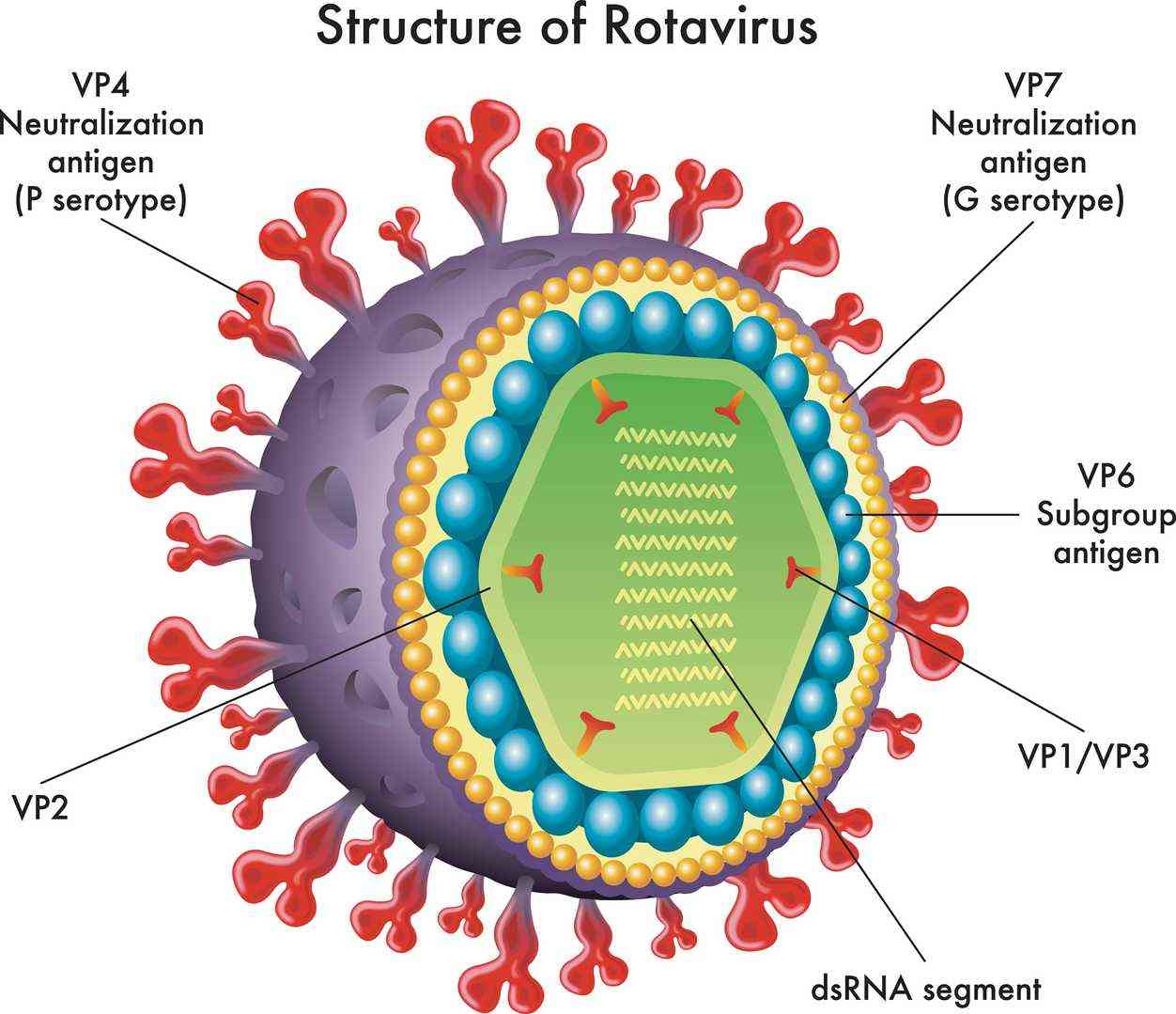 Figure 1. Structure of Rotavirus.
Rotavirus infection is a rotavirus infection. Rotavirus infection can be treated by general treatment, drug treatment, etc.
1. General treatment
Rotavirus infection has high infectivity. This disease can be transmitted through contact between people, and it can also be transmitted by air and droplets. In addition, it can also be transmitted through indirect contact with contaminated objects. In order to prevent the disease from getting worse, it is necessary to pay attention to personal hygiene before and after meals.
2. Drug treatment
After being infected with this disease, you will have symptoms of digestive system, you will have diarrhea, you can take a piece of ephedrine capsule and mineral green pill according to doctor's prescription to treat the disease, which can have the effect of stopping diarrhea. If you always have diarrhea, you may lose a lot of water and electrolytes in your body, resulting in dehydration, you can use oral rehydration salt, sodium chloride injection, glucose injection under the guidance of the doctor.
The virus RNA in the sample was extracted, and was stained with silver nitrate after 10% discontinuous polyacrylamide gel electrophoresis (PAGE). According to the electrophoresis map of 11 segments of dsRNA, the virus infection could be judged, but it was inconsistent with the serotype. In addition, nucleic acid hybridization or RT-PCR techniques can also be used for detection and typing identification.

Real time PCR is a highly sensitive and specific method for detecting the genetic material of rotavirus. It is particularly useful for confirming the presence of viruses in clinical samples. However, it does not provide information about immune reactions, making it a supplementary tool for ELISA kits.

Morphological examination is the most accurate, reliable, and rapid method for detecting rotavirus infection. Collect patient water samples and observe virus particles under electron microscopy by negative staining with tungsten phosphate, or use immunoelectron microscopy to examine virus antibody complexes.
Rotavirus can infect intestinal epithelial cells and lead to cell vacuolization, apoptosis, and shedding, thus causing damage to the function of intestinal mucosal barrier. This kind of injury is characterized by villous atrophy, damage to microvilli structure and changes in the function of tight junction, which in turn affect the intestinal absorption and barrier function.
Rotavirus infection can induce the activation of host immune system, release various inflammatory mediators (such as IL-6, IL-8, TNF - α, etc.), and aggravate the damage of intestine. The inflammatory factors not only damage the function of intestinal barrier, but also may cause more extensive tissue injury.
ELISA is widely used for clinical diagnosis and research of rotavirus antigens. In clinical settings, ELISA kits are used to quickly identify rotavirus infection in patients with symptoms of gastroenteritis. These kits are designed to be user-friendly, portable, and reliable, making them suitable for environments with limited resources. In the study, ELISA was used to investigate the epidemiology of rotavirus, monitor vaccine efficacy, and investigate immune responses to infection. For example, the study used ELISA to detect rotavirus antigen in newborn fecal samples and evaluate the immune response of vaccinated individuals. The development of high-sensitivity ELISA kits also enables researchers to detect low levels of rotavirus antigen, which is particularly useful in early infections or asymptomatic carriers.
Rotavirus is the main cause of gastroenteritis in infants and young children worldwide. Diagnosing rotavirus through rapid ELISA is simple and easy. This may greatly reduce unnecessary use of antibiotics, making it difficult to control infections caused by rotavirus. ELISA is the best method for laboratory diagnosis of rotavirus. If RT-PCR is used, it is recommended to use a real-time platform and a viral load cut-off value equivalent to the ELISA detection limit.
| Cat. No. | Product Name | Size | Species Reactivity | Application | Detection Method | |
| DEIA2435 | Adenovirus (Fecal) ELISA Kit | 96T | N/A | Qualitative | ELISA | Inquiry |
| DEIA2435 | Adenovirus (Fecal) ELISA Kit | 96T | N/A | Qualitative | ELISA | Inquiry |
| DEIAFY102 | Rotavirus Antigen ELISA Kit | 96T | Human | Qualitative | sELISA | Inquiry |
| Cat. No. | Product Name | Host | Isotype | Application | |
| DMAB-CBXY25151 | Human Anti-Rotavirus VP4 Monoclonal antibody, clone 564G | Human | IgG | Control, ELISA | Inquiry |
| DMAB-CBXY25152 | Human Anti-Rotavirus VP4 Monoclonal antibody, clone 564M | Human | IgM | Control, ELISA | Inquiry |
| DMAB-CBXY25153 | Human Anti-Rotavirus VP6 Monoclonal antibody, clone 566G | Human | IgG | Control, ELISA | Inquiry |
| DMAB-CBXY25154 | Human Anti-Rotavirus VP6 Monoclonal antibody, clone 566M | Human | IgM | Control, ELISA | Inquiry |
| DMAB-CBXY25155 | Human Anti-Rotavirus VP7 Monoclonal antibody, clone 567G | Human | IgG | Control, ELISA | Inquiry |
| DMAB-CBXY25156 | Human Anti-Rotavirus VP7 Monoclonal antibody, clone 567M | Human | IgM | Control, ELISA | Inquiry |
Loading ......
