
Inquiry Basket
 Loading ......
Micro-albumin, also known as urinary albumin or microalbuminuria, is a crucial biomarker used in the evaluation and diagnosis of various kidney disorders. This microscopic protein plays a significant role in assessing the health of the renal system, specifically the glomerular filtration rate (GFR).
Microalbuminuria is a medical term used to describe the presence of a specific range of abnormal albumin levels in the urine. It is characterized by a slight increase in the excretion of albumin, a protein, in the urine. The term "microalbuminuria" was coined to highlight the detection of small yet abnormal amounts of albumin in the urine, which can be indicative of underlying health issues.
Microalbuminuria is defined as the excretion of 30-300 mg of albumin per 24 hours, or 20-200 mcg/min, or 30-300 mcg/mg creatinine, based on 2 out of 3 urine collections. Detecting microalbuminuria is crucial as it can indicate the early stages of diabetic kidney disease.
| Spot Collection | Timed Collection | 24 hour Collection | Category |
| Less than 30 mcg/mg creatinine | Less than 20 mcg/min | Less than 30 mg | Normal |
| 30-300 mcg/mg creatinine | 20-200 mcg/min | 30-300 mg | Microalbuminuria |
| More than 300 mcg/mg creatinine | More than 200 mcg/min | More than 300 mg | Clinical albuminuria |
Under normal circumstances, the kidneys filter waste products from the blood, including albumin, and prevent their excretion in the urine. However, when there is damage or dysfunction in the kidneys or the renal system, small amounts of albumin may leak into the urine.
Proteinuria can occur due to three primary mechanisms. The first mechanism involves glomerular injury, which leads to increased filtration of proteins. The second mechanism is tubular injury, causing excessive production and excretion of tubular proteins, such as Tamm-Horsfall protein. The third mechanism involves the overfiltration of plasma proteins due to high plasma concentrations, as seen in multiple myeloma. Various diseases, including glomerular and tubular diseases, can contribute to the excessive excretion of proteins in the urine.
Microalbuminuria serves as a vital clinical marker with significant implications for various medical conditions, particularly those affecting the kidneys and cardiovascular system. It plays a crucial role in the early detection, diagnosis, and monitoring of kidney diseases and cardiovascular complications. Some key points regarding the clinical significance of microalbuminuria include:
To detect and quantify albuminuria, there are two main methods available:
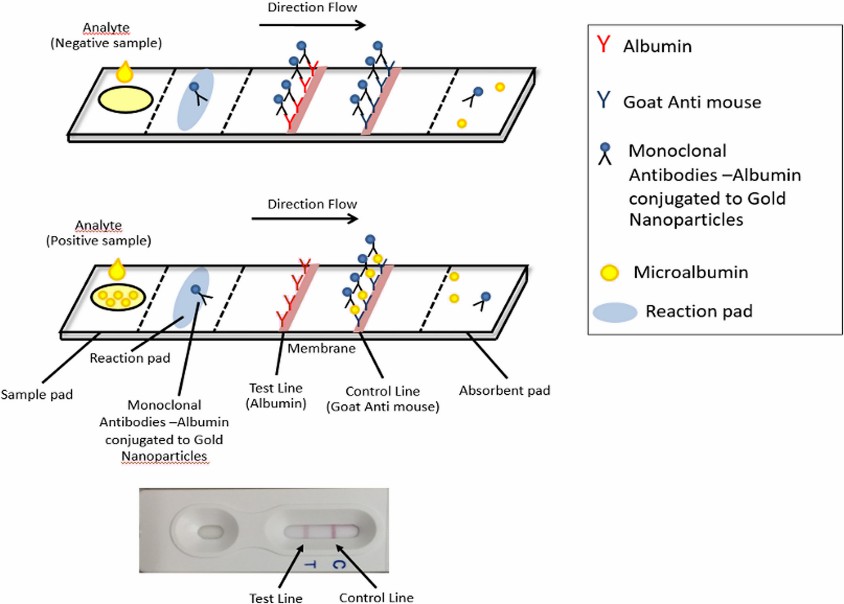 Figure 1. Diagram of a test strip showing a top-view of its components and principle of a competitive strip test assay with microalbuminuria.
(Source: Vutthikraivit, N. et al., 2021)
Laboratory methods for albumin detection in urine include immunoturbidimetric, radioimmunoassay, and high-performance liquid chromatography. These methods can accurately measure albumin levels in urine, with high-performance liquid chromatography being particularly effective for detecting low levels of intact albumin molecules. It's worth noting that these methods may also detect albumin fragments, but the significance of detecting these fragments is not yet fully understood.
References
| Target | Cat. No. | Product Name | Host | Isotype | Application | |
| Creatinine | DPAB-DC4134 | Anti-Creatinine polyclonal antibody | Sheep | EIA | Inquiry | |
| DMAB27374 | Anti-Creatinine Monoclonal antibody, clone NBC20353 | Sheep | ELISA, WB, Dot, IHC, IA | Inquiry | ||
| Creatinine N | DPABY-827 | Anti-Creatinine N polyclonal antibody | Sheep | ELISA, Pr* | Inquiry |
| Target | Cat. No. | Product Name | Expression System | Tag/Conjugate | Application | |
| Creatinine | DAG-WT125 | Recombinant Creatinase | E. coli | His | Immunoassay | Inquiry |
| DAG-WT124 | Recombinant Creatinine Amidohydrolase | E. coli | His | Immunoassay | Inquiry | |
| DAGA-369 | Creatinine Standard (98%) | N/A | N/A | ELISA | Inquiry | |
| DAG-CL005 | Creatinine-HRP | HRP | ELISA, Immunoassays | Inquiry | ||
| DAGA-186G | Creatinine [BTG] | Synthetic | BTG | LFIA | Inquiry | |
| DAGA-186B | Creatinine Acid [BSA] | N/A | BSA | LFIA | Inquiry | |
| DAGA-186H | Creatinine Acid [HRP] | N/A | HRP | ELISA | Inquiry | |
| DAGA-186K | Creatinine Acid [KLH] | N/A | KLH | Immunogen | Inquiry | |
| DAG608S | Creatinine [BSA] | N/A | BSA | ELISA, LFIA | Inquiry | |
| DAG1075 | Creatinine(N) [HRP] | N/A | HRP | N/A | Inquiry |
| Target | Cat. No. | Product Name | Size | Species Reactivity | Application | Detection Sample | |
| Microalbumin | DEIA2299 | Human Micro-Albumin ELISA Kit | 96T | Human | Quantitative | Urine | Inquiry |
| DEIA2299R | Human Micro-Albumin ELISA Kit | 96T | Human | Quantitative | Urine | Inquiry | |
| Creatinine | DEIABL-M4 | Cr(Creatinine) Assay Kit(Colorimetric) | 96T | Universal | Quantitative | serum, plasma, tissue homogenates and other biological fluids. | Inquiry |
| DEIA-ZH073 | Cr (Creatinine) Assay Kit (Colorimetric) | 96T | Universal | Quantitative | Serum, Plasma and Urine | Inquiry | |
| DEIA-XYL4 | Creatinine ELISA Kit | 96T | Human, Research Animal | Quantitative | Urine, Forensic Matrices | Inquiry |
Loading ......
