
Inquiry Basket
 Loading ......
Melatonin is an amphiphilic tryptophan-derived indoleamine that scavenges free radicals and has remarkable antioxidant properties, stimulating antioxidant enzymes in different tissues. Some tissues and organs (e.g., retina, gastrointestinal tract, bone marrow, lymphocytes, and skin) produce localized melatonin with specific endocrine, autocrine, and paracrine effects, in addition to the presence of a specific gland, the pineal gland, in vertebrates, which synthesizes melatonin with an endocrine effect. Mammalian pineal melatonin synthesis is controlled by a master clock in the hypothalamus suprachiasmatic nucleus (SCN) and is synchronized with the light/dark cycle via retinal intrinsic photosensitive ganglion cells. Because retinal intrinsic photosensitive ganglion cells transmit ambient photoperiodic information to the SCN, melatonin secretion is restricted to the dark phase of the night. Melatonin synthesis is blocked by nocturnal light, an effect mediated by the retinal melanopsinergic system and a complex neural system that ultimately inhibits sympathetic projections to the pineal gland. In humans, this photoinhibition phenomenon is determined by light, especially blue light. Based on light/dark cycle synchronization and nocturnal photoinhibition, melatonin can function as a time-domain molecule to synchronize an organism's internal time sequence with the external daily and seasonal light/dark environment. Melatonin plays a role in promoting a sleep state, so a decrease in its expression level would keep a person awake, especially since exposure to high wavelength light suppresses melatonin circulating in the blood.
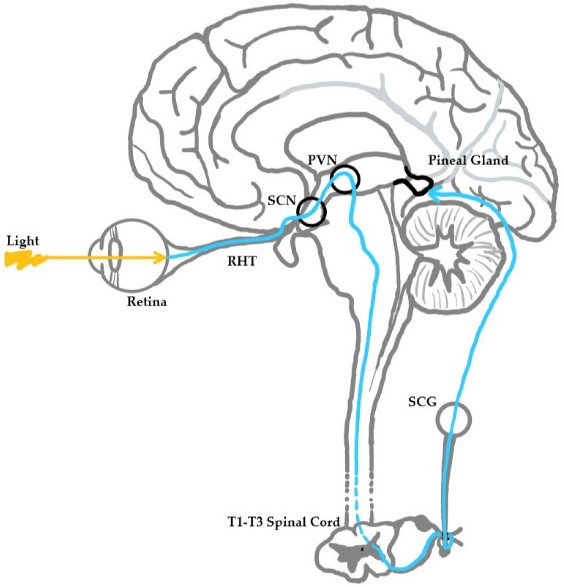 Figure 1. Neuroanatomical pathway of light stimulus to the pineal gland
(Source: Vasey C, et al. 2021)
The pineal gland of newborn mammals does not produce melatonin until after birth, so maternal melatonin is the only source of obtaining this hormone (in the fetal period through the placental circulation and in the newborn period through breastfeeding). In humans, pineal melatonin appears in full-term infants between 3 and 4 months of age, peaks in prepubertal children, decreases after puberty, and reaches young adult levels. In adults, however, pineal melatonin production continues to decline with age, with people over the age of 90 producing only 20% of their young adult levels.
Endogenous melatonin is synthesized in pineal cells and other tissues and is the end-product of the tryptophan and serotonin biosynthetic pathways. First tryptophan is transported into the cell to form serotonin in the presence of tryptophan-5-hydroxylase and 5-hydroxytryptophan decarboxylase. Serotonin is then acetylated by arylalkylamine-N-acetyltransferase (AA-NAT) and then methylated by acetylserotonin-O-methyltransferase (ASMT) to form melatonin. AA-NAT is the rate-limiting enzyme for melatonin synthesis. Therefore, it is likely to be a regulatory site in melatonin synthesis.
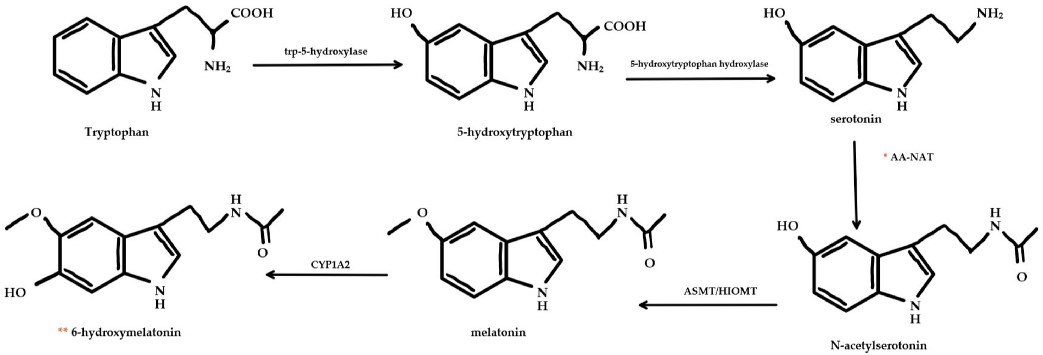 Figure 2. Melatonin metabolic pathway
(Source: Vasey C, et al. 2021)
Signal transduction in the pineal gland begins at the cell membrane. Adrenergic neurons emanating from the superior cervical ganglion release norepinephrine, which acts on β1- and α1-adrenergic receptors. β1-adrenergic receptors stimulated by norepinephrine increase cytoplasmic cAMP by signaling adenylate cyclase, which activates cAMP-dependent protein kinase A (PKA). PKA stimulates AA-NAT production through a signaling cascade. In addition, norepinephrine stimulates α1-adrenergic receptors, leading to an increase in cytoplasmic calcium ions.
Table 1. Factors affecting production of melatonin
| Factor | Effect on Melatonin | Remarks |
| Light | Suppress | A>30 lx light intensity in the wavelength of 460–480 nm has found to be more potent |
| Light | Phase-shift | Light of shorter wavelengths found to be efficacious |
| Timing of sleep | Phase-shift | Secondarily partial light exposure |
| Exercise | Increased phase-shift | Vigorous |
| 5-Hydroxytryptamine | Increases fluvoxamine | Metabolic effect |
| Chlorpromazine | Increases | Metabolic effect |
| Ibuprofen, Aspirin | Decreases | - |
| Alcohol | Decreases | - |
| Smoking | Possibly changes | - |
| Menstrual cycle | Changes are inconsistent | - |
(Source: Ahmad SB, et al. 2023)
Melatonin is found in a variety of foods, and some foods contain not only melatonin but also its precursors. Melatonin is commonly found in plants, which is involved in physiological processes in plants such as reducing oxidative stress, promoting seed growth and germination, and controlling the closure of leaf stomata, and also play an important role in resistance to drought, toxic chemicals, heavy metal stress, and ultraviolet radiation. In addition, melatonin has a variety of properties such as antibacterial, antiviral and antifungal.
Table 2. Amount of melatonin in edible plant and related foods
| Plant/Food | Amount | Part/Organ |
| Tomato | 3-114 ng/g | Fruit |
| Strawberry | 1-11 ng/g | Fruit |
| Rice/Barley | 300-1000 pg/g | Seed |
| Walnuts | 3-4 ng/g | Seed |
| Black pepper | 1093 ng/g | Leaf |
| Curcuma | 120 ng/g | Root |
| White radish | 485 ng/g | Bulb |
| Beer | 52-230 pg/mL | Fruit |
(Source: Ahmad SB, et al. 2023)
Melatonin is amphiphilic and can directly interact with intracellular molecules through cell membrane, cell organ membrane and nuclear membrane. In addition, melatonin also has a receptor-mediated effect, which is the result of interaction with membrane receptors and nuclear receptors.
Melatonin and its metabolites directly scavenge free radicals, and stimulate the transcription and activity of antioxidant enzymes and inhibit the formation of hydroxyl radicals. Melatonin is highly concentrated in mitochondria and protects lipids, proteins and DNA from oxidative damage. The antioxidant properties of melatonin are critical for mitochondrial function. In addition to its protective antioxidant effects, melatonin plays key roles in mitochondrial function, such as regulating the activity of respiratory chain complexes I and IV, and protecting mitochondrial DNA from mutations and deletions. These effects are the result of direct interactions between melatonin and proteins. Melatonin also plays a role in the regulation of the ubiquitin-proteasome system, and has been found to act as an antagonist by inhibiting Ca2+/calmodulin-dependent protein kinase II activity and autophosphorylation through direct interaction with Ca2+-activated calmodulin.
The melatonin receptor (MT) is a high-affinity specific G protein-coupled receptor containing MT1 and MT2. Human MT1, which contains 350 amino acids, and human MT2, which contains 362 amino acids, are found in several regions of the CNS, such as the SCN, thalamus, temporal lobe, hippocampus, retina, cerebellum, and pars tuberalis (PT). MT1 and MT2 are also present in a number of peripheral tissues and organs, including adipose tissue, kidney, pancreatic islets, skin, reproductive tract, immune cells, and cardiovascular system (CVS). Melatonin receptors interact with downstream messengers such as adenylate cyclase, phospholipase A2, and phospholipase C, as well as calcium and potassium channels, and typically reduce cAMP and cGMP production and activate phospholipase C.
MT1 and MT2 usually dimerize to form homodimers or heterodimers, allowing both melatonin binding sites to function with their own selectivity. The MT1 signaling pathway involves activation of potassium channels that inhibit SCN neuronal firing, regulation of protein kinase C (PKC) and phospholipase A2, stimulation of the mitogen-activated protein kinase 1/2-ERK1/2 pathway in non-neuronal cells, and vasoconstriction. The MT2 signaling pathway includes inhibition of cGMP formation in the SCN, stimulation of PKC activity, and regulation of uterine contractility and vasodilation. Some investigators have suggested that MT2 in the SCN may correspond to G protein-coupled inwardly rectifying potassium channels.
Melatonin functions as a circadian rhythm regulator in the human body. It has been used clinically as a chronic biologic agent primarily for the control of clinical conditions involving circadian rhythm disturbances, such as jet lag, delayed sleep phase disorders, and other syndromes involving temporary or permanent circadian rhythm disorders, as well as clinical syndromes resulting in free-running circadian rhythms. Treatment requires a decision on the duration of melatonin administration based on the desired effect, and the duration of treatment based on whether the patient's illness is transient or prolonged.
Early research on melatonin found that low doses of melatonin reduced sleep onset latency and oral temperature, thereby triggering the common polysomnographic pattern of nocturnal sleep structure observed in young adults. The idea that melatonin triggers nocturnal circadian rhythmic sleep was subsequently proposed by researchers who suggested that nocturnal secretion of melatonin switches the organism from a daytime state of activity (energy intake and storage, high cortisol, and positive interactions with the external environment) to a nocturnal state (sleep, hypothermia, and energy depletion), suggesting that melatonin may promote the activity-arousal-rest-sleep circadian rhythm by regulating the sleep. Treatment with melatonin increases the circadian activity ratio (rhythm amplitude), reduces segmentation of the rhythm, and improves rhythm stability. By observing the behavior of patients who had their pineal gland removed, the researchers discovered the importance of physiological levels of pineal melatonin on human sleep. These patients had disrupted 24-hour circadian rhythms, decreased total sleep time, increased nocturnal awakenings, and poor sleep quality, all of which were alleviated with melatonin treatment. In addition to circadian rhythm control, melatonin may also influence the sleep mechanism itself. Experimental findings have shown that MT1 melatonin receptors appear to be associated with the incidence of rapid eye movement sleep episodes, whereas MT2 melatonin receptors are associated with the incidence of non-rapid eye movement episodes. In addition to improving overall sleep quality, melatonin has been shown to shorten sleep latency, increase total sleep time, and reduce nighttime awakenings. Melatonin and analogs appear to be effective in treating primary insomnia in the elderly, sleep disorders associated with neurological and neurodegenerative disorders, hypertensive patients taking beta-blockers, and patients with rapid eye movement sleep behavior disorder.
References
| Target | Cat. No. | Product Name | Size | Species Reactivity | Application | Detection Sample | |
| Melatonin | DEIA-S10024 | Salivary Melatonin ELISA Kit | 96T | Quantitative | Saliva | Inquiry | |
| DEIA-XY58 | Melatonin ELISA kit | 96T | Human | Quantitative | Saliva | Inquiry | |
| DEIABL355 | Melatonin direkt Saliva (Non-Extraction) ELISA Kit | 96T | Quantitative | Saliva | Inquiry | ||
| DEIA2238 | Human Melatonin ELISA Kit | 96T | Human | Quantitative | Serum, plasma | Inquiry | |
| DEIA2239 | Human Melatonin-Sulfate Urine ELISA Kit | 96T | Human | Quantitative | Human Urine | Inquiry | |
| DEIA-NS2307-11 | Human MT(Melatonin) ELISA Kit | 96T | Human | Quantitative | Serum, plasma, cell culture supernatant and other biological samples | Inquiry | |
| DEIA-NS2307-22 | Chicken MT(Melatonin) ELISA Kit | 96T | Chicken | Quantitative | Serum, plasma, tissue homogenates and other biological fluids. | Inquiry | |
| DEIA-NS2307-37 | 6-hydroxymelatonin sulfate ELISA Kit | 96T | Universal | Quantitative | Serum, plasma, cell culture supernatant and other biological samples. | Inquiry |
| Target | Cat. No. | Product Name | Expression System | Tag/Conjugate | Application | |
| Melatonin | DAG3367 | Melatonin [AG-BSA] | N/A | AG-BSA | IHC, ICC | Inquiry |
| DAG2997 | Melatonin [HRP] | N/A | HRP | N/A | Inquiry | |
| DAG3652 | Melatonin [BSA] | N/A | BSA | N/A | Inquiry | |
| DAGA-163K | Melatonin [KLH] | N/A | KLH | Immunogen | Inquiry | |
| DAGS079 | Melatonin standard | N/A | N/A | ELISA | Inquiry |
| Target | Cat. No. | Product Name | Host | Isotype | Application | |
| Melatonin | DPAB-DC4519 | Anti-Melatonin polyclonal antibody | Rabbit | IgG | ELISA | Inquiry |
| CABT-L47M | Mouse Anti-Melatonin Monoclonal Antibody, clone N75 | Mouse | IgG | ELISA | Inquiry |
Loading ......
