HBV and HCV infections continue to be major global health problems, causing over 1 million deaths annually. Because the two hepatotropic viruses share same modes of transmission, coinfection with the two viruses is not uncommon, especially in areas with a high prevalence of HBV infection and among people at high risk for parenteral infection. Patients with dual HBV and HCV infection have more severe liver disease, and are at an increased risk for progression to hepatocellular carcinoma (HCC). Treatment of viral hepatitis due to dual HBV/HCV infection represents a challenge.
HBV Infections
Whether HBV activates innate immunity or suppresses innate antiviral signaling continues to be debated. In 2018, three reports confirmed that HBV replication does not induce innate inflammatory cytokine production. These independent studies showed that HBV did not induce interferon or interferon-stimulated gene (ISG) expression in hepatocytes.
Evidence from mouse models of human hepatocyte and ex vivo gene expression from HBV-infected human livers suggest that HBV interacts with the innate immune system to some degree. Ultimately, this interaction may be subclinical or limited to specific conditions. Other studies will help address these differences, but these three studies further confirm that the hepatitis B virus does not stimulate innate response liver cells in humans. HBV is not recognized by the innate immune system to suppress adaptive immune responses. When immune control of HBV occurs, it usually precedes the onset of hepatitis. People stimulated flares by stopping antiviral to induce immunocontrol therapy, and it was found that forcing an immune response by stopping treatment had the potential to cause loss of hepatitis B surface antigen (HBsAg), which represents a functional cure but can also stimulate severe liver inflammation or a range of milder immune-mediated pathologies.
To understand the mechanism of immune control after stopping treatment, in 2018, Rivino and Rinker analyzed the response of HBV-specific T cells expanded in vitro and performed a comprehensive immunogenetic analysis of peripheral immune response. The results showed that patients without ALT flares had an increased frequency of HBV core and polymerase protein-specific T cells before stopping treatment, and determined the minimum threshold at which the T cell response could be detected.
These studies are an important first step in understanding the immune response to HBV reactivation and suggest that the identification of an immunological biomarker is possible. They are limited by in vitro T cell expansion, which did not correlate with HBsAg loss in the study by Rinker. These studies are an important first step in understanding the immune response to HBV reactivation and show that identification of immune biomarkers is possible. They are limited by in vitro T cell expansion, but are not associated with HBsAg loss.
A few case reports suggest the association between HBV superinfection in HCV infection and severe clinical presentation. In contrast to HBV therapy, HCV treatment has truly been optimized, with direct-acting antiviral agents (DAAs) reliably leading to >95% cure rates in almost all clinical scenarios. However, chronic shortage of organs suitable for transplantation has led to the use of HCV-infected organs transplanted into uninfected recipients. In order to prevent HCV infection caused by transplanted organs, the following measures are taken. The first consideration is to use an organ from a donor that is positive for HCV antibodies but negative for nucleic acid testing (NAT). The risk of HCV transmission was expected to be low in this setting. However, the extreme rarity of late relapse even with immunosuppression has raised questions about its clinical relevance. This study highlights that at least some individuals harbour replication-competent HCV in their livers after viral clearance and transmission occurs more frequently than expected, at least with liver transplantation. Recipients of HCV-antibody-positive and NAT-negative grafts should be tested for HCV RNA early after transplantation to enable prompt treatment.
A more controversial question is transplantation from donors who are viraemic to uninfected recipients. In 2018, two trials evaluated this question in renal transplantation with slightly different approaches. In the EXPANDER trial, 10 patients received the first dose of elbasvir-grazoprevir before transplantation. In both trials all patients cleared the virus, but in the EXPANDER trial only 3 of 10 individuals had documented viraemia, suggesting that preemptive therapy might prevent infection. Pilot studies of lung, heart and liver transplantation have also been reported with generally good results. High cure rates and the potential for expanding donor pools have led some transplant programs to adopt transplantation from HCV-infected donors as the new standard of care. While these preliminary results look promising, the trial does not fully encapsulate the real-world environment. In practice, issues ranging from appropriate consent to scheduling timely treatment must be considered. Episodes and relapses of severe infection (fibrotic cholestatic hepatitis) have been reported, possibly due to delayed initiation of treatment.
Progress in the field of viral hepatitis continues at an alarming rate. Key insights into the determinants of immune control of HBV infection by carefully looking at patients who have stopped long-term antiviral therapy are expected to lead to the discovery of biomarkers and may guide the development of effective immunotherapies to achieve HBV cure. For HCV, it is difficult to improve existing treatments. New advances will be the creative use of these new therapies in selected clinical settings, such as in organ transplant settings, where careful study may also advance our understanding of chronic viral infections.
References
Feld JJ, Gehring AJ. Host-pathogen interactions in chronic HBV infection and transplantation of HCV-positive organs[J]. Nature Reviews Gastroenterology & Hepatology, 2019. Feb.

 Loading ......
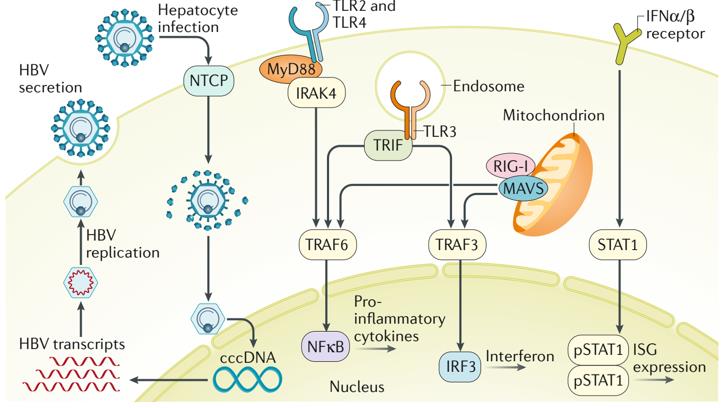 Fig1. HBV and innate immune sensors.