
Inquiry Basket
 Loading ......
It is known to all that drug abuse is one of the most serious public health problems in the world. However, in recent years, more and more prescription drugs, including opioid analgesics, sedatives and hypnotics, have been abused. For example, the European Union survey found that 13.5% and 10.9% of young people, respectively, had used opioids and sedatives and hypnotics non-medically. In addition, the current global drug situation is grim, and countries continue to strengthen anti-drug efforts, so the demand for drug testing will gradually increase.
Psychoactive substance refers to a class of chemical substances that can affect human emotions, behavior, change the state of consciousness, and cause dependence. Drug varieties generally include central analgesics, central stimulants, antipsychotics, antidepressants, antimanics, sedative hypnotics.
Drug abuse monitored by the EU mainly includes cannabis, cocaine and so on. In recent years, the use of drugs in Europe has been undergoing new changes, and some new psychoactive substances (NPS) will be approved for the market. However, with the increase of overdose deaths, the supply of NPS and synthetic opioids have attracted more and more attention. As described in the 2018 European Drugs Report, the emergence of NPS is a considerable public health challenge in Europe. These drugs mainly include a wide range of synthetic substances, including cannabinoids, cathinones, opiates and benzodiazepines. Cannabis remains a common drug in Germany and is one of the drugs being monitored, along with MDMA and cocaine. In Slovenia, the local government has focused on cocaine abuse surveillance.
Globally, the United States ranks first among countries in opioid consumption, and the prescription volume is growing rapidly. In 2016, the use of morphine, codeine, oxycodone, methadone and fentanyl in the United States accounted for 41.9%, 14.2%, 72.9%, 56.0% and 30.1% of the world's total, respectively. Between 1996 and 2011, total opioid use increased by 1,448%, and the number of patients treated for opioid abuse increased by 187%.
In recent years, data from the United States and Australia have found a significant rise in benzodiazepine prescriptions. A British study found that 7.7% of adults admitted to having used benzodiazepines inappropriately1. The Norwegian study found that 70% of 110,000 people aged 70-89 had used benzodiazepines for more than 30 weeks2. Official Canadian data show that benzodiazepine poisoning accounts for 7.7% of all hospital admissions for toxic injuries.
NPS include antiepileptics, antidepressants, and antipsychotics. The rate of gabapentin analogue abuse was much higher in the antidepressant abuse population than in the general population. In antidepressants, high doses of bupropion or Venlafaxine can produce an amphetamine-like high. European data from 2005 to 2016 suggest that improper use of bupropion and Venlafaxine accounted for 10.8% and 8.5% of adverse events, respectively3. For antipsychotics, inappropriate use of quetiapine accounted for about 52% of cases4.
Morphine has a strong narcotic effect on the central nervous system mainly inhibitory effect. Morphine can cause blood pressure drop, can also make cerebral vascular dilation, cranial pressure increase; It can also inhibit the respiratory center, the direct cause of death is respiratory center paralysis.
Cocaine is the main alkaloid contained in coca leaf. The most important role of cocaine is to stimulate the central system. After cocaine poisoning, the first feeling of euphoria will be followed by emotional upset, nausea, vomiting and other symptoms. In severe cases, rapid pulse and breathing can cause hypertension and its complications, leading to ventricular fibrillation, respiratory and circulatory system failure and even death.
 Fig. 1 Effects abusing cocaine on the human body (Roushani, M.; et al. 2016)
About 20 kinds of benzodiazepine compounds, including alprazolam, midapulam, clonazepam, diazepam, etc., are widely used in clinic. They have anti-anxiety, anti-convulsive, sedative and analgesic effects. Long-term use of benzodiazepines can affect cognition, increase the risk of dementia, and produce strong withdrawal effects. At high doses, it can cause severe memory loss and even death5.
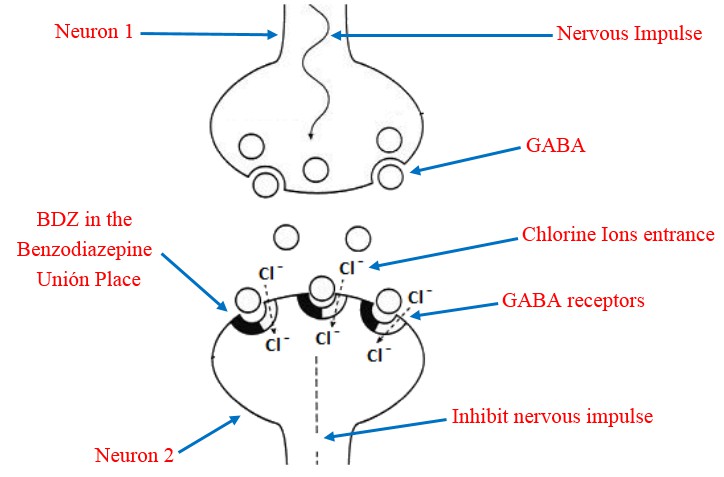 Fig. 2 Representation of the benzodiazepines (BDZ) action mechanism and their role in the nervous impulse inhibition (Sanabria, E., et al. 2021)
Ketamine has central excitation, central inhibition, analgesia, antianxiety, anesthesia, hallucinogenic effects, and its hallucinogenic effects lead to the abuse of ketamine. Long-term use of ketamine can cause damage to the nervous system, urinary system, digestive system, cardiovascular system, affecting important organs of the whole body.
Amphetamines are a group of central nervous system stimulants with similar chemical structures, including amphetamine, methamphetamine (MA), methylene dioxymethamphetamine (MDMA), and other psychostimulants. Amphetamine can make people mentally excited and physically active. Amphetamine can cause chronic intoxication resulting in drug dependence and addiction through abuse or medical overdose. Long-term abuse of amphetamines can cause significant weight loss, physical decline, high blood pressure and lead to cerebrovascular accidents. In addition, amphetamine can also cause mental disorders, causing mental illness.
Drug of Abuse Products
Drugs of Abuse Antibodies
Drugs of Abuse Antigens
Drugs of Abuse ELISA Kits
Small Molecule Drugs Monitoring
Highly Sensitive Antibodies and Conjugates for Drugs of Abuse Detection
At a time when the number of deaths caused by drug abuse is on the rise globally, drug use monitoring is increasingly important. The application of various drug detection techniques can provide important data support for drug treatment and monitoring. Immunological detection methods are widely used because of their low price and rapid detection of drugs.
RIA uses radioactive isotopes to test the saliva and blood of abusers. Its commercial kit has a detection limit of 0.3 ng/mL of morphine in blood. RIA has the advantages of strong specificity, high sensitivity, simple equipment, cheap reagent and short detection time. Results are usually obtained within 2 hours after receiving the urine sample, which can be tested in general laboratories. The standard curve of unlabeled antigen with concentration gradient and corresponding radioactivity is established to realize quantitative and qualitative analysis of unknown antigen6.
Enzyme-linked immunoassay is one of the most popular immunoassay techniques using enzyme-labeled antibody reagents. In the early stage, this technique followed the principle of limited labeled antigen or haptens and sample analytes competitively binding specific antibodies in the radioimmunoassay, and now it has been developed into a variety of sandwich methods. This method can quickly and qualitatively detect drugs in serum or urine, and has the advantage of being clearly readable. ELISA has also been reported for marijuana and cocaine, but this method is relatively less sensitive.
FPIA is an analytical method that uses fluorescent groups instead of radioisotopes as markers. Kraemer et al. determined the content of amphetamine and its metabolites in urine, the detection limit was 50 μg/L, and the results were basically consistent with the GC-MS method. FPIA has good repeatability, and its sensitivity and specificity are close to that of chromatographic analysis.
LFIA is a solid phase immunochromatography technique that combines the principle of chromatographic analysis and immune response, and can be used for qualitative analysis of target compounds. The technology is widely used in the detection of ketamine, amphetamine, benzodiazepines, cocaine and other drugs. LFIA has the advantages of being fast, portable and cheap, but it cannot be used for quantitative analysis.
References
Loading ......
