
Inquiry Basket
 Loading ......
At each developmental stage, children have significant specific characteristics in physiology, pathology, immunity and other aspects. Therefore, some specific diseases will seriously endanger children's health. Common childhood infectious diseases include diphtheria, pertussis, tetanus, hepatitis B, polio, chickenpox, leprosy and so on. Children infected with these pathogens will affect their own growth and development and even threaten their lives, or leave sequelae, bring misfortune to individuals and families, and create a burden on society. Historical experience has shown that immunization is an effective means of controlling, preventing and ultimately eliminating pathogens. As a result, many countries have immunization programs for children. Vaccination can improve children's immunity and build a strong immune barrier against infectious diseases.
Infectious diseases in children mainly harm the respiratory system, digestive system and nervous system, leading to pneumonia, gastroenteritis, movement disorders and so on. In addition, there are many serious rare diseases that start in childhood and continue into adulthood, involving immune, blood, cardiovascular, growth disorders, respiratory systems and more.
The most dangerous age for child death is within 28 days of birth, followed by within 5 years of age. Newborns are vulnerable to infectious diseases due to their low immunity. Although breast milk contains immune substances, it is not nearly enough to protect newborns from diseases. In 2015, an estimated 5.9 million children under the age of five died globally. Pneumonia, other acute respiratory infections and childhood diarrhoea are the leading causes of death in children under five years of age.
Diphtheria has caused great harm to human health, especially to children, often with respiratory obstructive pseudomembrane or myocardial injury, with a fatality rate of up to 10%. Tetanus is an infectious bacterial disease that causes muscle stiffness and spasm. It has a high mortality rate and mainly occurs in newborns and pregnant women with unclean delivery and poor postpartum hygiene conditions. Pertussis is a highly infectious respiratory disease, the main pathogen is Bordetella pertussis. Pertussis, which is transmitted through direct person-to-person contact, was the most deadly infectious disease in infants before vaccines were invented.
Diphtheria, Tetanus and Pertussis Combined Vaccine (DTP) is the most economical and effective public health intervention for the prevention and control of pertussis, diphtheria and tetanus. However, Vaccination does not provide lifelong immunity against pertussis, and vaccine protection diminishes after 4 to 12 years. In recent years, the United States, the United Kingdom, Australia and other countries have experienced frequent outbreaks of whooping cough, with a high number of cases in older children, adolescents and adults. After 5 doses of DTaP, the protective antibody weakened or disappeared within 5 years, and the United States recommends that children aged 11 to 12 receive one more dose of Tdap.
Chickenpox is an acute respiratory infectious disease caused by varicella zoster virus, which is highly contagious. The clinical manifestations of chickenpox are papules and herpes. Severe chickenpox can cause complications such as pneumonia, encephalitis and hepatitis, which seriously threaten the physical and mental health of children. Currently, the most cost-effective way to prevent chickenpox is vaccination.
The chickenpox vaccine is highly immunogenic and stimulates an immune response similar in nature to the wild-type strain but slightly smaller in scope. The vaccine induces specific antibodies and T-cell-mediated cellular immunity. Serum antibody conversion rate and antibody titer are often used to evaluate the titer of chickenpox vaccine. Specific IgG antibodies can be detected in children after 1 month of vaccination. The specific antibody production rates of single dose and two doses of monovalent chickenpox vaccine are 85-89% and 99%, respectively.
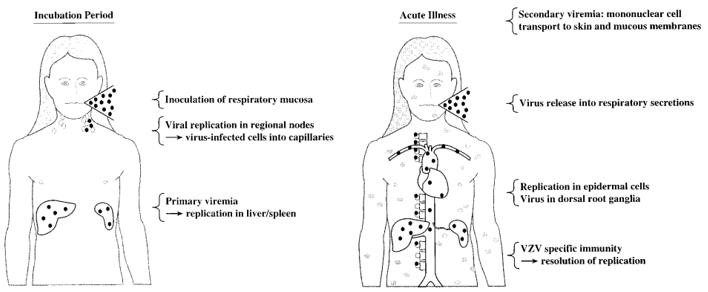 Fig.1 Pathogenesis of primary infection with VZV. (Arvin, AM, 1996)
Measles, rubella and mumps are common infectious diseases in children and are spread by airborne droplets. Children have no natural immunity to measles, rubella and mumps and are easily infected. Crowded conditions and close contact between children can increase the chances of infection.
Combined live attenuated MMR vaccine was introduced in the USA in the 1970s. In total, the MMR vaccine is used in more than 90 countries around the world. The accepted recommendation is that the first dose of MMR should be given on or after the first birthday and the second dose should be given at least 28 days later. The incidence of MMR worldwide has been significantly reduced by MMR vaccination.
Hepatitis B is an infectious disease mainly caused by hepatitis B virus. Children belong to the high-risk group of hepatitis B virus infection. Places such as kindergartens and primary schools are densely populated areas, which can easily lead to the spread of the virus and lead to a large area of infection. Therefore, it is necessary to immunize children against hepatitis B vaccine.
Infants should get their first dose of hepatitis B vaccine at birth and will usually complete the series at 6-18 months of age. Children and adolescents younger than 19 years of age who have not yet gotten the vaccine should also be vaccinated. The immune effect of the vaccine can be evaluated by detecting HBsAb. Studies have shown that the protective effect of hepatitis B vaccine decreases with the increase of age. Therefore, on the basis of routine vaccination, immunization enhancement can be implemented for children with reference to their own serum HBsAb level, so as to achieve the best preventive effect.
Group A rotaviruses (RV) are the major cause of severe gastroenteritis and death in children younger than 5 years of age worldwide, and nearly every child has been infected with RV at least once before age 5. The level of RV-specific IgG in serum increased after viral infection, which can neutralize the virus. In addition, the RV-specific IgA in serum also has neutralizing activity, which plays a crucial role in the timely clearance of the virus after infection and the prevention of reinfection.
Currently, six RV vaccines marketed worldwide are live attenuated oral vaccines, four of which are pre-certified by WHO, including RotaTeq(Merck, USA), Rotarix(GSK, Belgium), Rotavac (Bharat Biotech, India) and Rotasiil (Serum Institute of India, India). In clinical trials, RV-specific IgA titers were used as an indicator of the immunogenicity of RV vaccines. In addition, antibodies on the intestinal mucosa may also affect the effectiveness of RV vaccine.
 Fig.2 Complications of poliomyelitis
(Kidd, D.; et al. 1996)
Poliomyelitis is an acute infectious disease caused by three types of poliovirus serotypes (type I, type II, type III). Before the introduction of the polio vaccine, almost all children were infected with the polio virus, with an average of 1 polio case in every 200 infected people, and 5-10% of the cases of paralysis caused by respiratory paralysis and death, which seriously endangers children's health (WHO).
Inactivated poliomyelitis vaccine (IPV) and live attenuated oral poliomyelitis vaccine (OPV) are the main vaccines used in global immunization. OPV can replicate in the intestinal tract and induce mucosal immunity, which not only limits poliovirus infection but also blocks the transmission of the virus. IPV has good safety, but it is not as effective as OPV in inducing intestinal mucosal immunity. One study showed that no intestinal neutralizing antibodies or IgA were detected after four doses of IPV.
At present, children around the world are still at risk of contracting many infectious diseases, and vaccines are an important tool for disease prevention. With the continuous development of scientific research, a variety of new vaccines emerge endlessly. Generally, the immunization effect of vaccines can be evaluated by measuring the positive rate of antibodies, the average titer of antibodies and the duration of antibodies after vaccination, which is of great significance for the development of vaccines and adjustment of immunization strategies.
Loading ......
