Medica 2026
Nov 16-19, 2026 - Düsseldorf, Germany

Inactivated Bacterial Antigens for Vaccine Research and Development

Diphtheria, tetanus, pertussis and haemophilus influenzae type b are four infectious diseases that are particularly dangerous to babies. Vaccines are the best way to protect against these infectious diseases. There are several different types of vaccines that can safety prevent diphtheria, tetanus, pertussis and haemophilus influenzae type b: DTaP (diphtheria, tetanus, and acellular pertussis) vaccine, DT (diphtheria and tetanus) vaccine, Tdap (combined tetanus, diphtheria and acellular pertussis) vaccine, Td (tetanus and diphtheria) vaccine, DTaP-IPV-Hib (combined diphtheria, tetanus, acellular pertussis, polio and haemophilus influenzae type b) vaccine. Inactivated toxins such as tetanus toxoid, diphtheria toxoid and diphtheria CRM197 are also widely used as protein carriers in licensed vaccines to develop strong immune responses. Conjugate vaccines rely on these immunogenic molecules to stimulate long-lasting immunity to attached polysaccharides or peptides.
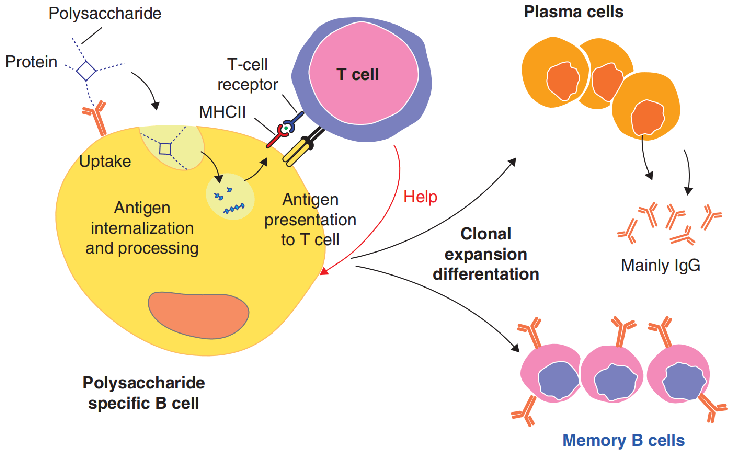
Schematic diagram of mechanism of action for conjugate vaccines Fig. 1 Schematic diagram of mechanism of action for conjugate vaccines (Costantino P, et al. 2011)

Creative Diagnostics has developed a series of inactivated bacterial antigens to support your vaccine research and development. These antigens are well-validated in comprehensive applications.

Performance

  • Purified by proprietary chromatographic techniques (Purity: >95%)
  • The inactivation effect was verified under the original culture condition
  • Large lot sizes are available with very competitive pricing

Introduction

  • Diphtheria causes a thick membrane-like covering in the back of the throat. It can lead to breathing problems, paralysis, heart failure, and even death. The first vaccine against diphtheria was developed in the early 1800s and was widely used in the United States as early as 1914. In the 1920s, the toxin was treated with formalin to produce toxoid, the toxicity of the preparation could be reduced while maintaining the immunogenic properties. The mid-1940s diphtheria toxoid was being combined with tetanus toxoid and whole-cell pertussis vaccine to create the diphtheria-tetanus-pertussis (DTP) vaccine.
  • CRM197, a non-toxic mutant of diphtheria toxin which instead does not need chemical detoxification, has been extensively used as carrier for licensed Hib, pneumococcal, meningococcal conjugate vaccines and for other vaccines being developed.
  • Tetanus is a serious disease that causes painful tightening of the muscles, usually all over the body. It can lead to “locking” of the jaw so the person cannot open their mouth or swallow. Currently, commercial tetanus toxoid is produced by culturing C. tetani in liquid medium and transforming the purified toxin with 40 percent formaldehyde at 37°C. Tetanus toxoid vaccines are available as a single tetanus toxoid vaccine (TT) and in combination with diphtheria toxoid as DT/Td, acellular pertussis as DTaP/Tdap, and as DTaP with other antigens such as Haemophilus influenzae B (HiB) conjugate.
  • Pertussis is a highly contagious respiratory tract infection. Although it initially resembles an ordinary cold, whooping cough may eventually turn more serious, particularly in infants. Pertussis toxin (PT) is responsible for leukocytosis with lymphocytosis seen in B. pertussis infections in unimmunized individuals. Leukocytosis is a major risk factor for severe disease in unprotected infants. Filamentous hemagglutinin (FHA) is highly immunogenic and is the dominant attachment factor for Bordetella in animal model systems. FHA is a component of most diphtheria, tetanus, and acellular component pertussis combination (DTaP and Tdap) vaccines. Pertactin (PRN) is an outer membrane protein of B. pertussis that allows it to resist neutrophil-mediated clearance.
  • Haemophilus influenzae type b (Hib) is a bacterial infection that most commonly infects children under 5 years old. Hib bacteria spread through coughing, sneezing or close face-to-face contact. Hib can cause serious and life-threatening infections of the lining that covers the brain (meningitis), the blood (septicemia) and the throat (epiglottitis). Before the introduction of the conjugate vaccine in 1987, Hib was responsible for about 50% of bacterial meningitidis worldwide. The first vaccine against Hib, which consisted of the type b purified polysaccharide capsule polyribosylribitol phosphate (PRP).

References

  1. Redhead K, Sesardic D, Yost SE, et al. (1994). Combination of DTP and Haemophilus influenzae type b conjugate vaccines can affect laboratory evaluation of potency and immunogenicity. Biologicals. 22(4), 339-45.
  2. Nieves DJ, Heininger U. (2016). Bordetella pertussis. Microbiology Spectrum. 4(3), 311–339.
  3. Eskola J, Ward J, Dagan R, et al. (1999). Combined vaccination of Haemophilus influenzae type b conjugate and diphtheria-tetanus-pertussis containing acellular pertussis. Lancet. 354(9195), 2063-2068.
  4. Costantino P, Rappuoli R, Berti F. (2011). The design of semi-synthetic and synthetic glycoconjugate vaccines. Expert Opinion Drug Discovery. 6(10), 1045-1066.
<

Product List

OrganismCat#Description
Corynebacterium diphtheriaeDAG2689Native C. diphtheriae Diphtheria ToxoidInquiry    
DADF-086Purified CRM197 proteinInquiry    
Clostridium tetaniDAGC698Inactivated Tetanus Bacteria AntigenInquiry    
DAG2692Native C. tetani Tetanus Toxoid AntigenInquiry    
Bordetella pertussisDAGH043Native B. pertussis FHAInquiry    
DAG2687Native B. pertussis ToxinInquiry    
DAGB124Native B. pertussis PertactinInquiry    
Haemophilus influenzae type bDAGHIB002Inactived Haemophilus influenzae type b (Hib) AntigenInquiry    
DAGL0481Polyribosyl ribitol phosphate from Haemophilus influenzae type bInquiry    
Inquiry Basket
loading Loading ......

Inquiry

Inquiry