
Inquiry Basket
 Loading ......
Antimicrobial resistance is recognized as a major public health crisis globally and gentamicin plays a vital role in this worsening situation because it remains a frequently used antibiotic in the aminoglycoside class. The antibiotic gentamicin which doctors use to combat severe infections such as sepsis and pneumonia is becoming less effective because of increasing bacterial resistance. Through genetic changes and bacterial enzymatic protection systems in addition to adaptive survival behavior bacteria develop resistance to gentamicin by multiple complex mechanisms. Public health strategies need to be based on an in-depth knowledge of the molecular mechanisms that drive this threat.
The antibiotic gentamicin hinders bacteria by binding to the 30S ribosomal subunit which bacteria cells use for protein synthesis. When bacteria encounter antibiotic binding they produce faulty protein chains which results from mRNA mistranslation and premature chain termination and ultimately leads to bacterial growth interruption and cell death. This antibiotic demonstrates effective treatment capabilities against numerous Gram-negative bacteria positioning it as the preferred option for addressing severe infections. Through its bacterial attack approach gentamicin forces bacteria to develop specialized resistance defenses to combat Gram-negative pathogens.
Rising gentamicin resistance presents significant treatment barriers by reducing our capabilities to manage severe infections. The treatment of infections caused by resistant strains of Klebsiella pneumoniae, Pseudomonas aeruginosa, and Enterococcus species presents growing challenges which result in increased mortality rates and extended hospital stays that elevate healthcare costs. Researching molecular mechanisms that cause resistance will help us preserve gentamicin effectiveness together with other antibiotics as bacterial resistance keeps evolving into a serious threat.
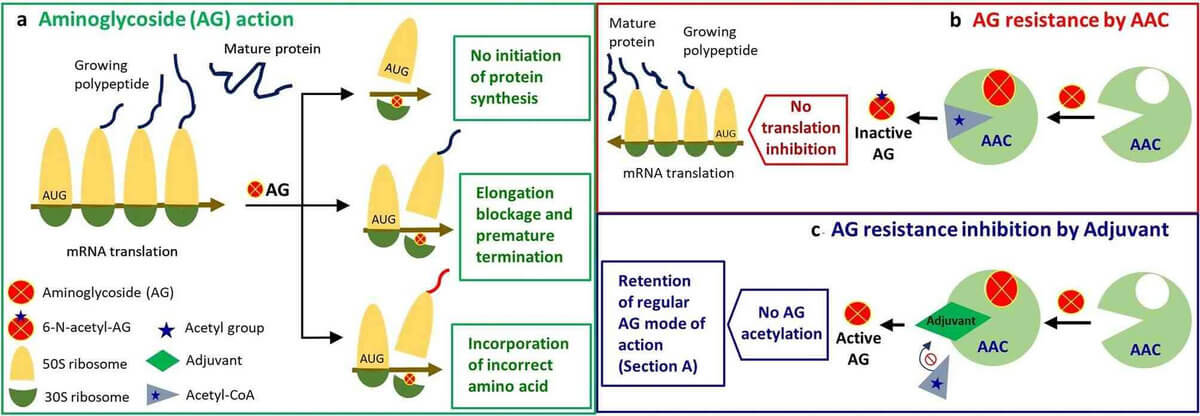 Figure 1. Mechanism of aminoglycoside activation, inactivation, and the provability of activity retention. (Sources: Ahmed S, et al. 2020)
Bacteria primarily become resistant to gentamicin through mutations that affect the antibiotic's target binding sites. Gentamicin attaches itself to particular areas of the bacterial 16S rRNA located in the 30S ribosomal subunit. The rrs gene mutations which encode the 16S rRNA reduce gentamicin's effectiveness by impairing its binding capability to these regions. Mutations in ribosomal proteins such as rpsL create structural changes in the ribosome that weaken gentamicin's ability to bind and function.
Because of these genetic modifications gentamicin's ability to bind decreases which reduces its effectiveness at interrupting protein synthesis. Escherichia coli and other Gram-negative bacteria develop resistance through mutations in target genes such as rrs and rpsL which often lead to clinical resistance against aminoglycosides.
Aminoglycoside-modifying enzymes (AMEs) produce chemical modifications to gentamicin which deactivate its antibacterial properties. AAC enzymes transfer acetyl groups, APH enzymes transfer phosphate groups, and ANT enzymes transfer nucleotide groups onto gentamicin molecules. The alteration stops gentamicin from attaching to the ribosome which makes it unable to function as an antibiotic.
The aac(3)-II gene serves as a prominent example of resistance because it produces an acetyltransferase enzyme that deactivates gentamicin. Bacterial plasmids that move genetic material between microorganisms frequently contain this gene. Bacterial populations experience rapid dissemination of resistance because horizontal gene transfer can spread resistance genes among them.
Gentamicin's ability to kill bacteria depends on bacterial mechanisms for drug uptake and expulsion. Some antibiotic-resistant strains show reduced gentamicin absorption because of outer membrane porin changes such as OmpF modifications in E. coli. The bacterial cell membrane incorporates porins which serve as pathways for small molecules including antibiotics to enter cells. When bacteria downregulate or mutate their porins the result is diminished gentamicin entry into the cells.
Efflux pumps produced by bacteria work to remove gentamicin before it enters cells and causes damage. Through the AcrAB-TolC efflux system E. coli expels gentamicin which reduces its internal concentration and lowers its antibacterial impact.
Antimicrobial resistance poses a major threat as it quickly disseminates through bacterial communities and crosses species boundaries. Bacteria use horizontal gene transfer as a primary method to acquire antimicrobial resistance. Through horizontal gene transfer mechanisms bacteria take up genetic material and resistance genes from their environment. Through conjugation which transfers plasmids containing resistance genes between bacteria transformation which enables bacteria to incorporate free DNA from their surroundings and transduction which lets bacteriophages move DNA between bacterial hosts horizontal gene transfer becomes possible.
Transposons and integrons are crucial elements that facilitate the movement of resistance genes between bacterial cells. Multiple resistance genes can be moved by transposons to new positions both inside bacterial genomes and onto plasmids. Integrons function as genetic platforms which enable the capture and integration of resistance gene thereby accelerating resistance dissemination. Genetic elements' capability to transfer between bacterial species has enabled gentamicin resistance to spread quickly throughout different species thus creating a worldwide public health emergency.
Bacteria utilize adaptive resistance mechanisms enabling them to thrive in adverse conditions while facing antibiotics such as gentamicin. Biofilm formation is one such strategy. The dense bacterial cell cluster produced by biofilm extracellular matrix stops gentamicin from reaching internal bacteria. The effectiveness of gentamicin drops significantly when it is used to target biofilm-related infections in patients with cystic fibrosis as well as those suffering from chronic wound infections.
Bacteria deploy survival tactics through the development of dormant persister cell populations that withstand antibiotic treatments. Persister cells stay dormant which blocks their growth and division hence they become resistant to antibiotics that target protein synthesis. Once antibiotic treatment stops persister cells that stayed dormant throughout the treatment reactivate and begin to cause infection again.
Bacterial survival during antibiotic exposure depends on the SOS response and oxidative stress adaptations along with several other bacterial stress response mechanisms. Bacterial systems facilitate DNA repair and oxidative stress management while enabling survival against strong environmental factors like gentamicin exposure.
Gentamicin resistance leads to extensive clinical consequences. Healthcare facilities worldwide struggle with treating significant infections due to antibiotic-resistant Klebsiella pneumoniae, Pseudomonas aeruginosa and Enterococcus species. Multidrug-resistant bacteria create treatment challenges since healthcare providers must use medications that either pose greater risks to patients or demonstrate lower effectiveness.
Detecting gentamicin resistance involves various difficulties. Traditional resistance detection methods require extensive time and effort which illustrates the necessity for rapid genomic technologies like PCR and whole-genome sequencing (WGS) to pinpoint resistance genes and support treatment decisions.
Research teams explore combination therapies to address resistance problems in treatment. The effectiveness of treatment increases when gentamicin and β-lactam antibiotics work together because they attack various bacterial functions. New inhibitors against AMEs and efflux pumps are under development to improve gentamicin's antibiotic effectiveness alongside other drugs.
Combating gentamicin resistance demands continuous innovation efforts. CRISPR-based precision medicine approaches show potential to target and silence bacterial resistance genes in populations. Researchers in drug development are focused on producing next-generation aminoglycosides that withstand enzymatic modification to fight against resistant bacterial strains.
To control antibiotic misuse and track resistance patterns worldwide surveillance programs for antibiotics such as gentamicin must be established. Implementing policies to reduce unnecessary antibiotic prescriptions along with rapid diagnostic testing will play a vital role in controlling the spread of resistance.
Gentamicin resistance emerges from multiple complex molecular processes that include genetic mutations and enzymatic drug inactivation together with decreased drug absorption and survival mechanisms such as biofilm development and persistence of resistant cells. Effective solutions against antimicrobial resistance require a deep understanding of these biological mechanisms. To prevent gentamicin resistance from compromising public health we need to merge new drug development with improved diagnostics and global stewardship measures. Research scientists need to solve these problems to protect antibiotic treatments which will maintain the effectiveness of crucial medications like gentamicin for serious bacterial infections.
References
| Target | Cat. No. | Product Name | Host | Isotype | Application | |
| Gentamicin | HMABPY043 | RHA™ anti-Gentamicin monoclonal antibody, clone GM | Mouse | IgG | ELISA, LFIA | Inquiry |
| DPBT-68266SG | Anti-Gentamicin polyclonal antibody | Sheep | IgG | ELISA | Inquiry | |
| DMAB3403 | Anti-Gentamicin monoclonal antibody, clone A104 | Mouse | IgG2a | IA | Inquiry | |
| DMAB3404 | Anti-Gentamicin monoclonal antibody, clone A103 | Mouse | IgG2a | ELISA | Inquiry | |
| DMAB6614 | Anti-Gentamicin monoclonal antibody, clone monoclonal,H5-10 | Mouse | IgG2a | cELISA, IFIA | Inquiry | |
| DMAB6615 | Anti-Gentamicin monoclonal antibody, clone monoclonal, clone CloneH11-18 | Mouse | IgG1a | cELISA, IFIA | Inquiry | |
| DMAB6616 | Anti-Gentamicin monoclonal antibody, clone monoclonal,H17-33 | Mouse | IgG1a | cELISA, IFIA | Inquiry | |
| DMABT-54913MG | Anti-Gentamicin monoclonal antibody, clone HF2 | Mouse | IgG1 | IA | Inquiry | |
| DMABT-54914MG | Anti-Gentamicin monoclonal antibody, clone HF3 | Mouse | IgG1 | IA | Inquiry |
| Target | Cat. No. | Product Name | Expression System | Tag/Conjugate | Application | |
| Gentamicin | DAG4468 | Gentamicin [BSA] | N/A | BSA | N/A | Inquiry |
| DISNJ17 | Gentamicin Sulfate Standard | N/A | N/A | ELISA | Inquiry | |
| DAGA-043K | Gentamicin [KLH] | N/A | KLH | Immunogen | Inquiry | |
| DAGA-032H | Gentamicin [HRP] | N/A | HRP | ELISA | Inquiry | |
| DAG4468O | Gentamicin [OVA] | N/A | OVA | ELISA, LFIA | Inquiry | |
| DAG-WT2703 | Gentamicin control | N/A | Unconjugated | Immunoassays | Inquiry |
| Target | Cat. No. | Product Name | Size | Species | Application | Detection Sample | |
| Gentamicin | DEIA047 | Gentamicin ELISA Kit | 96T | N/A | Quantitative | Vaccine, cell culture | Inquiry |
| DEIA6884 | Gentamicin ELISA Kit | 96T | N/A | Quantitative | serum, plasma, cell lysates, tissue homogenates, and food samples | Inquiry | |
| DEIA-WZ6884 | High Sensitivity Gentamicin ELISA Test Kit | 96T | Quantitative | biological samples | Inquiry |
Loading ......
