
Inquiry Basket
 Loading ......
Kanamycin as an established antibiotic that continues to protect lives after many years of use. For both critical infections and milder health issues Kanamycin serves as the primary treatment option against harmful bacterial infections. Powerful antibiotics have their drawbacks, which Kanamycin also possesses. Despite its life-saving properties Kanamycin presents hidden dangers through its side effects.
Get ready to explore whether Kanamycin holds the power of an exceptional antibiotic or conceals harmful toxicity. The paper examines Kanamycin's toxic effects such as hearing loss called ototoxicity and kidney damage known as nephrotoxicity while seeking ways to optimize its medical benefits without exceeding safe boundaries.
Our initial focus should be on understanding Kanamycin's nature and its importance within the class of antibiotics before we examine its side effects. Kanamycin which belongs to the aminoglycoside family delivers strong defense against tough bacterial infections. Kanamycin binds to bacterial ribosomes to halt protein production which ultimately leads to bacterial death. Kanamycin functions as a silent bacterial killer that kills bacteria with deadly precision.
Kanamycin serves as a prescribed treatment for tuberculosis and systemic infections caused by gram-negative bacteria as well as urinary tract infections. Kanamycin serves as the dependable alternative therapy for patients who cannot tolerate other antibiotics or suffer from resistant infections. Patients need heightened attention when using powerful medications due to the necessity for careful application because of their potent nature.
Patients face substantial health hazards from kanamycin because it induces both ototoxic and nephrotoxic effects.
We must now examine the negative aspects associated with Kanamycin treatment. The primary risks associated with Kanamycin include ototoxicity and nephrotoxicity even though we desire all antibiotics to be completely safe.
Your doctor prescribed Kanamycin to treat a severe infection. Your recovery from the symptoms improves temporarily before an unusual event begins to occur. Your ears start to experience a continuous ringing sound. Your ear seems to be performing a continuous irritating concert that nobody else can hear. You may observe that your hearing becomes muffled and distorted. You discover that your hearing problems extend beyond just auditory distortions since everyday conversations become challenging to follow and music seems different than before.
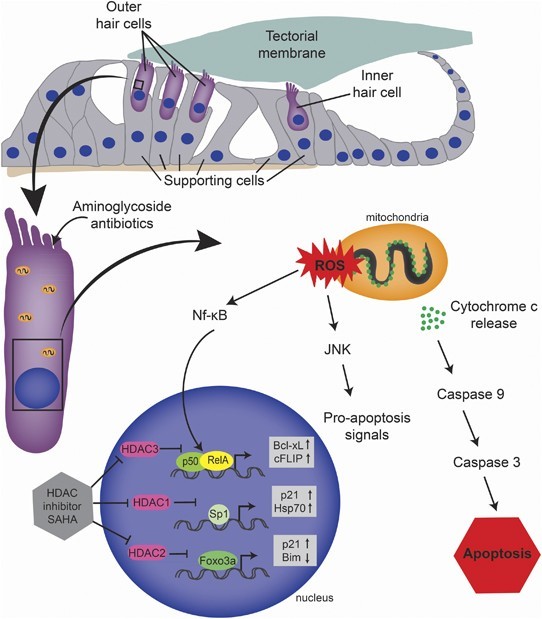 Figure 1. A simplified schematic diagram depicting aminoglycoside-induced hair cell death in the mammalian inner ear. (Sources: Layman WS, et al. 2015)
What's going on? The root cause of the problem is ototoxicity which Kanamycin frequently induces. The ototoxic effects of Kanamycin occur through damage to the cochlea within the inner ear which is essential for transforming sound vibrations into electrical signals for brain interpretation. Hearing loss results when the cochlea's delicate hair cells sustain damage.
The challenging aspect of ototoxicity lies in its ability to develop unnoticed by the patient. Hearing loss from Kanamycin begins with subtle signs such as ear ringing and progresses until noticeable impairment develops. Untreated damage can lead to permanent hearing problems that cannot be reversed.
Kanamycin users who receive high doses or undergo long-term treatment and individuals with existing hearing conditions face an elevated risk of ototoxicity. Patients taking Kanamycin over extended periods require routine hearing evaluations because early detection through these tests helps avoid permanent hearing loss.
Patients treated with Kanamycin must be concerned about hearing loss but should also recognize that other organs face risk. Kanamycin causes serious kidney damage through its toxic properties. Kanamycin causes kidney damage that progresses from mild to severe and may lead to kidney failure in some cases.
But how does Kanamycin damage the kidneys? The kidneys filter the drug during its natural metabolic breakdown. The toxic elements of Kanamycin build up within the renal tubules which filter waste in the kidneys leading to damage. This condition leads to a diminished capability for waste filtration from the bloodstream resulting in kidney malfunction or total kidney failure.
Patients with nephrotoxicity show signs of swelling from fluid retention, decreased urine production, tiredness, and increased blood pressure. Severely impaired kidney function may lead doctors to perform dialysis as a substitute for cleaning the blood.
Individuals with existing kidney disease together with elderly patients and those who undergo high doses or extended Kanamycin treatment face an increased risk of nephrotoxicity. As with ototoxicity, monitoring is key. Early detection of kidney damage and prevention of further damage can be achieved through routine blood tests that measure kidney function and urine tests.
Kanamycin continues to serve as an essential antibiotic tool despite its associated risks. The key is to use it safely. Follow these tips to reduce side effects while enhancing Kanamycin's therapeutic effects.
1. Get the Right Dosage
Administering Kanamycin successfully demands precise dosage similar to the accurate flour measurement needed for baking a cake. The risk of side effects grows substantially when the usage exceeds recommended limits. The infection will fail to respond adequately if the treatment amount is insufficient. Your weight along with kidney function and infection severity determine the correct Kanamycin dosage. Your doctor will set the optimal dose for you and following it is crucial.
2. Regular Monitoring: Eyes on the Prize
Regular monitoring remains the sole method to detect sneaky side effects before they escalate to become serious problems. Patients taking Kanamycin will need regular blood testing to monitor kidney function and hearing tests to spot early signs of ototoxicity. Extended treatment duration or high dosage requires these tests to monitor potential health impacts.
Detecting side effects at an early stage allows for easier adjustments to the treatment plan. When problems develop your doctor may choose to lower the dosage, prescribe a different antibiotic or terminate the treatment.
3. Risk Management: Striking a Balance
Doctors usually choose not to use Kanamycin for extended treatments because of its toxic nature. Doctors usually prescribe Kanamycin for brief treatment durations to reduce potential side effects. Doctors may suggest alternative antibiotics to avoid potential hearing and kidney complications in certain situations. Medical professionals prioritize patient health by balancing benefits against risks when Kanamycin stands as the only viable treatment option.
Although the previous measures reduce risks pharmacovigilance which monitors drug safety serves as a vital approach to detect and manage Kanamycin-related hazards.
Pharmacovigilance requires continuous data gathering and analysis about medication side effects. Monitoring patient responses to Kanamycin requires observation after the medication has been prescribed. Medical professionals can establish preventive guidelines through the identification of consistent side effects reported by a substantial number of patients.
The prescribing guidelines for Kanamycin may undergo modifications if there is an increase in hearing loss or kidney problems among its users. Medical professionals might implement stricter monitoring processes or revise dosage guidelines while also developing safer drug alternatives.
Pharmacovigilance remains on alert to identify potential risks whenever Kanamycin is prescribed for you or your family members. You should always inform your doctor about any side effects because this information can help protect others.
Kanamycin remains an essential and robust medication in combating bacterial infections. The antibiotic continues to save numerous lives while remaining the preferred treatment for severe infections that don't respond to other antibiotic options. The serious side effects of Kanamycin which include ototoxicity and nephrotoxicity require careful attention and management.
Safe Kanamycin use requires proper dosage administration together with routine monitoring and risk management strategies. Kanamycin proves to be a lifesaving solution but possesses vulnerabilities that limit its effectiveness. When doctors and patients work together effectively to manage Kanamycin use it helps to reduce its risks thus showcasing its crucial life-saving potential.
Kanamycin serves as an effective weapon against infections but carries potential risks. Continue to keep yourself well-informed while remaining alert and above all make health your top priority.
Reference
| Target | Cat. No. | Product Name | Host | Isotype | Application | |
| Kanamycin | HMABPY044 | RHA™ anti-Kanamycin Monoclonal antibody, clone KAN | Mouse | IgG | ELISA, LFIA | Inquiry |
| DPABY-883 | Anti-Kanamycin polyclonal antibody | Sheep | ELISA, Pr* | Inquiry | ||
| DPAB-DC4461 | Anti-Kanamycin polyclonal antibody | Sheep | EIA | Inquiry |
| Target | Cat. No. | Product Name | Expression System | Tag/Conjugate | Application | |
| Kanamycin | DAG1208 | Kanamycin [HRP] | N/A | HRP | N/A | Inquiry |
| DISNJ15 | Kanamycin Sulfate Standard | N/A | N/A | ELISA | Inquiry | |
| DAGA-040B | Kanamycin [BSA] | N/A | BSA | LFIA | Inquiry | |
| DAGA-044K | Kanamycin [KLH] | N/A | KLH | Immunogen | Inquiry | |
| DAG227S | Kanamycin [HSA] | N/A | HSA | ELISA | Inquiry | |
| DAG515S | Kanamycin [HSA-Biotin] | N/A | HSA-Biotin | ELISA | Inquiry |
| Target | Cat. No. | Product Name | Size | Species | Application | Detection Sample | |
| Kanamycin | DEIAH-004H | Kanamycin ELISA Kit | 96T | Quantitative | milk, milk powder, chicken, pork | Inquiry | |
| Kanamycin | DEIA048 | Kanamycin ELISA Kit | 96T | N/A | Quantitative | biological samples | Inquiry |
| Kanamycin | DEIA-WZ048V | High Sensitivity Kanamycin ELISA Test Kit | 96T | Quantitative | biological samples | Inquiry | |
| Kanamycin | DEIA048V | Kanamycin ELISA Kit | 96T | Quantitative | Vaccine | Inquiry | |
| Kanamycin | DEIA-004H | Kanamycin ELISA Kit | 96T | N/A | Quantitative, qualitative | tissue, milk | Inquiry |
| kanamycin | DTS761 | Kanamycin Residue Rapid Test(milk) | 96T | N/A | Qualitative | Milk | Inquiry |
Loading ......
