
Inquiry Basket
 Loading ......
Doctors use Gentamicin, a potent aminoglycoside antibiotic, for treating severe bacterial infections. This potent drug must maintain its therapeutic safety and effectiveness during its entire shelf-life period. Gentamicin stability studies enable scientists to understand how different environmental conditions affect the potency of the drug. Stability testing verifies that Gentamicin preserves its therapeutic benefits and remains safe for patients while preventing any harm from degradation. The paper investigates the multiple elements impacting Gentamicin stability and describes the scientific techniques used to evaluate its quality durability.
Pharmaceutical stability measures whether a drug keeps its identity and potency along with its quality and purity from production until expiration. Gentamicin requires stability studies because it serves as a therapeutic choice for critical infections that endanger life. Drug degradation from environmental influences results in decreased efficacy of medication along with potential health risks by making it ineffective.
The therapeutic effect of Gentamicin during its shelf life requires its stability under normal storage conditions. When Gentamicin becomes unstable it generates harmful degradation products which pose risks to patient safety. Through stability tests pharmaceutical companies prove Gentamicin effectiveness and establish precise shelf-life claims and packaging solutions to meet regulatory requirements.
Gentamicin potency depends on several stability factors that need careful evaluation throughout testing and storage processes.
Temperature plays a major role in determining drug degradation rates. Gentamicin exhibits heat sensitivity which mirrors the thermal responses of many antibiotics as temperature changes impact its stability. Extreme heat causes chemical reactions that break down Gentamicin drug molecules thereby reducing their effectiveness. Gentamicin loses its effectiveness under extremely low temperatures because these conditions reduce its solubility.
Gentamicin requires refrigerated storage temperatures between 2°C and 8°C to prevent its degradation. Product degradation rates increase when Gentamicin experiences temperature variations during storage or transportation. Scientists conduct stability studies to establish how much temperature variation a batch of Gentamicin can endure while preserving its medicinal qualities.
The stability of Gentamicin drops significantly when the pH environment changes particularly in liquid solutions. When Gentamicin encounters acidic or alkaline environments it undergoes hydrolysis reactions which create degradation products. When Gentamicin breaks down it generates degradation products which reduce drug effectiveness and may cause harmful side effects.
Gentamicin stability stays best when pH levels remain between 4.5 and 7.0.The drug starts to degrade faster when it exceeds the mentioned pH boundaries. Formulation and testing processes must maintain suitable pH levels to sustain Gentamicin potency throughout its shelf life.
The stability of Gentamicin depends significantly on humidity levels. Hydrolytic degradation occurs when excess moisture interacts with the drug resulting in reduced potency and the formation of toxic byproducts. Powder forms of Gentamicin degrade swiftly when exposed to moisture.
Gentamicin is preserved from humidity effects by storing it in containers resistant to moisture or environments with desiccants. Stability studies require drug testing under multiple humidity conditions to identify ideal storage environments for each formulation.
Exposure to light and ultraviolet (UV) rays triggers photochemical reactions that degrade Gentamicin. Light exposure makes drug molecules absorb energy which can break chemical bonds leading to reduced potency.
The opaque packaging used for Gentamicin serves to shield the medication from UV radiation and stop light-induced degradation.
Quality control procedures depend heavily on stability testing as a fundamental component. Through stability testing processes scientists ensure that Gentamicin retains its therapeutic effectiveness throughout its entire shelf life. Various testing methods help determine how pharmaceuticals withstand environmental changes to preserve stability.
Scientists employ various analytical methods to assess Gentamicin stability during testing procedures. The techniques used by scientists help measure drug concentration and purity levels alongside the detection of degradation products.
High-Performance Liquid Chromatography serves as the primary method for analyzing Gentamicin's chemical makeup and quantifying its concentration. Researchers utilize HPLC to separate drug sample components which helps them detect degradation products and track the active ingredient's stability over time.
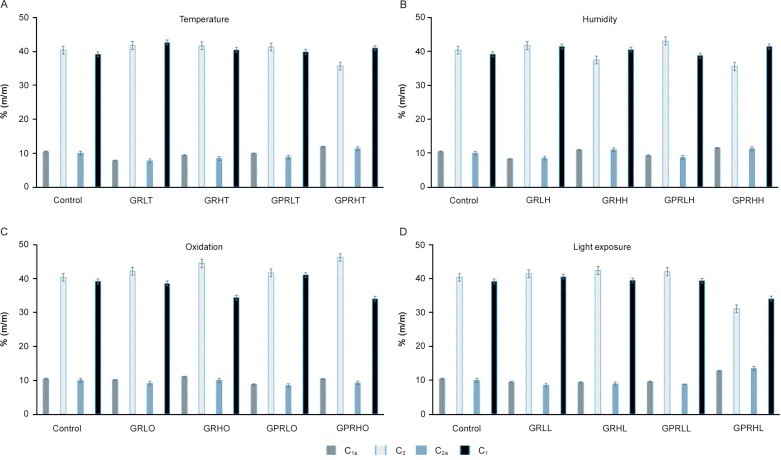 Figure 1. The effect of 30-day storage conditions on the composition of the GS coating determined by HPLC–ELSD. (Sources: Mullins ND, et al. 2016)
UV-Vis spectroscopy represents a standard method for evaluating Gentamicin stability through analysis. The measurement of UV light absorbance at specific wavelengths enables researchers to investigate Gentamicin degradation and detect new chemical species that influence its effectiveness.
Through mass spectrometry scientists obtain exact measurements of Gentamicin molecular weight together with the molecular weight of its degradation products. The analytical method helps identify minor structural changes in Gentamicin which indicate degradation and it gives thorough information about the drug's stability.
Thin Layer Chromatography serves as a simple yet efficient technique to evaluate Gentamicin degradation. Through the application of small drug samples onto a chromatographic plate researchers observe how drug components move and identify if the active substance stays intact or decomposes into less potent compounds.
Gentamicin requires proper packaging and storage to preserve its stability. Multiple protective methods are put into practice to shield Gentamicin from environmental elements which might cause its degradation.
Gentamicin is preserved from damaging elements by being packaged in containers that block light and air while maintaining an airtight seal. Utilization of aluminum or specialized plastic materials helps maintain the drug's stability throughout its expiration period.
Gentamicin's opaque packaging functions to protect the medication against UV radiation and prevent degradation from light sources. Drug manufacturers analyze stability under different lighting conditions to create packaging which maintains drug potency and stability.
Quality control procedures depend heavily on stability testing as a fundamental component. Through stability testing processes scientists ensure that Gentamicin retains its therapeutic effectiveness throughout its entire shelf life. Various testing methods help determine how pharmaceuticals withstand environmental changes to preserve stability.
Gentamicin stability assurance is crucial because demand for dependable high-quality antibiotics keeps increasing. Manufacturers who understand stability factors and implement proper packaging and storage methods will deliver safe therapeutic options for patient use across many years.
References
| Target | Cat. No. | Product Name | Host | Isotype | Application | |
| Gentamicin | HMABPY043 | RHA™ anti-Gentamicin monoclonal antibody, clone GM | Mouse | IgG | ELISA, LFIA | Inquiry |
| DPBT-68266SG | Anti-Gentamicin polyclonal antibody | Sheep | IgG | ELISA | Inquiry | |
| DMAB3403 | Anti-Gentamicin monoclonal antibody, clone A104 | Mouse | IgG2a | IA | Inquiry | |
| DMAB3404 | Anti-Gentamicin monoclonal antibody, clone A103 | Mouse | IgG2a | ELISA | Inquiry | |
| DMAB6614 | Anti-Gentamicin monoclonal antibody, clone monoclonal,H5-10 | Mouse | IgG2a | cELISA, IFIA | Inquiry | |
| DMAB6615 | Anti-Gentamicin monoclonal antibody, clone monoclonal, clone CloneH11-18 | Mouse | IgG1a | cELISA, IFIA | Inquiry | |
| DMAB6616 | Anti-Gentamicin monoclonal antibody, clone monoclonal,H17-33 | Mouse | IgG1a | cELISA, IFIA | Inquiry | |
| DMABT-54913MG | Anti-Gentamicin monoclonal antibody, clone HF2 | Mouse | IgG1 | IA | Inquiry | |
| DMABT-54914MG | Anti-Gentamicin monoclonal antibody, clone HF3 | Mouse | IgG1 | IA | Inquiry |
| Target | Cat. No. | Product Name | Expression System | Tag/Conjugate | Application | |
| Gentamicin | DAG4468 | Gentamicin [BSA] | N/A | BSA | N/A | Inquiry |
| DISNJ17 | Gentamicin Sulfate Standard | N/A | N/A | ELISA | Inquiry | |
| DAGA-043K | Gentamicin [KLH] | N/A | KLH | Immunogen | Inquiry | |
| DAGA-032H | Gentamicin [HRP] | N/A | HRP | ELISA | Inquiry | |
| DAG4468O | Gentamicin [OVA] | N/A | OVA | ELISA, LFIA | Inquiry | |
| DAG-WT2703 | Gentamicin control | N/A | Unconjugated | Immunoassays | Inquiry |
| Target | Cat. No. | Product Name | Size | Species | Application | Detection Sample | |
| Gentamicin | DEIA047 | Gentamicin ELISA Kit | 96T | N/A | Quantitative | Vaccine, cell culture | Inquiry |
| DEIA6884 | Gentamicin ELISA Kit | 96T | N/A | Quantitative | serum, plasma, cell lysates, tissue homogenates, and food samples | Inquiry | |
| DEIA-WZ6884 | High Sensitivity Gentamicin ELISA Test Kit | 96T | Quantitative | biological samples | Inquiry |
Loading ......
