
Inquiry Basket
 Loading ......
In the realm of antibiotics, erythromycin has emerged as a potent weapon against various bacterial infections. It is the first macrolide antibiotic that can be used in clinical practice and has become the prototype of new macrolide drugs. Its broad-spectrum activity, excellent tolerability, and extensive clinical history have made it a cornerstone in the treatment of numerous infectious diseases. In addition to antibacterial activity, erythromycin also has anti-inflammatory, immunomodulatory, and prokinetic activities.
The mechanism of action of erythromycin, a macrolide antibiotic, involves inhibiting bacterial protein synthesis. This process occurs through binding to the 50S ribosomal subunit of bacteria, specifically at the ribosomal exit tunnel. By binding to this site, erythromycin prevents the movement of the newly synthesized peptide chain from the ribosome, inhibiting the elongation of the protein.
Erythromycin's binding to the ribosome interferes with the translocation of peptidyl-tRNA from the A-site to the P-site on the ribosome. This disruption prevents the addition of new amino acids to the growing peptide chain, ultimately leading to the inhibition of protein synthesis. Moreover, erythromycin also has been found to stimulate the dissociation of the peptidyl-tRNA from the ribosome, further impairing protein synthesis. This dual mechanism of action contributes to the bacteriostatic effect of erythromycin, as it halts bacterial growth and replication.
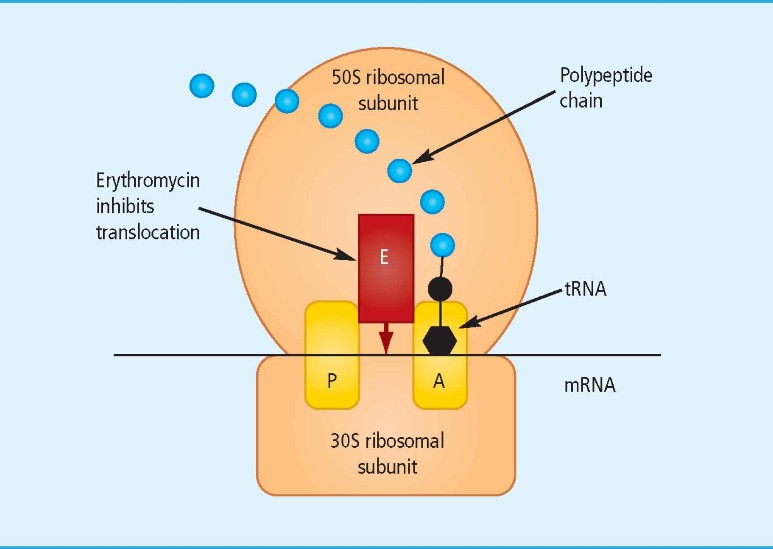 Figure 1. Erythromycin inhibits the translocation of the polypeptide chain from A site to P site.
(Source: Ahmed, F. W. et al., 2011)
The exact mechanisms underlying the anti-inflammatory and immunomodulatory effects of erythromycin are unknown. Erythromycin has been reported to reduce oxidative production of cytokines by neutrophils (IL-1, IL-6, IL-8, and TNF). Additionally, IL-10 production and platelet count are increased.
Erythromycin is highly effective against a wide range of bacterial pathogens. It belongs to the macrolide class of antibiotics and acts by inhibiting protein synthesis in susceptible bacteria. This mechanism of action allows erythromycin to target both Gram-positive and some Gram-negative bacteria. Its medical uses encompass various infections, including respiratory tract infections, skin and soft tissue infections, and sexually transmitted infections.
Respiratory tract infections, such as pneumonia and bronchitis, are common indications for erythromycin use. The antibiotic demonstrates excellent activity against pathogens like Streptococcus pneumoniae and Haemophilus influenzae. Additionally, erythromycin is frequently employed in the treatment of skin and soft tissue infections caused by Staphylococcus aureus and Streptococcus pyogenes.
Moreover, erythromycin plays a crucial role in managing sexually transmitted infections, particularly when patients are allergic to other antibiotics like penicillin. It effectively treats infections caused by Chlamydia trachomatis and Neisseria gonorrhoeae.
Erythromycin, while generally well-tolerated, can cause various adverse effects.
Residue of erythromycin in various tissues or substances can occur due to various factors:
The extensive use of erythromycin drugs in production leads to its residues in livestock and poultry tissues, honey, milk, fish and shrimp, and other products, posing a risk to public health. Currently, there are two main categories of methods for detecting erythromycin residues.
One is a method that allows for simultaneous separation and analysis. These methods employ highly efficient separation techniques and high detection sensitivity, enabling qualitative and quantitative analysis of residual erythromycin. Examples of such methods include high-performance liquid chromatography (HPLC), gas chromatography (GC), thin-layer chromatography (TLC), gas chromatography-mass spectrometry (GC-MS), and liquid chromatography-mass spectrometry (LC-MS).
The other type is a qualitative and semi-quantitative biological method for erythromycin, which has the characteristics of high selectivity and low detection limit. This method mainly includes enzyme-linked immunoassay (ELISA), microbial method, and radioimmunoassay.
Efficient and accurate detection of erythromycin residues is crucial to ensure food safety and protect public health. These methods, whether based on separation and analysis or biological approaches, play a significant role in monitoring and regulating erythromycin residues in various food products.
References
| Target | Cat. No. | Product Name | Expression System | Tag/Conjugate | Application | |
| Erythromycin | DISNJ23 | Erythromycin Standard (95%) | N/A | N/A | ELISA | Inquiry |
| DAGA-044B | Erythrocin [BSA] | N/A | BSA | LFIA | Inquiry | |
| DAGA-048K | Erythrocin [KLH] | N/A | KLH | Immunogen | Inquiry | |
| DAGA-036H | Erythrocin [HRP] | N/A | HRP | ELISA | Inquiry | |
| DAGA-189K | Erythromycin [KLH] | N/A | KLH | Immunogen | Inquiry | |
| DAG241S | Erythromycin [HSA] | N/A | HSA | ELISA | Inquiry | |
| TNF | DAG330 | Human Tumor Necrosis Factor alpha (aa 158) | Unconjugated | N/A | Inquiry | |
| DAG287 | Rat Tumor Necrosis Factor alpha | Unconjugated | N/A | Inquiry |
| Target | Cat. No. | Product Name | Size | Species Reactivity | Application | Detection Sample | |
| Erythromycin | DEIABL-QB21 | Erythromycin ELISA Kit | 96T | Quantitative | vaccine | Inquiry | |
| IL-6 | DEIABL-G5 | Goat IL-6(Interleukin 6) ELISA Kit | 96T | Goat | Quantitative | Serum, plasma, tissue homogenates and other biological fluids. | Inquiry |
| DEIABL87 | Monkey IL-6(Interleukin 6) ELISA Kit | 5 Plates | Monkey | Quantitative | Serum, plasma, tissue homogenates and other biological fluids. | Inquiry | |
| IL-8 | DEIABL471 | Bovine IL-8(Interleukin 8) ELISA Kit | 6 plates | Bovine | Quantitative | Serum, plasma, tissue homogenates and other biological fluids. | Inquiry |
| DEIA-NS2307-21 | Chicken IL-8(Interleukin 8) ELISA Kit | 96T | Chicken | Quantitative | serum, plasma, tissue homogenates and other biological fluids. | Inquiry | |
| TNF | DEIA-XYA1544 | Rat TNF-alpha (Luminometer) ELISA Kit | 96T | Quantitative | cell lysates, serum, plasma | Inquiry | |
| DEIA-XYA1545 | Rat TNF-alpha (Colorimetric) ELISA Kit | 96T | Quantitative | cell lysates, serum, plasma | Inquiry | ||
| DEIA-XYA1276 | Mouse TNF-alpha (Luminometer) ELISA Kit | 96T | Quantitative | cell lysates, serum, plasma | Inquiry | ||
| DEIA-XYA1277 | Mouse TNF-alpha (Colorimetric) ELISA Kit | 96T | Quantitative | cell lysates, serum, plasma | Inquiry | ||
| DEIA-FN1537 | Horse TNFa (Tumor Necrosis Factor Alpha) ELISA Kit | 96T | Quantitative | serum, plasma, cell culture supernatants, tissue homogenate | Inquiry | ||
| DEIA-FN1538 | Hamster TNF-α (Tumor Necrosis Factor-α) ELISA Kit | 96T | Quantitative | serum, plasma, cell culture supernatants, tissue homogenate | Inquiry | ||
| ABPR-ZB091 | Human TNF beta Antibody Pair Set | 5 Plates, 15 Plates | Human | sELISA | Inquiry | ||
| DEIA-NS2307-16 | Canine TNF-α(Tumor Necrosis Factor Alpha) ELISA Kit | 96T | Canine | Quantitative | serum, plasma, tissue homogenates and other biological fluids. | Inquiry | |
| DEIA068J | TNF α-Blocker ADA, Antibodies against infliximab ELISA Kit | 96T | Human | Qualitative | serum, EDTA plasma | Inquiry | |
| DEIA069J | TNF α-Blocker ADA, Total Antibodies against infliximab ELISA Kit | 96T | Human | Qualitative | serum, EDTA plasma | Inquiry | |
| DEIA072J | TNF α-Blocker monitoring, golimumab drug level ELISA Kit | 96T | Human | Quantitative | serum, EDTA plasma | Inquiry | |
| DEIA073J | TNF α-Blocker monitoring, infliximab drug level ELISA Kit | 96T | Quantitative | serum, EDTA plasma | Inquiry | ||
| DEIA018J | TNF α-Blocker ADA, Antibodies against etanercept ELISA Kit | 96T | Human | Qualitative | EDTA plasma, serum | Inquiry | |
| DEIA019J | TNF α-Blocker ADA, Antibodies against infliximab ELISA Kit | 96T | Human | Qualitative | EDTA plasma, serum | Inquiry | |
| DEIA020J | TNF α-Blocker ADA, Total Antibodies against infliximab ELISA Kit | 96T | Human | Qualitative | EDTA plasma, serum | Inquiry | |
| DEIA022J | TNF α-Blocker monitoring, golimumab drug level ELISA Kit | 96T | Human | Quantitative | EDTA plasma, serum | Inquiry | |
| DEIA024J | TNF α-Blocker monitoring, infliximab drug level ELISA Kit | 96T | Quantitative | EDTA plasma, serum | Inquiry | ||
| DEIA-LL240 | Mouse High sensitive Tumor Necrosis Factor Alpha ELISA Kit | 96T | Mouse | Quantitative | Serum, plasma, tissue homogenates and other biological fluids | Inquiry | |
| DEIA-JY2148 | Anti-Certolizumab ELISA Kit | 96T | Human | Quantitative | Serum, Plasma (EDTA, Heparin) | Inquiry | |
| DEIA-JY2149 | Certolizumab ELISA Kit | 96T | Human | Quantitative | Serum, Plasma (EDTA, Heparin) | Inquiry | |
| IL-10 | DEIABL-B1 | Bovine IL-10(Interleukin 10) ELISA Kit | 96T | Bovine | Quantitative | Serum, plasma, tissue homogenates and other biological fluids. | Inquiry |
| DEIA-NS2307-18 | Chicken IL-10(Interleukin-10) ELISA Kit | 96T | Chicken | Quantitative | serum, plasma, tissue homogenates and other biological fluids. | Inquiry |
Loading ......
