
Inquiry Basket
 Loading ......
Veterinarians frequently use Kanamycin as a broad-spectrum antibiotic to treat bacterial infections in livestock. Farm animal health and productivity gets better because the use of this treatment helps stop disease outbreaks from occurring. Using kanamycin extensively in agriculture triggers worries related to its residue contamination in food products. Human health faces considerable dangers from antibiotic residues in food products through antibiotic resistance development and allergic reactions. Effective detection methods must be implemented to maintain food safety standards.
The Enzyme-Linked Immunosorbent Assay (ELISA) represents the preferred economical technique for kanamycin residue detection in food products compared to other testing methods. The article explains ELISA operations and its strengths and weaknesses in kanamycin residue detection while also evaluating methods to improve its sensitivity and specificity.
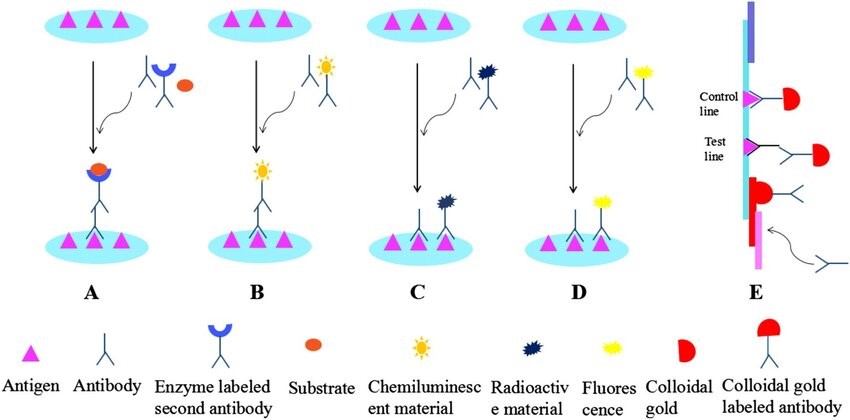 Figure 1. Principles of the immunoassays for the detection of antibiotics. (Sources: Saeed Ahmed, et al. 2020)
Detection of kanamycin residues in samples is most effectively conducted using competitive ELISA because this method excels in identifying small molecular structures like antibiotics. The competitive ELISA format requires the sample along with the enzyme-conjugated antigen to vie for antibody binding sites. The higher the presence of kanamycin in the sample reduces the binding of enzyme-conjugated antigen to the antibody which produces a lower signal.
The sandwich ELISA method which detects larger antigens including proteins works by holding the antigen between two antibodies. Although this method does not traditionally detect small molecules, an adaptation for antibiotic residue detection might be feasible with appropriate antibody development.
The ELISA technique serves as an economical solution to identify kanamycin residues in food because it delivers high sensitivity, specificity and fast results. Though ELISA encounters problems with cross-reactivity and food matrix interference ongoing optimization efforts keep improving its effectiveness. The requirement for strict food safety standards means ELISA must become an indispensable method for detecting antibiotic residues to protect public health.
References
| Target | Cat. No. | Product Name | Host | Isotype | Application | |
| Kanamycin | HMABPY044 | RHA™ anti-Kanamycin Monoclonal antibody, clone KAN | Mouse | IgG | ELISA, LFIA | Inquiry |
| DPABY-883 | Anti-Kanamycin polyclonal antibody | Sheep | ELISA, Pr* | Inquiry | ||
| DPAB-DC4461 | Anti-Kanamycin polyclonal antibody | Sheep | EIA | Inquiry |
| Target | Cat. No. | Product Name | Expression System | Tag/Conjugate | Application | |
| Kanamycin | DAG1208 | Kanamycin [HRP] | N/A | HRP | N/A | Inquiry |
| DISNJ15 | Kanamycin Sulfate Standard | N/A | N/A | ELISA | Inquiry | |
| DAGA-040B | Kanamycin [BSA] | N/A | BSA | LFIA | Inquiry | |
| DAGA-044K | Kanamycin [KLH] | N/A | KLH | Immunogen | Inquiry | |
| DAG227S | Kanamycin [HSA] | N/A | HSA | ELISA | Inquiry | |
| DAG515S | Kanamycin [HSA-Biotin] | N/A | HSA-Biotin | ELISA | Inquiry |
| Target | Cat. No. | Product Name | Size | Species | Application | Detection Sample | |
| Kanamycin | DEIAH-004H | Kanamycin ELISA Kit | 96T | Quantitative | milk, milk powder, chicken, pork | Inquiry | |
| Kanamycin | DEIA048 | Kanamycin ELISA Kit | 96T | N/A | Quantitative | biological samples | Inquiry |
| Kanamycin | DEIA-WZ048V | High Sensitivity Kanamycin ELISA Test Kit | 96T | Quantitative | biological samples | Inquiry | |
| Kanamycin | DEIA048V | Kanamycin ELISA Kit | 96T | Quantitative | Vaccine | Inquiry | |
| Kanamycin | DEIA-004H | Kanamycin ELISA Kit | 96T | N/A | Quantitative, qualitative | tissue, milk | Inquiry |
| kanamycin | DTS761 | Kanamycin Residue Rapid Test(milk) | 96T | N/A | Qualitative | Milk | Inquiry |
Loading ......
