
Inquiry Basket
 Loading ......
Gentamicin requires precise dosage for severe infection treatment since its therapeutic range is extremely limited. Because Gentamicin's therapeutic window is very narrow it creates a precarious difference between doses that save lives and those that cause serious side effects like nephrotoxicity and ototoxicity. In these situations patient safety demands careful monitoring of Gentamicin serum levels.
We must understand why monitoring plays a crucial role before we begin examining specific techniques. Gentamicin dosage management poses significant difficulty because of its therapeutic window very narrow. An inadequate dosage of medication fails to properly treat the infection. Patients exposed to high medication doses risk permanent hearing loss or kidney damage. Healthcare providers rely on serum level monitoring to adjust medication dosages ensuring therapeutic levels achieve successful treatment while protecting patient safety.
Monitoring Gentamicin requires various methods each having unique advantages and disadvantages. Professionals must thoroughly understand each method to succeed in both clinical settings and research laboratories. This section delivers a summary of the most common techniques.
| Technique | Methodology | Strengths | Limitations | Best Use Case |
| HPLC (High-Performance Liquid Chromatography) | Separates components in a liquid sample, then quantifies Gentamicin based on concentration. | Reliable, precise, widely accepted in clinical settings. | Time-consuming, requires skilled technicians. | Ideal for clinical labs needing accurate results. |
| LC-MS (Liquid Chromatography-Mass Spectrometry) | Couples HPLC separation with mass spectrometry for ultra-precise identification of compounds. | Extremely sensitive, capable of analyzing multiple substances at once. | Expensive, requires expert operators and equipment. | Best for cases requiring high sensitivity or multiple-drug analysis. |
| Immunoassays | Uses antibodies that bind to Gentamicin, producing measurable changes in the sample. | Fast, cost-effective, easy to implement. | Less precise, subject to interference from other compounds. | High-throughput environments or rapid testing needs. |
How It Works:
HPLC stands as the dependable mainstay of laboratory testing. A liquid phase transports the sample through the column that contains the stationary phase. The sample separation occurs as it moves through HPLC while Gentamicin creates a distinct peak at its designated retention time. The peak measurement provides the quantitative concentration of the drug.
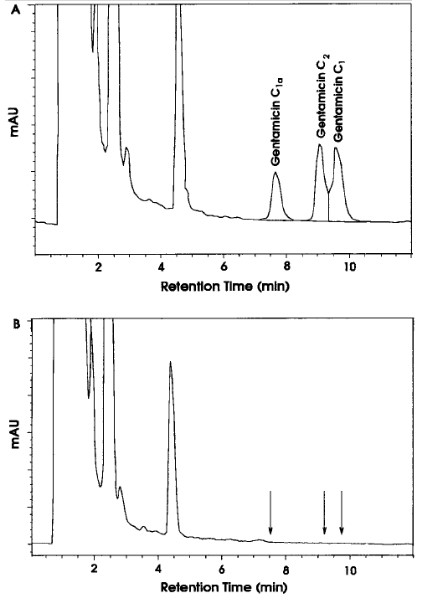 Figure 1. Representative chromatograms of gentamicin from dog plasma 2 h after an intravenous bolus of gentamicin. (Sources: D'Souza J, et al. 1982)
Why Use HPLC?
Clinical laboratories continue to depend on HPLC because it has consistently demonstrated accurate and reliable performance. The method's standardized design and broad acceptance enable its application both in clinical monitoring routines and research environments.
Downsides:
Although HPLC enjoys a strong reputation it still faces multiple practical limitations.
When to Use It:
Labs with sufficient expertise and time can employ HPLC results to confirm that Gentamicin levels fall within therapeutic ranges.
How It Works:
LC-MS combines HPLC separation techniques with mass spectrometry to conduct in-depth analyses of molecular structures. Mass spectrometry detects molecular mass of individual compounds from the HPLC-separated sample to achieve exceptional sensitivity and specificity.
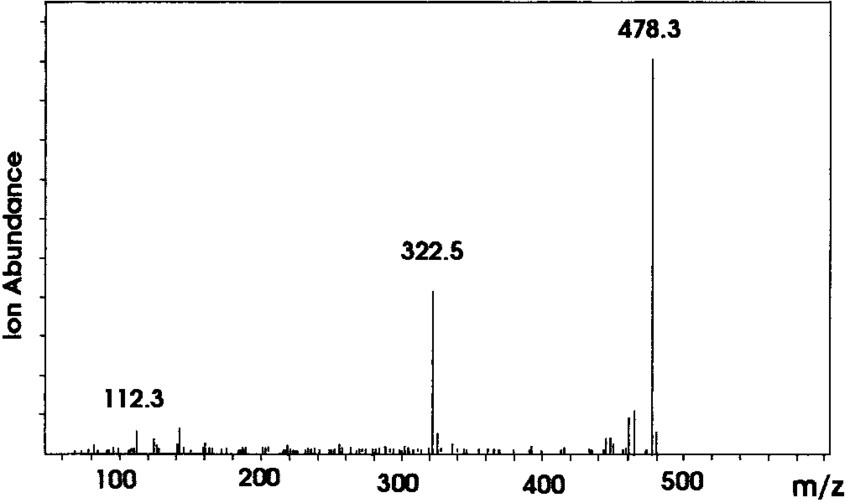 Figure 2. Mass spectrum of gentamicin C1. (Sources: D'Souza J, et al. 1982)
Why Use LC-MS?
The extreme sensitivity of LC-MS makes it essential for detecting Gentamicin levels in patients with renal problems as well as for monitoring multiple drugs at the same time. Polypharmacy cases rely on this technology because it enables simultaneous measurement of multiple medications that patients take.
Downsides:
However, this method isn't for everyone:
When to Use It:
LC-MS stands as the highest standard for achieving precise and sensitive measurements especially when detecting low quantities of Gentamicin or when analyzing multiple drugs in one sample.
How It Works:
Immunoassays work by using specially created antibodies to attach themselves to Gentamicin. The binding event between the antibodies and Gentamicin generates a detectable signal through color change or fluorescence which corresponds to the serum drug level.
Why Use Immunoassays?
Immunoassays deliver quick results at a low cost which makes them perfect for situations requiring immediate outcomes. With only minimal technical expertise required for implementation, immunoassays become accessible to many different healthcare providers.
Downsides:
Immunoassays offer convenience but lack precision in their measurements.
When to Use It:
Immunoassays work well for situations where large numbers of tests must be processed rapidly. In busy hospital settings clinicians require fast feedback to make dose adjustments. These methods fail to deliver the exact results needed for precise applications.
The adjustment of medication dosages becomes essential through regular monitoring of patient serum levels.
After measuring serum levels healthcare providers must then adjust treatment dosages as their next essential action. Clinicians must carefully adjust Gentamicin dosage to maintain therapeutic levels while avoiding toxicity.
Through ongoing monitoring clinicians can optimize treatment by modifying doses based on serum levels to provide patients with optimal drug efficacy and minimal risk.
The direction of Gentamicin monitoring is moving toward solutions for real-time assessment and point-of-care applications. Envision a healthcare system where wearable devices monitor Gentamicin blood levels continuously so clinicians can adjust medication dosages instantly without requiring lab visits. These portable testing kits are expected to deliver precise Gentamicin measurements in just minutes which will revolutionize treatment for patients as well as healthcare providers.
Due to Gentamicin's narrow therapeutic range medical professionals must monitor its levels closely to prevent toxic effects while maintaining its therapeutic benefits. Different clinical situations require specific analytical techniques because HPLC, LC-MS, and immunoassays each offer unique advantages. Certain techniques deliver fast results with ease while other methods achieve unmatched precision and accuracy. The most suitable method is determined by the particular clinical situation.
References
| Target | Cat. No. | Product Name | Host | Isotype | Application | |
| Gentamicin | HMABPY043 | RHA™ anti-Gentamicin monoclonal antibody, clone GM | Mouse | IgG | ELISA, LFIA | Inquiry |
| DPBT-68266SG | Anti-Gentamicin polyclonal antibody | Sheep | IgG | ELISA | Inquiry | |
| DMAB3403 | Anti-Gentamicin monoclonal antibody, clone A104 | Mouse | IgG2a | IA | Inquiry | |
| DMAB3404 | Anti-Gentamicin monoclonal antibody, clone A103 | Mouse | IgG2a | ELISA | Inquiry | |
| DMAB6614 | Anti-Gentamicin monoclonal antibody, clone monoclonal,H5-10 | Mouse | IgG2a | cELISA, IFIA | Inquiry | |
| DMAB6615 | Anti-Gentamicin monoclonal antibody, clone monoclonal, clone CloneH11-18 | Mouse | IgG1a | cELISA, IFIA | Inquiry | |
| DMAB6616 | Anti-Gentamicin monoclonal antibody, clone monoclonal,H17-33 | Mouse | IgG1a | cELISA, IFIA | Inquiry | |
| DMABT-54913MG | Anti-Gentamicin monoclonal antibody, clone HF2 | Mouse | IgG1 | IA | Inquiry | |
| DMABT-54914MG | Anti-Gentamicin monoclonal antibody, clone HF3 | Mouse | IgG1 | IA | Inquiry |
| Target | Cat. No. | Product Name | Expression System | Tag/Conjugate | Application | |
| Gentamicin | DAG4468 | Gentamicin [BSA] | N/A | BSA | N/A | Inquiry |
| DISNJ17 | Gentamicin Sulfate Standard | N/A | N/A | ELISA | Inquiry | |
| DAGA-043K | Gentamicin [KLH] | N/A | KLH | Immunogen | Inquiry | |
| DAGA-032H | Gentamicin [HRP] | N/A | HRP | ELISA | Inquiry | |
| DAG4468O | Gentamicin [OVA] | N/A | OVA | ELISA, LFIA | Inquiry | |
| DAG-WT2703 | Gentamicin control | N/A | Unconjugated | Immunoassays | Inquiry |
| Target | Cat. No. | Product Name | Size | Species | Application | Detection Sample | |
| Gentamicin | DEIA047 | Gentamicin ELISA Kit | 96T | N/A | Quantitative | Vaccine, cell culture | Inquiry |
| DEIA6884 | Gentamicin ELISA Kit | 96T | N/A | Quantitative | serum, plasma, cell lysates, tissue homogenates, and food samples | Inquiry | |
| DEIA-WZ6884 | High Sensitivity Gentamicin ELISA Test Kit | 96T | Quantitative | biological samples | Inquiry |
Loading ......
