Multipotency and cardiomyogenic potential of human adipose-derived stem cells from epicardium, pericardium, and omentum
STEM CELL RESEARCH & THERAPY
Authors: Wystrychowski, Wojciech; Patlolla, Bhagat; Yan Zhuge; Neofytou, Evgenios; Robbins, Robert C.; Beygui, Ramin E.
Abstract
Background: Acute myocardial infarction (MI) leads to an irreversible loss of proper cardiac function. Application of stem cell therapy is an attractive option for MI treatment. Adipose tissue has proven to serve as a rich source of stem cells (ADSCs). Taking into account the different morphogenesis, anatomy, and physiology of adipose tissue, we hypothesized that ADSCs from different adipose tissue depots may exert a diverse multipotency and cardiogenic potential. Methods: The omental, pericardial, and epicardial adipose tissue samples were obtained from organ donors and patients undergoing heart transplantation at our institution. Human foreskin fibroblasts were used as the control group. Isolated ADSCs were analyzed for adipogenic and osteogenic differentiation capacity and proliferation potential. The immunophenotype and constitutive gene expression of alkaline phosphatase (ALP), GATA4, Nanog, and OCT4 were analyzed. DNA methylation inhibitor 5-azacytidine was exposed to the cells to stimulate the cardiogenesis. Finally, reprogramming towards cardiomyocytes was initiated with exogenous overexpression of seven transcription factors (ESRRG, GATA4, MEF2C, MESP1, MYOCD, TBX5, ZFPM2) previously applied successfully for fibroblast transdifferentiation toward cardiomyocytes. Expression of cardiac troponin T (cTNT) and alpha-actinin (Actn2) was analyzed 3 weeks after initiation of the cardiac differentiation. Results: The multipotent properties of isolated plastic adherent cells were confirmed with expression of CD29, CD44, CD90, and CD105, as well as successful differentiation toward adipocytes and osteocytes; with the highest osteogenic and adipogenic potential for the epicardial and omental ADSCs, respectively. Epicardial ADSCs demonstrated a lower doubling time as compared with the pericardium and omentum-derived cells. Furthermore, epicardial ADSCs revealed higher constitutive expression of ALP and GATA4. Increased Actn2 and cTNT expression was observed after the transduction of seven reprogramming factors, with the highest expression in the epicardial ADSCs, as compared with the other ADSC subtypes and fibroblasts. Conclusions: Human epicardial ADSCs revealed a higher cardiomyogenic potential as compared with the pericardial and omental ADSC subtypes as well as the fibroblast counterparts. Epicardial ADSCs may thus serve as the valuable subject for further studies on more effective methods of adult stem cell differentiation toward cardiomyocytes.
Duchenne Muscular Dystrophy and Early Onset Hypertrophic Cardiomyopathy associated with Mutations in Dystrophin and Hypertrophic Cardiomyopathy-Associated Genes
JOURNAL OF PEDIATRIC GENETICS
Authors: Aspit, Liam; Arwas, Noga; Krymko, Hanna; Etzion, Yoram; Parvari, Ruti; Levitas, Aviva
Abstract
Duchenne muscular dystrophy (DMD) is a progressive muscular damage disorder caused by mutations in dystrophin gene. Cardiomyopathy may first be evident after 10 years of age and increases in incidence with age. We present a boy diagnosed at 18 months with a rare phenotype of DMD in association with early-onset hypertrophic cardiomyopathy (HCM). The cause of DMD is a deletion of exons 51-54 of dystrophin gene. The cause of HCM was verified by whole exome sequencing. Novel missense variations in two genes: MAP2K5 inherited from the mother and ACTN2 inherited from the father, or de novo. The combination of MAP2K5, ACTN2, and dystrophin mutations, could be causing the HCM in our patient. This is the second patient diagnosed, at relatively young age, with DMDand HCM, with novel variations in genes known to cause HCM. This study demonstrates the need for genetic diagnosis to elucidate the underlying pathology of HCM.
CD151 expression marks atrial- and ventricular- differentiation from human induced pluripotent stem cells
Communications Biology volume 7, Article number: 231 (2024)
Authors: Misato Nakanishi-Koakutsu, al. (2024).
Abstract
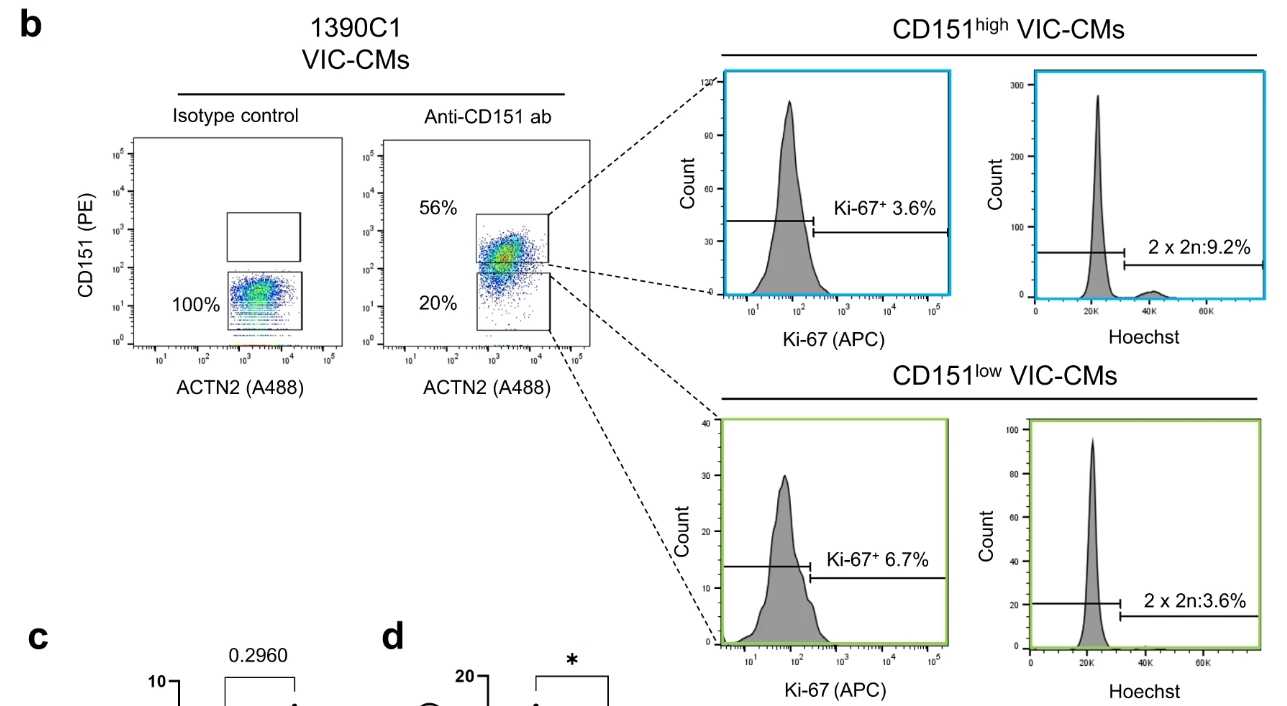
Current differentiation protocols for human induced pluripotent stem cells (hiPSCs) produce heterogeneous cardiomyocytes (CMs). Although chamber-specific CM selection using cell surface antigens enhances biomedical applications, a cell surface marker that accurately distinguishes between hiPSC-derived atrial CMs (ACMs) and ventricular CMs (VCMs) has not yet been identified. We have developed an approach for obtaining functional hiPSC-ACMs and -VCMs based on CD151 expression. For ACM differentiation, we found that ACMs are enriched in the CD151(low) population and that CD151 expression is correlated with the expression of Notch4 and its ligands. Furthermore, Notch signaling inhibition followed by selecting the CD151(low) population during atrial

 COA
COA Publication


 Loading ......


