
Inquiry Basket
 Loading ......
Vitamin B12, also known as cobalamin, is an important nutrient involved in metabolism. As a water-soluble vitamin, it is naturally present in certain foods, added to others, and available in the form of dietary supplements and prescription medications. Vitamin B12 plays an important role in various physiological processes, such as red blood cell formation, cell metabolism, nerve function, and DNA production. A lack of vitamin B12 often leads to problems such as anemia and heart and blood vessel disease.
Vitamin B12 is a complex molecule that comprises a central cobalt atom surrounded by a corrin ring structure. It exists in various forms, including cyano-, methyl-, deoxyadenosyl-, and hydroxy-cobalamin. The cyano form is commonly used in supplements and is found in small quantities in food. The other forms can be converted into the methyl- or 5-deoxyadenosyl forms, which are essential co-factors for important enzymes like methionine synthase and L-methyl-malonyl-CoA mutase.
Methionine synthase is vital for synthesizing purines and pyrimidines. This process relies on methylcobalamin as a co-factor and also requires folate. In this reaction, the methyl group from methyltetrahydrofolate is transferred to homocysteine, resulting in the formation of methionine and tetrahydrofolate. If there is a deficiency in vitamin B12 or any interruption in this reaction, it can lead to the development of megaloblastic anemia. Additionally, megaloblastic anemia can also occur due to a folate deficiency independent of vitamin B12.
Methylmalonyl CoA mutase is another enzyme that plays a crucial role in vitamin B12 metabolism. It converts methylmalonyl CoA to succinyl CoA, with 5-deoxyadenosyl cobalamin acting as a necessary cofactor. A defect in this reaction and the subsequent accumulation of methylmalonyl CoA are believed to be responsible for the neurological effects observed in vitamin B12 deficiency.
To be absorbed by the body, vitamin B12, which is bound to protein in food, needs to be released. The process begins in the mouth, where food mixes with saliva. The liberated vitamin B12 then attaches to haptocorrin, a protein found in saliva. In the stomach, hydrochloric acid and gastric protease further release vitamin B12 from its food source, allowing it to bind with haptocorrin. In the duodenum, digestive enzymes separate vitamin B12 from haptocorrin, and the freed vitamin B12 combines with intrinsic factor, a protein secreted by the stomach's parietal cells that facilitates transport and delivery. This complex is then absorbed in the distal ileum through receptor-mediated endocytosis. However, if vitamin B12 is added to fortified foods or dietary supplements, it is already in a free form and does not require the initial separation step from protein.
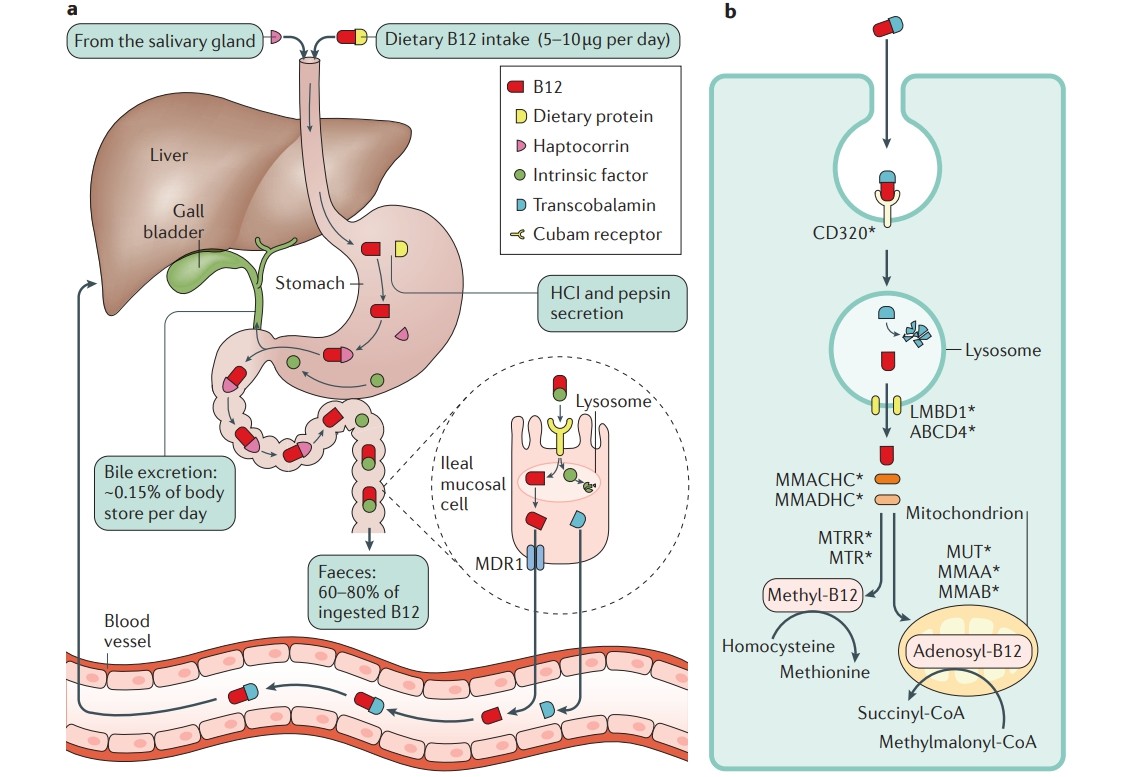 Figure 1. Absorption, enterohepatic circulation and intracellular metabolism of vitamin B12.
(Source: Green, R. et al., 2017)
Vitamin B12 plays a crucial role in maintaining overall health, and deficiencies in this vitamin can lead to various diseases and health conditions.
The measurement of vitamin B12 levels is an important tool in assessing an individual's vitamin B12 status. There are several methods commonly used to measure vitamin B12 levels in clinical practice.
References
| Target | Cat. No. | Product Name | Host | Isotype | Application | |
| Vitamin B12 | HMABPY073 | RHA™ anti-Vitamine B12 monoclonal antibody, clone VB12 | Mouse | IgG | ELISA, LFIA | Inquiry |
| DPATB-H83238 | Anti-Vitamin B12 polyclonal antibody | Rabbit | IgG | ELISA | Inquiry | |
| Folate | DMABT-Z60617 | Anti-Vitamin B9 / Folic acid monoclonal antibody, clone D874H | Mouse | IgG1 | ELISA | Inquiry |
| DPAB-CL013 | Anti-Vitamin B9 / Folic acid polyclonal antibody | Rat | IgG | ELISA: 1/2000 - 1/5000. | Inquiry | |
| DMAB3387 | Anti-Folate monoclonal antibody, clone A9/34 | Mouse | IgG1 | RIA, EIA | Inquiry | |
| DMAB3388 | Anti-Folate monoclonal antibody, clone C763F | Mouse | IgG1 | cELISA | Inquiry | |
| DMAB3390 | Anti-Folate monoclonal antibody, clone C765F | Mouse | IgG1 | cELISA | Inquiry | |
| Homocysteine | CABT-JX102 | Rabbit Anti-Homocysteine Polyclonal Antibody | Rabbit | IgG | ELISA, ICC, IHC, WB | Inquiry |
| DPAB-DC4378 | Anti-Homocysteine polyclonal antibody | Rabbit | IgG | IHC, ELISA | Inquiry |
| Target | Cat. No. | Product Name | Expression System | Tag/Conjugate | Application | |
| MMA | DWT80 | Methylmalonic acid Standard solution | N/A | N/A | Inquiry | |
| DAG3006 | Methylmalonic Acid [HRP] | N/A | HRP | N/A | Inquiry | |
| Homocysteine | DAG3334 | Homocysteine [G-BSA] | N/A | G-BSA | IHC, ICC | Inquiry |
| Target | Cat. No. | Product Name | Size | Species Reactivity | Application | Detection Sample | |
| Vitamin B12 | DEIA280 | Vitamin B12 ELISA Kit | 96T | N/A | Quantitative | food | Inquiry |
| DEIA2541 | Food Vitamin B12 ELISA Kit | 96T | Quantitative | multivitamin tablets, capsules, multivitamin juices, multivitamin jam, grain products, multivitamin sweets | Inquiry | ||
| DEIASL091 | Vitamin B12 ELISA Kit | 96T | Quantitative | cereals, milk, milk powder | Inquiry | ||
| DEIACL6 | CDSimple™ Vitamin B12 Chemiluminescent ELISA Kit | 96T, 192T | Quantitative | Serum | Inquiry | ||
| Folate | DEIACL2 | CDSimple™ Folate & Vitamin B12 Chemiluminescent ELISA Kit | 96T, 192T | Quantitative | Serum, Plasma | Inquiry | |
| DEIACL4 | CDSimple™ Folate Chemiluminescent ELISA Kit | 96T, 192T | Quantitative | Serum | Inquiry | ||
| Homocysteine | DEIABL3 | Homocysteine ELISA kit | 96T | Human | Quantitative | plasma, serum | Inquiry |
| DEIA1724 | Human HCY(Homocysteine) ELISA Kit | 96T | Human | Quantitative | serum, plasma, tissue homogenates, other biological fluids | Inquiry | |
| DEIA3576 | HCY(Homocysteine) ELISA Kit | 96T | Universal | Quantitative | Serum, plasma, tissue homogenates and other biological fluids. | Inquiry | |
| DEIABL3-2 | Homocysteic acid ELISA Kit | 96T | Quantitative | Serum, plasma, tissue homogenates, urine | Inquiry |
Loading ......
