
Inquiry Basket
 Loading ......
The MTT assay is a widely used colorimetric assay that measures cell viability or proliferation. It is a valuable tool in cell biology and is used for various applications, including drug discovery, large-scale screening of anti-tumor drugs, toxicity testing, tumor radiosensitivity testing, and cell proliferation studies.
The MTT assay is a colorimetric assay that measures the viability of cells based on their ability to reduce the yellow MTT (3-(4,5-dimethylthiazol-2-yl)-2,5-diphenyltetrazolium bromide) dye to a purple formazan product. The formazan crystals are then solubilized, and the absorbance is measured using a microplate reader. The amount of formazan product formed is proportional to the number of viable cells in the sample.
The MTT assay is a valuable tool in the field of cell biology. It is used to determine the viability or proliferation of cells in response to various treatments, including drugs, toxic agents, and growth factors. The assay provides a quantitative measure of cell viability or proliferation that can be used in various applications.
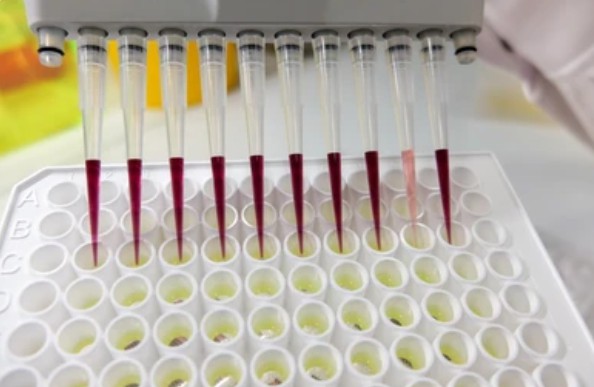 Fig 1. MTT Assay Kits
On this page, we provide a detailed protocol for performing the MTT assay, including instructions for preparing the MTT reagent, preparing the cells, performing the assay, and analyzing the results.
To prepare the MTT solution, it is recommended to dissolve it in PBS to make a 5 mg/mL solution. MTT can also be dissolved in water (10 mg/mL), ethanol (20 mg/mL), or buffered salt solutions and culture media (5 mg/mL). The solution should be vortexed or sonicated to mix it properly. After adding MTT, it is essential to filter and sterilize the solution. The MTT solution should be stored at -20°C, and it is stable for at least 6 months.
Culture the cells in an appropriate medium until they reach the exponential growth phase. Detach the cells from the culture dish using a trypsin-EDTA solution. Count the cells using a hemocytometer or an automated cell counter. Adjust the cell concentration to the desired density using a culture medium.
Plate the cells on a 96-well or 24-well plate and incubate them for a specified period. Add the MTT reagent to each well and incubate for another specified period.
Discard the culture medium and solubilize the formazan crystals using a solvent such as DMSO. The solubilization process can take up to 30 minutes and should be carried out in the dark to prevent formazan crystal breakdown.
Measure the absorbance of the solubilized formazan using a microplate reader. Read absorbance at OD=490 nm and OD 570 nm. Within 1 hour, read the plate.
| Suspension cell assay | For suspension cell detection, cell plating, drug intervention, MTT addition, microplate reader detection, setting zero well, etc. are the same as for adherent cell detection. When adding DMSO, it is necessary to centrifuge the plate first, then carefully suck off the supernatant, and then add DMSO. |
| Cell activity | The collection of cells in the logarithmic growth phase is critical to the experiment outcome. |
| Plank density | The plating density of different cells can be adjusted appropriately. If the cells are small or grow slowly, the plating density can be increased appropriately. |
| Plank uniformity | The cells must be evenly plated, and the cell suspension must be blown evenly, but not shaken to prevent cell death. It is strongly recommended to use a row gun to significantly improve plating efficiency. For every two to three rows, the cells need to be blown again to avoid the influence of cell sedimentation. After the plating is complete, shake the plate back and forth, left and right, to disperse the cells and prevent the cells from agglomerating into clumps. |
| Cell fusion | For drug or material toxicity testing, the degree of cell fusion should be slightly higher, 80-90% is more appropriate. When testing whether cell interventions promote cell proliferation or faster cell growth, a fusion degree of 50-60% is recommended. |
| Observe the MTT color | To ensure the stability of the MTT solution, it should be stored at 0°C and discarded properly if it changes color or forms crystals. In addition, be careful to avoid light when handling. |
| DMSO toxicity | Before using DMSO in the MTT assay, it is important to determine its cytotoxicity to the cells being tested. If DMSO proves to be too toxic, an alternative solution of 0.2% nonidet p-40 (NP-40) and 8 mM HCl in isopropanol can be used to solubilize the formazan. However, if this solution is used, it should be included as a blank in the assay. |
The MTT assay protocol provides a quantitative measure of cell viability or proliferation. The absorbance values obtained from the microplate reader can be used to calculate the percentage of viable cells. The following formula can be used for data analysis:
Cell viability% = (mean absorbance of treated cells / mean absorbance of control cells) x 100%
* Average the duplicate readings for each sample
*The control cells are the untreated cells, and the treated cells are cells exposed to a drug or a toxic agent. The percentage of cell viability can be used to determine the efficacy of a drug or the toxicity of a compound.
Loading ......
