
Inquiry Basket
 Loading ......
Pyruvate Dehydrogenase (PDH) is a key enzyme involved in acetyl coenzyme A synthesis during glycolysis. Here we will explore PDH's structure and function and its importance in cellular metabolism.
PDH (pyruvate dehydrogenase) plays a vital role in glycolysis. Glycolysis breaks down glucose into energy and metabolites. The following describes PDH's role in glycolysis:
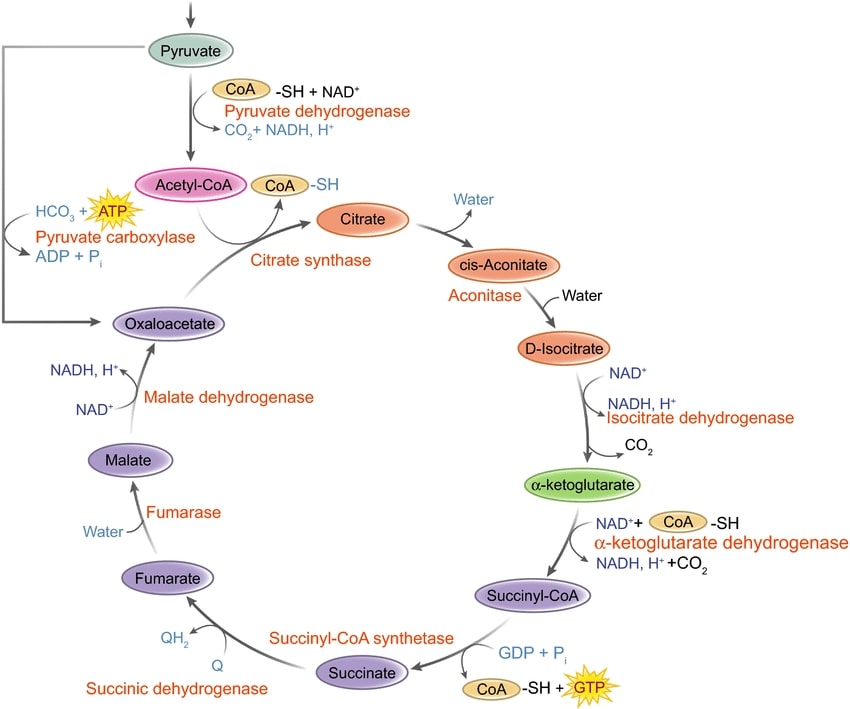 Fig 1. Pyruvate dehydrogenase and the tricarboxylic acid cycle.
(McGuire PJ, et al., 2020)
In conclusion, PDH plays a key role in glycolysis, catalyzing pyruvate conversion to acetyl coenzyme A. This provides the cell with an energy and carbon source and participates in the regulation of energy metabolic processes.
PDH (pyruvate dehydrogenase) is a complex enzyme consisting of several subunits, including three core enzymes: E1 (pyruvate decarboxylase), E2 (carbon dioxide transferase), and E3 (disulfide phosphatase), as well as several auxiliary proteins.
Browse all pyruvate dehydrogenase E1 alpha subunit products
Browse all pyruvate dehydrogenase (lipoamide) alpha 2 products
Browse all pyruvate dehydrogenase (lipoamide) beta products
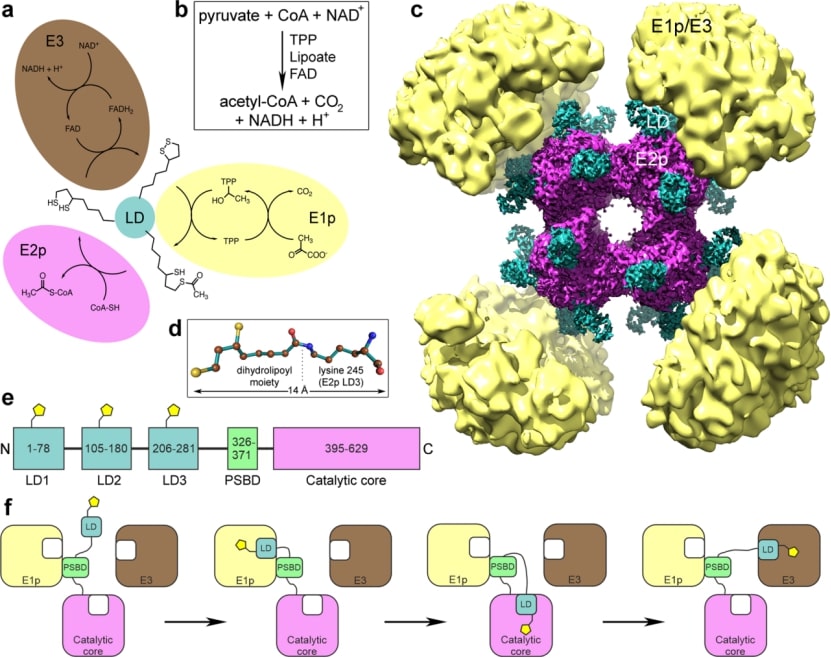 Fig 2. Reaction mechanism and cryo-EM reconstruction of E. coli PDHc.
(Škerlová J, et al., 2021)
In addition to the core enzyme, the PDH complex includes several auxiliary proteins, such as PDH kinase and PDH phosphatase. These proteins regulate the PDH complex activity through phosphorylation and dephosphorylation.
PDH (pyruvate dehydrogenase) has a crucial role in cellular metabolism and the following are some of the aspects of PDH's importance in cellular metabolism:
In summary, PDH has critical roles in cellular metabolism, including energy production, utilization of carbon sources, regulation of cell energy metabolism, and association with metabolic diseases. Studying the structure and function of PDH can help us to understand the basic principles of cellular metabolism and the mechanisms of related diseases. This will provide a theoretical basis for disease prevention and treatment.
References
| Target | Cat. No. | Product Name | Application | |
| PDHA1 | DAG-KO163 | PDHA1 Knockout Cell Lysate | WB | Inquiry |
| Target | Cat. No. | Product Name | Size | Species Reactivity | Application | Detection Sample | |
| PDHa | DEIA-BJ685 | Human PDHα(Pyruvate Dehydrogenase Alpha) ELISA Kit | 96T | Human | Quantitative | Serum, plasma, tissue homogenates, other biological fluids | Inquiry |
| PDHA1 | DEIA-BJ2231 | Rat Pdha1(Pyruvate dehydrogenase E1 component subunit alpha, somatic form, mitochondrial) ELISA Kit | 96T | Rat | Quantitative | Serum, plasma, tissue homogenates, cell culture supernatant, cell culture lysate and other biological fluids. | Inquiry |
| PDHA1 | DEIA-BJ2541 | Mouse Pyruvate Dehydrogenase Alpha ELISA Kit | 96T | Quantitative | Serum, plasma, cell culture supernatants, body fluid and tissue homogenate | Inquiry | |
| PDHA2 | DEIA-FN1097 | Human PDHA2 (Pyruvate dehydrogenase E1 component subunit alpha, testis-specific form, mitochondrial) ELISA Kit | 96T | Quantitative | serum, plasma, cell culture supernatants, tissue homogenate | Inquiry | |
| PDHA2 | DEIA-FN1098 | Rat Pdha2 (Pyruvate dehydrogenase E1 component subunit alpha, testis-specific form, mitochondrial) ELISA Kit | 96T | Quantitative | serum, plasma, cell culture supernatants, tissue homogenate | Inquiry |
Loading ......
