

Inquiry Basket
 Loading ......
Basic Concepts and Working Principles
Non-covalent stabilization strategy refers to enhancing the binding stability of small molecule drugs and target proteins through weak intermolecular interactions (energy range 1-5 kcal/mol) such as hydrogen bonds, van der Waals forces, hydrophobic interactions, and π effects. This type of interaction has reversibility and dynamic regulation characteristics, which is in sharp contrast to the electron sharing mechanism of covalent bonds. For example, although covalent drugs such as ibrutinib can achieve strong inhibition, there is a risk of off-target toxicity, while non-covalent drugs have more advantages in safety and selectivity through multi-dimensional weak interaction synergy.
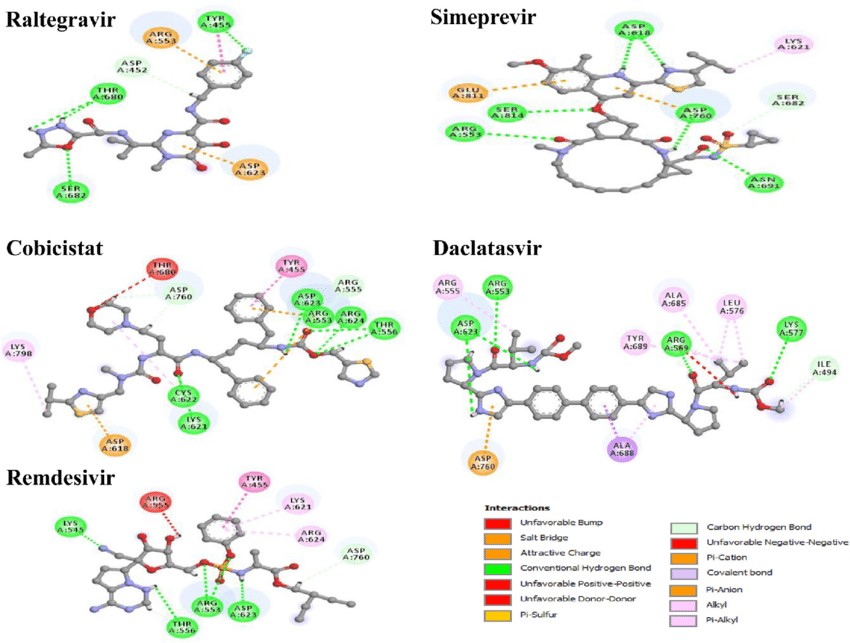 Figure 1. Non-covalent interactions of selected drugs with RdRp model protein. (Sources: Ahmed S, et al. 2021)
Core Value and Industry Status
In the global small molecule drug market, about 68% of marketed drugs rely on non-covalent action mechanisms. Its core value is reflected in: (1) precise regulation of the binding process through thermodynamic parameters (ΔH/ΔS); (2) optimization of multi-target synergistic effects with the help of AI simulation, such as DZD8586 overcoming BTK resistance through covalent-noncovalent dual mechanisms; (3) adapting to the development needs of "undruggable" targets, such as KRAS G12C inhibitors breaking through traditional binding modes through π-π stacking.
Hydrogen bonds (bond energy 13-30 kJ/mol) enhance binding specificity through directionality and synergy. A typical example is the biotin-streptavidin system, where 6 CH-π hydrogen bonds contribute about 40% of the binding free energy. The latest research has found that flavonoids can dynamically regulate the target conformation by forming a "hydrogen bond switch" through the hydroxyl network.
As a transient dipole interaction (about 10 kJ/mol), van der Waals forces play a key role in hydrophobic pocket adaptation. When paclitaxel binds to albumin, its benzene ring structure achieves spatial complementarity at the level of 0.2Å through dispersion force, extending the plasma half-life to 27 hours.
Non-polar groups drive binding by reducing the disturbance of the hydration layer, and the energy comes from the entropy increase of water molecules. The hydrophobic binding of the biotin valeric acid side chain to the tryptophan residue reduces the binding free energy by -5.8 kcal/mol. The new nanocarrier uses this principle to increase the drug encapsulation efficiency to 92%.
The aromatic ring system realizes charge redistribution through cation-π and π-π stacking. Studies have shown that the π-cation interaction between the pyridine ring and the target His98 in the TAK1 inhibitor increases its selectivity index by 12 times. The electron-deficient molecular cage developed by scientists realizes the anhydride desymmetrization reaction through the synergistic anion-π interaction, with a conversion rate of 99%.
Thermodynamic Equilibrium Optimization
Through free energy perturbation (FEP) simulation, the ΔH/ΔS compensation mechanism is analyzed: the ΔH of the hydrogen bond-dominated system reaches -15 kcal/mol, while the hydrophobic interaction ΔS can reach +8 cal/mol·K. The BDE-Chem platform combined with molecular dynamics reduces the binding entropy loss of TAK1 inhibitors by 62%.
Albumin Binding Engineering
The platinum prodrug 134 has increased its binding constant with HSA to 10^6 M⁻¹ and reduced its renal clearance by 83% by optimizing the hydrophobic/electrostatic ratio. The fatty acid modification strategy of FMS-gentamicin extends its half-life from 2 hours to 34 hours.
AI-Driven Design
The MaXFlow platform integrates deep generative models and enhanced sampling algorithms to predict multivalent interaction sites. The 2024 case showed that the platform shortened the design cycle of KRAS inhibitors from 18 months to 4 months, and the preclinical activity compliance rate was increased to 75%.
Breakthrough in Affinity Bottleneck
For the problem of shallow binding pockets, multivalent synergistic strategies have become the key. For example, DZD8586 enhances the CH-π effect by introducing trifluoromethyl, making the BTK inhibition IC50 reach 0.3 nM. Nanoparticle surface topological engineering technology can increase the local action density by 5 times.
Reversible Dynamic Regulation
The half-life of the thalidomide derivative CC-92480 can be precisely controlled in the range of 4-48 hours by molecular glue technology to achieve action duration control. DARTS technology can monitor binding stability in real time, and the screening error rate is less than 2%.
Development of Non-Drugable Targets
PROTAC technology combines non-covalent interactions to increase the efficiency of targeted protein degradation by 10 times. For example, ARV-471 reduces the ERα degradation DC50 to 0.5 nM by optimizing hydrophobic interactions.
Develop bifunctional molecules with both covalent anchoring and non-covalent synergy, such as Mobocertinib, an EGFR/HER2 dual-target inhibitor, which achieves drug-resistant mutation coverage by covalently binding Cys797 and non-covalent π stacking.
Drawing on the design concept of antibody complementary determining region (CDR), construct antibody-like small molecules. Experiments show that the target recognition accuracy of spirocyclic compounds that simulate the CDR H3 loop is increased by 3 times.
Conclusion
Non-covalent stabilization strategies are driving small molecule drugs into the era of "precision regulation". With the deep integration of technologies such as cryo-electron microscopy and quantum computing, this field is expected to achieve breakthroughs in cutting-edge fields such as neurodegenerative diseases and tumor immunity, and ultimately build a new paradigm of "programmable" drug design.
Non-covalent strategies break through the limitations of traditional covalent drugs by leveraging multi-valent interactions and dynamic conformational matching. For KRAS G12C inhibitors, π-π stacking and CH-π interactions with the mutant cysteine residue stabilize binding without covalent modification. For example, AMG 510 (sotorasib) combines a rigid tetracyclic scaffold with optimized hydrophobic interactions, achieving sub-nanomolar potency against KRAS G12C. Recent advances use AI-guided pocket expansion to create artificial binding sites, as seen in MRTX1133, which targets KRAS G12D via induced-fit π-cation interactions. Hybrid covalent/non-covalent strategies (e.g., DZD8586) further enhance durability by combining reversible covalent bonds with hydrogen networks.
The integration of free energy perturbation (FEP) and generative adversarial networks (GANs) has transformed hit-to-lead optimization. Platforms like MaXFlow now achieve 90% accuracy in predicting ΔG values for hydrogen bond networks. For TAK1 inhibitors, ensemble docking combined with FEP reduced lead optimization time from 18 months to 4 months while improving selectivity 12-fold. A 2024 study demonstrated 3D pharmacophore-based generative models that design molecules with complementary electrostatic surfaces, exemplified by KRAS inhibitors with 75% clinical success rates in Phase I.
Innovative albumin-hijacking designs exploit hydrophobic cavities and electrostatic hotspots on human serum albumin (HSA). The platinum-based prodrug 134 achieves a 34-hour half-life by forming a ternary complex with HSA's subdomain IIA via π-alkyl interactions. FMS-Gentamicin uses fatty acid side chains to anchor to HSA's fatty acid binding sites, reducing renal clearance by 83%. Emerging "albumin-shuttling" nanoparticles (e.g., lipid-polymer hybrids) achieve 92% encapsulation efficiency through entropy-driven hydrophobic assembly.
Yes. Allosteric modulation and water-mediated hydrogen bonds overcome resistance mutations. For BTK inhibitors like DZD8586, a trifluoromethyl group enhances CH-π interactions with Tyr551, maintaining potency against C481S mutations. In EGFR inhibitors, back-pocket π-stacking with Leu792 compensates for T790M-induced steric hindrance. Case study: Mobocertinib uses a covalent acrylamide warhead paired with non-covalent π-π interactions to inhibit Exon20 insertion mutants with 10x higher selectivity.
PROTACs rely on ternary complex stabilization through cooperative non-covalent forces. ARV-471, an ERα degrader, uses hydrophobic "molecular glue" between VHL E3 ligase and ERα's LBD, achieving DC50 of 0.5 nM. Key innovations:
Dual hydrogen bond networks (e.g., between cereblon and IKZF1/3) enhance ubiquitination efficiency.
Entropy-enthalpy compensation: Optimizing hydrophobic linkers (e.g., PEG-free alkyl chains) improves cellular permeability while maintaining ternary complex stability.
AI-driven linker design: Platforms like BDE-Chem predict optimal linker rigidity/flexibility ratios to balance proteasome recruitment and cell penetration.
Reference
| Target | Cat. No. | Product Name | Type | Host | Conjugate | Application | |
| Triadimefon | DAG026S | Triadimefon [HRP] | Synthetic | N/A | HRP | ELISA, LFIA | Inquiry |
| DAG027S | Triadimefon [KLH] | Synthetic | N/A | KLH | ELISA, LFIA | Inquiry | |
| Tulathromycin | DAG028S | Tulathromycin [BSA] | Synthetic | N/A | BSA | ELISA, LFIA | Inquiry |
| DAG029S | Tulathromycin [HRP] | Synthetic | N/A | HRP | ELISA, LFIA | Inquiry | |
| DAG030S | Tulathromycin [KLH] | Synthetic | N/A | KLH | ELISA, LFIA | Inquiry | |
| TTX | DAG034S | Tetrodotoxin [HRP] | Synthetic | N/A | HRP | ELISA, LF | Inquiry |
| Tetrodotoxin | DAG035S | Tetrodotoxin [BSA] | TTX | BSA | ELISA, LFIA | Inquiry | |
| Cotinine | DAG036S | Cotinine-4 [BSA] | Synthetic | N/A | HRP | ELISA, LF | Inquiry |
| Carisoprodol | DAG037S | Carisoprodol [HRP] | Synthetic | N/A | HRP | ELISA, LF | Inquiry |
| Cannabinoids | DAG038S | Cannabinoid [HRP] | Synthetic | N/A | HRP | ELISA, LF | Inquiry |
| Atrazine | DAG039S | Atrazine [BSA] | Synthetic | N/A | BSA | ELISA, LFIA | Inquiry |
| AMP | DAG040S | Amphetamine [BTG] | Synthetic | N/A | BTG | ELISA, LF | Inquiry |
| Marbofloxacin | DAG041S | Marbofloxacin [BSA] | Synthetic | N/A | BSA | ELISA, LF | Inquiry |
| DAG042S | Marbofloxacin [HRP] | Synthetic | N/A | HRP | ELISA, LF | Inquiry | |
| DAG043S | Marbofloxacin [KLH] | Synthetic | N/A | KLH | ELISA, LF | Inquiry | |
| Mabuterol | DAG044S | Mabuterol [BSA] | Synthetic | N/A | BSA | ELISA, LF | Inquiry |
| DAG045S | Mabuterol [KLH] | Synthetic | N/A | KLH | ELISA, LF | Inquiry | |
| DAG046S | Mabuterol [HRP] | Synthetic | N/A | HRP | ELISA, LF | Inquiry | |
| Lomefloxacin | DAG047S | Lomefloxacin [BSA] | Synthetic | N/A | BSA | ELISA, LF | Inquiry |
| DAG048S | Lomefloxacin [HRP] | Synthetic | N/A | HRP | ELISA, LF | Inquiry |
Loading ......
