Influenza viruses comprise a family of four distinct viruses: influenza A, B, C and D viruses. Influenza A viruses infect a wide range of host species, whereas the main hosts for influenza B and C are humans, and influenza D virus has thus far been found to infect cattle, goats and pigs. Influenza A virus is a paradigm for an emerging virus. A large and antigenically diverse reservoir of influenza A viruses exists in wild aquatic birds, in which the infection is usually asymptomatic. When a novel influenza virus first accumulates sufficient adaptive mutations to sustain transmission between humans, it may result in a pandemic. During the first pandemic waves, a large proportion of the human population is infected and acquires immunity to the novel virus, but antigenically drifted variants of the pandemic virus emerge and continue to circulate as seasonal influenza virus. Influenza viruses rely on numerous host factors to support their replication. Conversely, restrictive host factors can control or curtail infections. The drivers of host-adaptive evolution are differences in identity and/or expression patterns of these host factors in different species.
Virus genome delivery to the nucleus
After the virus has attached to the cell, it is endocytosed and the decrease in pH within the endosome triggers an irreversible conformational change in HA that initiates a series of events that lead to the release of viral ribonucleoproteins (vRNPs) into the cytoplasm. The virus co-opts host factors to support uncoating, genome release and vRNP transport to the nucleus. vRNPs in transit from the cytoplasm to the nucleus can be targeted by host restriction factors, and unadapted AIVs are particularly susceptible to this block in mammalian cells.
Environmental and physiological factors affecting virus transmission
The final stage of the influenza virus infectious cycle is onward transmission to new hosts. Environmental and physiological factors that differ between animal species may drive adaptations for transmission under different conditions. In humans, transmitted virions must access epithelial cells in the human respiratory mucosa where the pH can be as low as 5.5. This value is close to the pH at which HA is irreversibly triggered to undergo fusion; therefore, it could inactivate the virus prematurely in secretions outside the target cell or in respiratory droplets as they pass from one host to the next. Human seasonal influenza viruses that transmit efficiently through the air have HAs with lower fusion pH than those isolated from poultry or pigs. Under dense housing conditions, as in poultry houses or pig farms, environmental stability of the virion may have a smaller role in onward transmission than in circumstances in which hosts are more disperse. Thus, for both receptor binding and virion stability traits, human-adapting mutations may attenuate AIV pathogenicity.

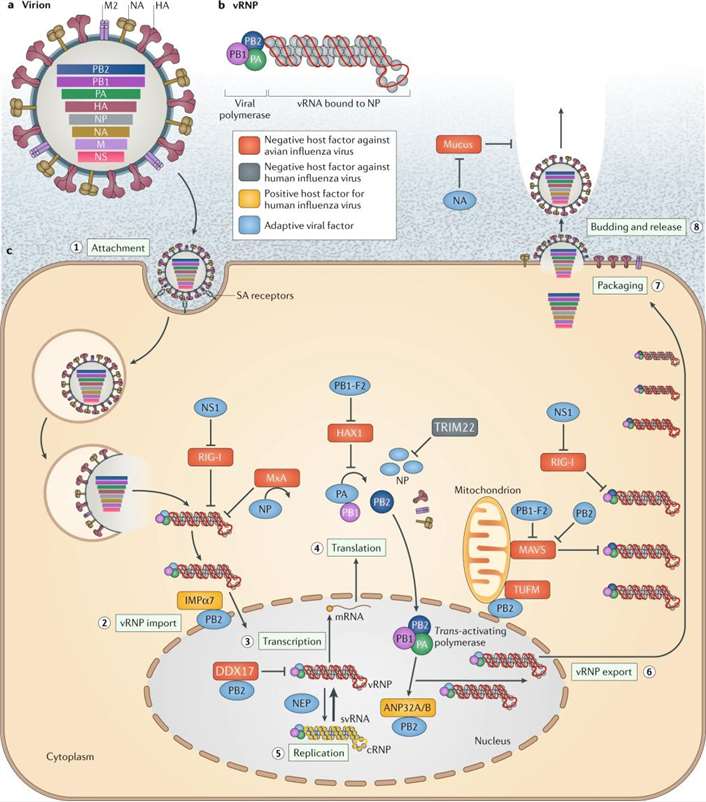 Fig. 1 Virus and host-specific determinants of influenza virus replication. (Long JS, et al., 2019)
 Loading ......
