
Inquiry Basket
 Loading ......
With HIV infection, multiple pathways converge on activated hepatic stellate cells (HSCs), the primary source of collagen in the injured liver, promoting hepatic inflammation andfibrosis. First, HIV-induced depletion of CD4+ T cells relative to CD8+ T cells alters the hepatic cytokine profile, establishing a fibrogenic environment. HIV and/or its envelope protein, gp120, promote direct pro-fibrogenic effects on HSCs, secretion of pro-inflammatory cytokines (such as MCP1) and hepatocyte apoptosis. In vitro, HIV can infect HSCs, sinusoidal endothelial cells and Kupffer cells, the resident macrophages of the liver, but evidence of in vivo infection has been demonstrated most consistently for Kupffer cells. These interactions are relevant for highly viraemic patients, but whether they remain relevant in patients whose infection is controlled by ART is a key question.
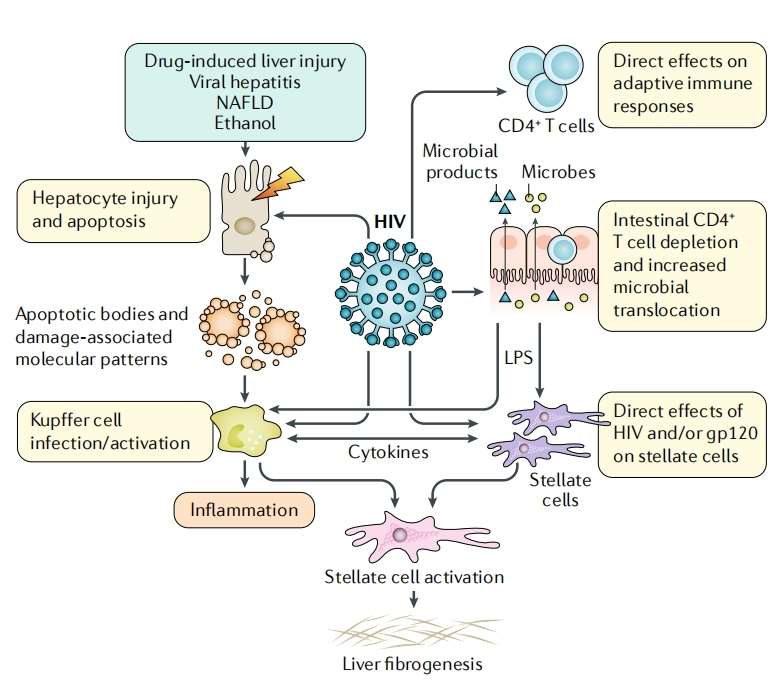 Fig.1 Promotion of hepatic inflammation and fibrosis by HIV in chronic liver disease. (Chamroonkul N, et al., 2019)
Early initiation of ART and advances in the treatment of viral hepatitis have greatly improved liver outcomes in patients with HIV, but some HIV-related alterations are not restored by ART and contribute to poor outcomes despite ART. In particular, persistent CD4+ T cell depletion in the gut and increased gut permeability might be critical factors in promoting microbial translocation and immune activation. Plasma lipopolysaccharide (LPS) levels decrease in patients treated with ART, but they never return to the levels of individuals without HIV.
As our understanding of the effects of HIV on the liver is increasing, attention turns to optimized management. Early initiation of ART and well-tolerated effective treatments for viral hepatitis have informed clear strategies to improve liver disease outcomes in all patients with HIV. This includes universal screening for HBV and HCV infection and treatment of HIV-HCV and HIV-HBV co-infected patients as early as possible with both ART and agents for HCV or HBV, respectively.
Screening for metabolic complications and fatty liver in patients with HIV should become standard of care. Fibrosis is the single greatest predictor for nonalcoholic steatohepatitis (NASH) progression; thus, non-invasive assessments (serum and liver elastography with controlled attenuation parameter) can help differentiate patients with simple steatosis from those with fibrosis, thereby stratifying those in need of confirmatory liver biopsy. Lifestyle modification, weight loss and control of metabolic syndrome, if present, are needed in all patients with NAFLD/NASH. As patients with HIV infection become older and our understanding of the unique features of liver disease in these patients increases, early detection of liver disease is the key to improved clinical outcomes.
| Target | Cat. No. | Product Name | Expression System | Tag/Conjugate | Application | Inquiry |
| HIV gp120 | DAG-B910 | HIV-M2 (gp41+gp120+gp36+O) | E. coli | Unconjugated | IA | Inquiry |
| Target | Cat. No. | Product Name | Size | Species Reactivity | Application | Detection Sample | Inquiry |
| HIV | DEIA064 | Antibody to Human Immunodeficiency Virus(1+2) ELISA Kit | 96T | Human | Qualitative | serum, plasma | Inquiry |
| HIV | DEIA066 | Human Immunodeficiency Virus (1+2) Antigen and Antibody ELISA Kit | 96T | Human | Qualitative | serum, plasma | Inquiry |
| HIV | DEIA2359 | Human HIV 1&2 Ag/Ab ELISA Kit | 96T | Human | Qualitative | serum, plasma | Inquiry |
| HIV | DEIA3571 | Lentivirus Titer Kit, HIV-1 p24 ELISA | 96T | Virus | Quantitative | Tissue culture supernatants | Inquiry |
| HIV | DEIA10155 | HIV-1 p24 ELISA Kit | 96T | Human | Quantitative | Tissue culture supernatants | Inquiry |
| HIV | IVDEIA002 | Human anti-HIV 1+2 ELISA Kit | 96T | Human | Qualitative | serum, plasma | Inquiry |
| HIV | DEIASL616 | HIV-1 gp120 Clade C ELISA Development Kit | 5 x 96T | Human | Quantitative | serum, cell culture supernatants | Inquiry |
Loading ......
