
Inquiry Basket
 Loading ......
To state that the treatment of Crohn's disease and ulcerative colitis was transformed by the arrival of monoclonal antibodies targeting TNF is no exaggeration. Nevertheless, despite considerable advances in our understanding of the optimal use of these drugs in treating IBD, a clear unmet need remains in the form of patients either unresponsive to anti-TNF therapy or those who show initial response but subsequently lose response over time. Two decades after the licensing of the first anti-TNF monoclonal antibody for Crohn's disease, 2016 finally saw the FDA and the European Medicines Agency (EMA) approve therapeutic targeting of a new cytokine with ustekinumab. More specifically, ustekinumab targets a cytokine subunit common to both IL-12 and IL-23.
IL-12 and IL-23 belong to the IL-12 family of cytokines, itself part of the IL-6 superfamily. The IL-12 family comprises four heterodimeric cytokines that share sequence homology, including IL-12 and IL-23, along with IL-35, an anti-inflammatory cytokine produced by regulatory T cells (Treg cells), and IL-27, which promotes TH1 cell differentiation and inhibits TH17 cell differentiation. The corresponding cytokine receptors are themselves heterodimeric, consisting of an IL-12Rβ1 and IL-12Rβ2 chain in the case of IL-12R, and IL-12Rβ1 paired with an IL-23R chain in the case of IL-23R. IL-35 and IL-27 also signal through heterodimeric receptors. Whereas IL-35 signals through a receptor consisting of IL-12Rβ2 and IL-6gp130, or homodimers of either chain, IL-27 signals through a heterodimer of the IL-27-specific receptor chain IL-27Rα and IL-6gp130.
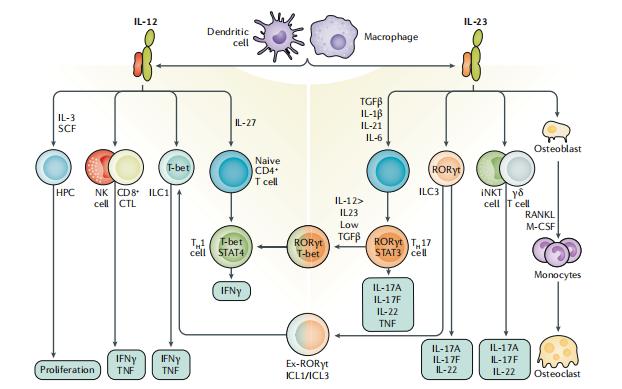 Fig1. Biology of IL-12 and IL-23. (Moschen AR, et al., 2019)
Macrophages and dendritic cells, as tissue sentinels, have a key role in maintaining immune homeostasis in the intestine. This function particularly applies in the context of IBD as demonstrated by the identification of a number of putative key driver genes in IBD that are enriched for macrophage-specific gene signatures. Many agonists of pattern recognition receptors augment the production of both IL-12 and IL-23, by activating the transcriptional regulator C-Rel of the nuclear factor-KB (NF-KB) family and also through epigenetic mechanisms.
Various studies have begun to decipher differential regulators of IL-12 and IL-23 production, and it has become apparent thatspecific microbial ligands signalling through receptors such as Toll-like receptor 2 (TLR2), nucleotide-binding oligomerization domain-containing protein 2 (NOD2), dectin 1 and dectin 2 can favour IL-23 production, as do certain damage-associated molecular patterns such as ATP or prostaglandin E2. The presence of certain cytokines, such as IL-4 or IL-13, enhance the production of IL-12p35, and TH1-cell-derived IFNγ enhances IL-12 production in a positive feedback loop. In vivo, the complex microenvironment of the commensal microbiota drives dendritic cells of the ileal lamina propria towards IL-23 production, and microbes adhering to intestinal epithelial cells such as segmented filamentous bacteria, Citrobacter rodentium or Escherichia coli O157 also preferentially trigger TH17 responses in an IL-23-dependent manner.
IL-12 performs several biological functions, including the differentiation of naive CD4+ T cells into IFNγ-producing TH1 cells, a process dependent on the transcription factors STAT4 and T-bet. IL-12 also acts on haematopoietic progenitors to increase proliferation and colony formation in conjunction with other colony-stimulating factors. Furthermore, IL-12 promotes proliferation and effector functions of NK cells, NKT cells and cytotoxic T cells and drives B cell class-switching to TH1-associated immunoglobulin classes.
In contrast to IL-12, IL-23 does not directly promote TH17 cell differentiation, owing to the absence of the IL-23R on naive T cells. T cell receptor engagement in combination with specific environmental conditions and cytokine signals (including transforming growth factor-β (TGFβ), IL-1 and IL-6) induces a network of transcription factors with retinoid-related orphan receptor-γt (RORγt) as the master regulator that promotes expression of the prototypic TH17 cytokine IL-17A and IL-23R. Interaction of IL-23 with its receptor then activates STAT3, which acts to promote transcription of IL-23R and RORγt, building up a positive feedback loop that stabilizes gene expression required for TH17 cell activation and effector functions.
An important target of both IL-12 and IL-23 are ILCs themselves. Developmentally rooted in the lymphoid lineage, ILCs are an essential, self-maintained component of the innate immune system. ILCs execute important effector functions rendering them key regulators of tissue homeostasis, repair, remodelling, microbial defence and antitumour immunity, particularly in intestinal inflammation. As ILCs possess few sensory elements for the recognition of extrinsic non-self signals, they depend on myeloid cells to translate environmental cues into a cytokine profile that modulates ILC function to further instruct lymphocyte responses.
| Target | Cat. No. | Product Name | Expression System | Tag/Conjugate | Application | Inquiry |
| IL17 | DAGC662 | Biotinylated Recombinant Human IL-17A & 17F Protein [Avi, His] | Mammalian Cells | Avi, His | SDS-PAGE | Inquiry |
| IL23 | DAG-H10325 | Marmoset Interleukin 23 | HEK293 | Unconjugated | ELISA | Inquiry |
| Target | Cat. No. | Product Name | Size | Species Reactivity | Application | Detection Sample | Inquiry |
| IL17 | DEIA7983 | Human Interleukin 17 ELISA Kit | 96T | Human | Quantitative | Serum, plasma, tissue homogenates and other biological fluids | Inquiry |
| IL17 | CKERS-IL17A-217M | Mouse Interleukin 17A, IL17A ELISA Kit | 96T | Mouse | Quantitative | serum, plasma, other biological fluids | Inquiry |
| IL17 | DEIA-FN704 | Hamster IL-17 (Interleukin 17) ELISA Kit | 96T | Hamster | Quantitative | serum, plasma, cell culture supernatants, tissue homogenate | Inquiry |
| IL12 | DEIA-LL283 | Human Interleukin 12 p70 ELISA Kit | 96T | Human | Quantitative | Serum, plasma, tissue homogenates and other biological fluids | Inquiry |
| IL12 | CKERS-IL12-035H | Human Interleukin 12, IL12 ELISA Kit | 10 plates | Human | Quantitative | Inquiry | |
| IL12 | DEIABL347 | IL-12/ IL-23 p40 ELISA Kit | 96T | Human | Quantitative | serum, plasma, cell culture supernatant | Inquiry |
Loading ......
