
Inquiry Basket
 Loading ......
Human parvovirus B19 (B19 virus) is one of the two members of the Parvoviridae family known to be pathogenic to humans. As an important pathogen, the B19 virus can cause diseases such as infectious erythema in children, acute aplastic crisis, fetal edema, and even death. B19 has also been implicated as a causative agent in several clinical syndromes, but given its common nature, causality is often difficult to infer. At present, researchers have made great progress in B19 virus genotypes, genome structure characteristics and replication, virus pathogenesis, and the development of treatment and diagnosis strategies.
Browse all Parvovirus B19 products
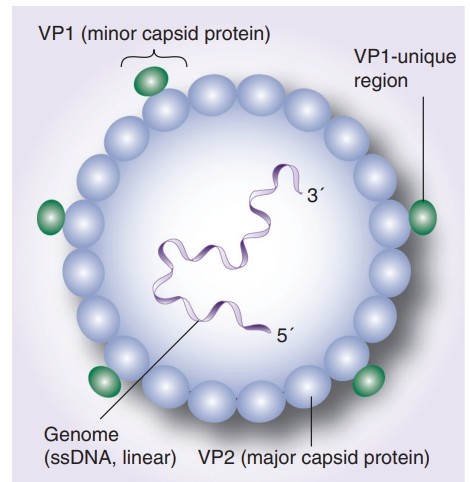 Figure 1. Schematic structure and composition of a parvovirus particle.
(Source: Plentz, A. et al., 2011)
Parvovirus B19 is a small, non-enveloped, single-stranded DNA virus. It is approximately 25 nanometers in diameter and has a characteristic icosahedral capsid structure. The viral genome consists of a linear, single-stranded DNA molecule that encodes two main proteins: the non-structural protein (NS1) and the viral capsid protein (VP1/VP2).
Non-Structural Protein (NS1)
The NS1 protein is a multifunctional protein that is essential for viral replication and modulation of host immune responses. Here are some important characteristics and functions of NS1:
Viral Capsid Protein (VP1/VP2)
The viral capsid protein is responsible for forming the outer shell or capsid of the B19V virion. It encapsulates the viral genome and protects it from degradation. Here are some key aspects of the viral capsid protein:
Globotetraosylceramide (Gb4), also known as the P antigen, is considered to be the primary receptor required for B19V infection. It has been observed that soluble Gb4 and its monoclonal antibodies can block B19V infection, and B19V virus-like particles (VLPs) containing VP1/VP2 can bind to Gb4 in vitro. However, evidence suggests that while Gb4 is necessary for B19V infection, it is not sufficient to sustain the infection. For example, mature human red blood cells (hRBCs), which express Gb4, are not susceptible to B19V infection, and individuals lacking Gb4 can resist B19V infection, indicating the potential involvement of other auxiliary receptors in the viral internalization process.
While early studies proposed integrin α5β1 and Ku80 as potential auxiliary receptors, subsequent research has shown that the expression of Ku80 on the surface of CD36+ endothelial progenitor cells (EPCs) is unrelated to B19V infectivity. Considering the crucial role of VP1u in B19V particle binding and internalization, it is theoretically possible that the B19V receptor exists in an unidentified protein that interacts with VP1u. Recent studies have discovered that Gb4 does not function as a receptor during the viral infection process but is essential for the completion of viral replication after infection. This finding explains the phenomenon observed in earlier studies where Gb4 was necessary for viral infection but not sufficient to sustain it.
References
| Target | Cat. No. | Product Name | Size | Species Reactivity | Application | Detection Sample | |
| Parvovirus B19 | DEIA-XY16 | Parvovirus B 19 IgM ELISA kit | 96T | Human | Qualitative | serum | Inquiry |
| DEIA10283 | Parvovirus B 19 IgG ELISA kit | 96T | Human | Qualitative | serum | Inquiry | |
| XRCC5 | DEIA-XYA1120 | Ku70/80 ELISA Kit | 96T | Qualitative | cultured cells | Inquiry | |
| DEIA-XYA1123 | Ku80/XRCC5 ELISA Kit | 96T | Qualitative | cultured cells | Inquiry | ||
| DEIA-XYA1124 | Ku80/XRCC5 (Phospho-Thr714) ELISA Kit | 2 x 96T | Qualitative | cultured cells | Inquiry | ||
| CD36 | DEIA6943 | Human GP4(Platelet Membrane Glycoprotein IV) ELISA Kit | 96T | Human | Quantitative | Serum, plasma, tissue homogenates and other biological fluids. | Inquiry |
| DEIA5290 | Mouse GP4/CD36(Platelet Membrane Glycoprotein IV) ELISA Kit | 96T | Mouse | Quantitative | Serum, plasma, tissue homogenates and other biological fluids. | Inquiry |
Loading ......
