
Inquiry Basket
 Loading ......
Accurate concentration measurements are essential in many scientific fields, including biochemistry, pharmacology, and clinical research. Concentration conversions are necessary when working with different concentration units or when comparing results from different experiments. Inaccurate concentration measurements can lead to incorrect conclusions or even result in hazardous conditions.
 Fig 1. Converting Concentration Units
There are several concentration units commonly used in scientific research, including molar (M), millimolar (mM), micromolar (μM), and nanomolar (nM). The molar concentration unit measures the number of moles of a substance in a liter of solution, while the other units measure the number of moles of a substance in a milliliter, microliter, or nanoliter of solution, respectively. The conversion factors between the most common concentration units are:
1 M = 1000 mM
1 mM = 1000 μM
1 μM = 1000 nM
The most common units of measurement used in chemistry are mass and moles. Mass refers to the amount of matter in an object, while a mole is a unit of measurement that represents a specified number of atoms or molecules. To convert between units based on mass and moles, it is necessary to know the molecular weight (Mw) of the substance. The molecular weight is the mass of one mole of the substance and can be found in the literature. Knowing the molecular weight allows you to use conversion factors and perform calculations to convert between mass and moles.
We can use the following relationship to convert one of these concentration units to another:
1 g = 1000 mg
1 g = 1 000000 μg
1 L = 1000 mL
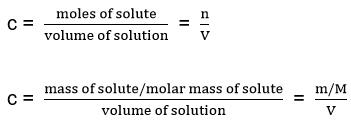
Molar Mass = Mass ÷ Moles (n = m ÷ M), where M = molar mass of the pure substance (measured in g moL-1), m = mass of the pure substance (measured in grams, g).
There are several ways to report the concentration of a solution, which depend on the volume of the solution.
| mass concentration | symbol: m/V or w/v units: g mL-1 or g L-1 |
| mass-volume percentage concentration | symbol: %(m/V) or %(w/V) units: g/100 mL or % |
| parts per million | symbol: ppm units: mg L-1 or μg mL-1 |
| amount of substance concentration (molarity) | symbol: c units: mol L-1 (or M) |
Note: Formula for calculating the quantity of substance concentration (molar concentration):
To convert between units based on mass and moles, you can use a conversion factor that matches the units you are converting from and the units you want to convert to. These conversion factors can be found in the following table, and selecting the correct one allows you to perform accurate conversions between mass and moles.
| M | M | mM | µM | nM | pM |
| g/mL | 103/Mw | 106/Mw | 109/Mw | 1012/Mw | 1015/Mw |
| mg/mL | 1/Mw | 103/Mw | 106/Mw | 109/Mw | 1012/Mw |
| µg/mL | 10-3/Mw | 1/Mw | 103/Mw | 106/Mw | 109/Mw |
| ng/mL | 10-6/Mw | 10-3/Mw | 1/Mw | 103/Mw | 106/Mw |
| pg/mL | 10-9/Mw | 10-6/Mw | 10-3/Mw | 1/Mw | 103/Mw |
Suppose we have a solution with a concentration of 2.5 g/mL of glucose (C6H12O6), and we want to convert it to molarity. The molecular weight of glucose is 180.16 g/mol.
Using the conversion formula, we can calculate the molarity of the solution as follows:
Concentration in M = Concentration in g/mL × (103 / Mw)
Concentration in M = 2.5 g/mL × (103 / 180.16 g/mol)
Therefore, the concentration of the glucose solution is 13.86 M when expressed in molarity.
Note:
When using a kit for an assay, the data may be presented as a concentration in molar units without a corresponding volume, such as nmol/well. To determine the actual concentration, the value must be divided by the volume of solution in the well. The volume loaded into the well can be found in the kit's protocol booklet and will depend on the specific assay. Most microplate wells are loaded with a standard volume of around 50 µL, which is equivalent to 0.05 mL or 5x10⁻⁵ dm3. Knowing the volume loaded into the well allows for the accurate determination of the concentration of the solution.
In conclusion, accurate measurements are essential in scientific research, and understanding the units of measurement is crucial to the success of any experiment. This guide has provided step-by-step instructions on how to convert between units based on mass and moles. Remember to identify the starting measurement and the desired measurement unit, identify the conversion factor, perform the calculation, and adjust the volume of the solution if necessary. By following these instructions and examples, you can ensure accurate measurements and reliable scientific results.
Loading ......
