
Inquiry Basket
 Loading ......
Ewing sarcoma (ES) is a poorly differentiated malignant tumor with small round cells. It accounts for 6% to 8% of all primary bone tumors and is the most common malignant primary bone tumor in children and adolescents. Pain and swelling are the most common early symptoms, followed by nerve root and spinal cord dysfunction. Some patients may have low-grade fever, significantly elevated serum high-density lipoprotein cholesterol and erythrocyte sedimentation rate, and sometimes accompanied by increased white blood cell count and anemia. Lesions can produce larger soft tissue masses. Biopsy is required for diagnosis. Imaging evaluation provides detailed anatomical location, soft tissue infiltration, degree of spinal canal invasion, and distant metastasis. CAL staging was established based on these tumor and surgical factors. ES is mainly distributed in non spinal structures and rarely involves the spine. The incidence rate is 3.5% to 5%.
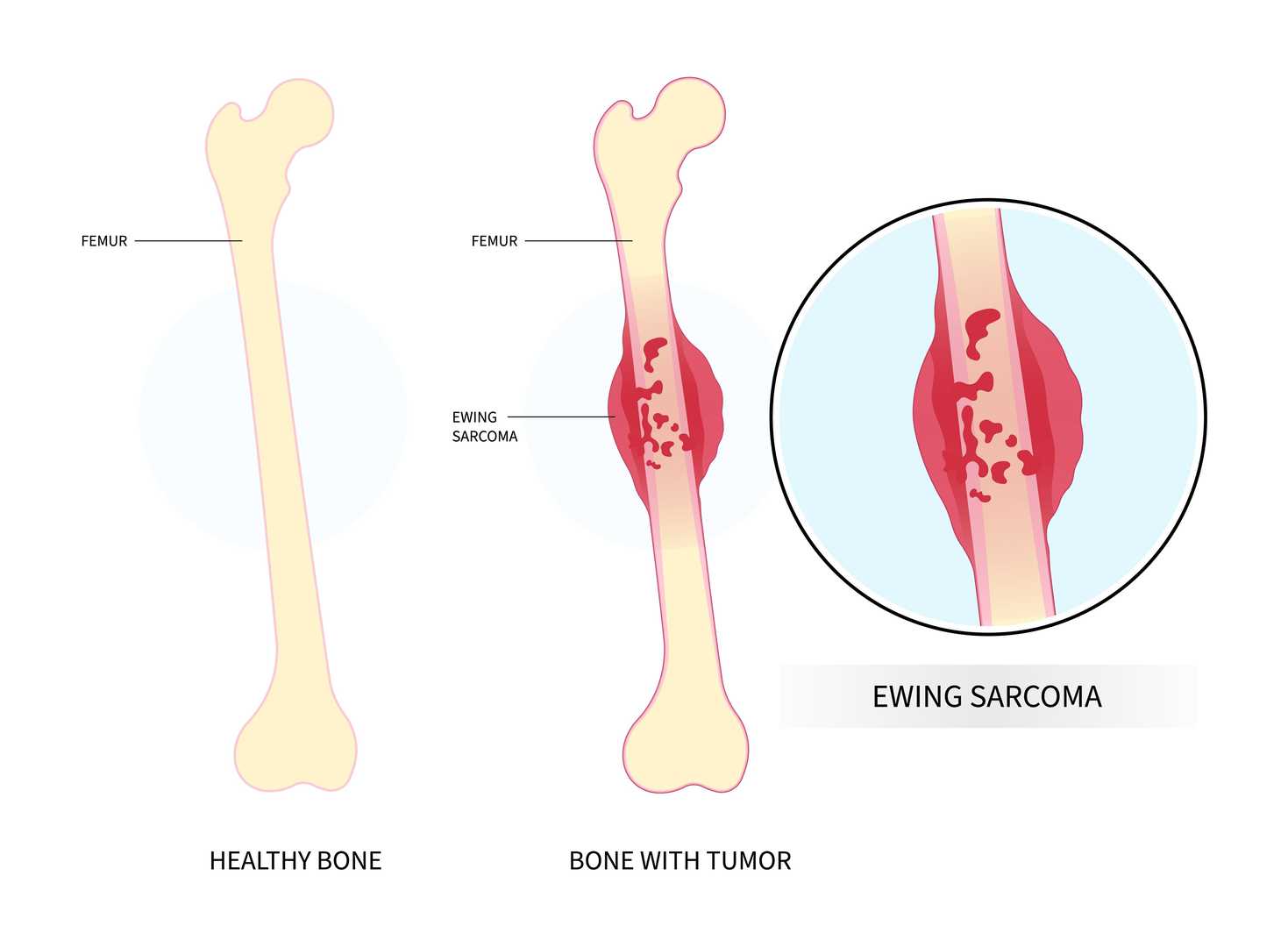 Figure 1. Ewing Sarcoma.
| Symptoms | Descriptions |
|---|---|
| Pain | It is the most common clinical symptom. About 2/3 of patients may experience intermittent pain. The degree of pain varies, initially not severe, but quickly becoming persistent pain; Depending on the location, local pain will spread as the tumor spreads. If it occurs in the pelvic area, the pain can radiate along the lower limbs, affecting hip joint movement; If it occurs near a joint in a long bone, it can result in limping, joint stiffness, and joint effusion. This tumor is rarely accompanied by pathological fractures and is located in the spine. Can cause radiating pain, weakness, and numbness in the lower limbs. |
| Lumps | As the pain intensifies, a local lump appears, which grows rapidly and presents with red, swollen, hot, and painful inflammatory symptoms on the surface. The tenderness is significant, and there may be venous distension on the surface. Sometimes the lump grows rapidly in soft tissue and can grow head by head within 2-3 months. Tumors that occur in the iliac bone can extend into the pelvic cavity and can be felt in the lower abdomen or anus during examination. |
| Systemic symptoms | Patients often have systemic symptoms, such as a temperature rise of up to 38 ℃ to 40 ℃, general discomfort, fatigue, decreased appetite, and anemia. In addition, depending on the location of the tumor, it can also cause other symptoms, such as lesions located at the lower end of the femur, which can affect knee joint function and cause repeated joint effusion; Lesions located in the ribs can cause pleural effusion, etc. |
| Symptoms | Descriptions |
|---|---|
| X-ray examination | There are various manifestations, and the manifestations vary depending on the location of occurrence. |
| Angiography | Angiography is very valuable for diagnosis. 90% of lesions can show increased and dilated blood vessels. |
| CT and MRI examinations | Can effectively determine the extent of tumors and their invasion of soft tissues. MRI shows extensive bone destruction at the tumor site, presenting as a soft tissue mass shadow; Presenting a uniform long T1 signal on the T1 weighted image; It shows a long T2 high signal on the T2 weighted image. On CT, it appears as a soft tissue mass originating from bone tissue, with extensive bone destruction. |
| Nuclear bone scan | Not only can it display the range of the primary lesion, but it can also detect other lesions throughout the body. |
1. Commonly seen in children and adolescents, it is more likely to occur in the long bones and shafts of the limbs.
2. The lump grows rapidly, with local pain and tenderness, skin flushing, high temperature, and superficial vein filling. There may be fever and increased white blood cell count throughout the body. Metastasis to the lungs and other parts may occur.
3. Based on clinical characteristics, combined with X-ray imaging and pathological examination, a clear diagnosis can be made.
The disease has a high degree of malignancy, a short course, and rapid metastasis. Simple surgery, radiotherapy, and monotherapy chemotherapy are not very effective, and the vast majority of patients die within 2 years, with a 5-year survival rate of no more than 10%. In recent years, the use of comprehensive therapy has increased the 5-year survival rate of localized Ewing sarcoma treatment to over 75%.

Surgical treatment: In the past, surgery was the main treatment for this disease. With the improvement of the efficacy of radiotherapy and chemotherapy and the gradual improvement of measures to deal with their side effects, the number of patients treated solely with surgery is decreasing. But so far, surgical amputation or amputation is still one of the treatment methods for this disease. The principle of surgical treatment is to completely remove the tumor in order to achieve effective local control, prevent and reduce tumor metastasis to the maximum extent possible.
Chemotherapy: Currently, drugs believed to be effective against Ewing's sarcoma include cyclophosphamide, doxorubicin, streptomycin, vincristine, and chlorambucil. There are also many joint schemes, and the most effective ones are CVD scheme (CTX+VCR+ACTT+VCDA), CVDA scheme (adding ADM on the basis of CVD scheme), etc. Due to the fact that most cases of metastasis occur within 2 years, it is generally recommended to continue chemotherapy for 2 years.
Female patients without metastasis have a slightly better prognosis than male patients without metastasis, and the younger the age of onset, the worse the prognosis. Most scholars believe that the prognosis is not closely related to the patient's age and gender, and the tumor location is an important factor affecting the prognosis. The prognosis is better for those located in the limbs than those located in the pelvis, sacrum, and other trunk positions. As for limb tumors, those located on the distal side of the limb are better than those located on the proximal side. According to statistics, multi drug combination chemotherapy has a better prognosis than single drug chemotherapy.
Ewing's sarcoma is a malignant and invasive bone cancer that requires a comprehensive and multidisciplinary approach to its diagnosis and treatment. Despite the great advancements in recent years that have led to improved survival rates, further research and development are still necessary in order to establish more effective treatments for patients with metastatic diseases. The current research on targeted therapy, immunotherapy, and personalized medicine for Ewing's sarcoma is a great source of hope, and there is a great potential for these novel approaches to further improve the prognosis and quality of life of the patients diagnosed with this rare disease.
| Cat. No. | Product Name | Host | Isotype | Application | |
| DPAB-DC2357 | Anti-FEV (aa 31-130) polyclonal antibody | Mouse | WB, ELISA | Inquiry | |
| CABT-L3819 | Rabbit Anti-Human MAP3K8 (Phospho-Ser400) polyclonal antibody | Rabbit | IgG | IHC, ELISA | Inquiry |
| CABT-L3487 | Rabbit Anti-Human DDIT3 (Phospho-Ser30) polyclonal antibody | Rabbit | IgG | WB, IHC, IF, ELISA | Inquiry |
| DCABH-3795 | Anti-EWSR1 monoclonal antibody, clone FQS0531 | Rabbit | IgG | WB, FC | Inquiry |
| DCABH-1753 | Anti-EWSR1 monoclonal antibody, clone 6I8 | Mouse | IgG2b | WB, ICC/IF | Inquiry |
| DCABH-11557 | Anti-FEV monoclonal antibody | Rabbit | IgG | WB, ELISA | Inquiry |
| Cat. No. | Product Name | Size | Target | Species | |
| CDBP1169 | Human EWSR1 blocking peptide | 100 g | EWS / EWSR1 | Human | Inquiry |
| DAG-KO132 | MAP3K8 Knockout Cell Lysate | 100 g | Inquiry |
Loading ......
