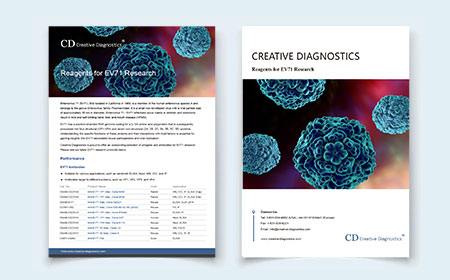
 Reagents for EV71 Research
Inquiry Basket
 Loading ......
Hand, foot and mouth disease (HFMD) is a common, highly contagious viral illness that primarily affects children under 5 years of age. It is caused by a group of enteroviruses, principally enterovirus A71 (EV-A71) and coxsackieviruses A16, A6 and A10 (CV-A16, CV-A6, CV-A10). Most cases are mild, presenting with fever and painful vesicular lesions on the hands, feet, oral mucosa and sometimes buttocks, together with reduced appetite and sore throat. A closely related presentation, herpangina, causes vesicles and ulcers confined to the posterior oral cavity.
HFMD occurs worldwide, but the highest burden is concentrated in East and Southeast Asia, where large outbreaks have been reported for decades. In China, more than 1 million and up to about 2 million cases have been reported annually since 2008, and HFMD consistently ranks among the top three notifiable diseases; a modelling study estimated about 96,900 disability-adjusted life-years per year across eight high-burden Asian countries. Although CV-A16 and CV-A6 cause the majority of generally mild cases, EV-A71 is responsible for nearly all severe and fatal outcomes. EV-A71 is strongly neurotropic and, in a small proportion of infections, causes aseptic meningitis, encephalitis, acute flaccid paralysis, brainstem encephalitis and rapidly fatal neurogenic pulmonary edema, as well as myocarditis and hemorrhage. Infants and toddlers are at greatest risk. Because no specific antiviral drug exists, vaccination is the most effective means of preventing severe HFMD.
EV-A71 is a member of the genus Enterovirus in the family Picornaviridae. It is a non-enveloped, roughly spherical virus about 28-30 nm in diameter, with an icosahedral capsid enclosing a single-stranded, positive-sense RNA genome of approximately 7,400 nucleotides. The genome has one open reading frame flanked by highly structured 5-prime and 3-prime untranslated regions, with a viral protein (VPg) covalently attached to the 5-prime end and a poly(A) tail at the 3-prime end. The 5-prime untranslated region contains a cloverleaf structure followed by an internal ribosomal entry site that drives cap-independent translation.
The RNA is translated as a single large polyprotein that is cleaved by the viral proteases 2A and 3C into three precursor regions. The P1 region yields the four capsid proteins VP1, VP2, VP3 and VP4 (VP4 arising from cleavage of VP0 during virion maturation), while P2 and P3 produce the nonstructural proteins 2A-2C and 3A-3D, including the error-prone RNA-dependent RNA polymerase 3D. The polymerase misincorporates roughly one to two bases per genome copied, which underlies the rapid evolution of enteroviruses. Several host receptors mediate entry, including human scavenger receptor B2 (SCARB2), P-selectin glycoprotein ligand 1 (PSGL-1), DC-SIGN, annexin A2, heparan sulfate and sialylated glycans; SCARB2 is considered the principal receptor.
 Fig. 1 The structure of Enterovirus 71
EV-A71 is divided into three genotypes, A, B and C. Genotype B is subdivided into B1-B5 and genotype C into C1-C5, with C4 further split into C4a and C4b. Different subgenotypes have circulated in the Asia-Pacific region over time; C4 is the most prevalent in China, C1 and C2 in Europe, and B4 and B5 elsewhere. The capsid protein VP1 carries the major neutralization epitopes and is the protein used for serotype identification and phylogenetic analysis, making it the central vaccine antigen.
Amino acid position 145 of VP1 is a key virulence determinant and acts as a molecular switch controlling receptor binding and resistance to neutralization; changes at this site and within the structured 5-prime untranslated region can markedly alter virulence. Because the virus is non-enveloped and the capsid is the principal target, vaccines that present authentic capsid structure elicit the most effective neutralizing antibodies. A theoretical concern for enterovirus vaccine design is antibody-dependent enhancement, in which non-neutralizing antibodies could facilitate viral entry; this has been observed experimentally and reinforces the importance of inducing high-quality neutralizing responses.
The leading EV-A71 vaccines are formalin-inactivated, whole-virus vaccines formulated with aluminum hydroxide. They induce high titers of neutralizing antibodies that bind the capsid and block viral attachment and entry. Protection is therefore primarily humoral and depends on sustained antibody levels, although neutralizing activity shows substantial cross-genotype breadth when the vaccine is based on a carefully selected strain. As with other inactivated vaccines, there is little replicating antigen, so immune memory is driven by repeated exposure and antibody titers gradually wane, particularly within the first months after vaccination.
A defining limitation of current EV-A71 vaccines is their narrow serotype coverage: they protect against EV-A71 but do not cross-protect against the other HFMD-causing enteroviruses, and they are not intended for post-exposure treatment. This has shifted the field toward multivalent vaccines that combine EV-A71 with CV-A16, CV-A6 and CV-A10.
Three inactivated, whole-virus EV-A71 vaccines, all based on the C4 subgenotype, were developed in China and licensed by the National Medical Products Administration (NMPA): the Sinovac (Beijing, China) vaccine (trade name Inlive, Yierlaifu) produced in Vero cells and approved in December 2015; the CAMS (Chinese Academy of Medical Sciences) vaccine grown in human diploid KMB-17 cells and approved in December 2015; and the Vigoo (Beijing, China) vaccine produced in Vero cells and approved in December 2016. Each is given as two doses several weeks apart to children aged roughly 6-35 months (the CAMS vaccine extended to 71 months).
Large phase III trials confirmed high efficacy: 94.8% for Sinovac, 97.4% for CAMS and 90% for Vigoo against EV-A71-associated HFMD, with 100% efficacy against EV-A71 disease involving neurological complications. Effectiveness studies in children under 5 reported complete protection against severe cases and about 80% against mild cases. Long-term follow-up of the Sinovac vaccine showed that immunogenicity persisted for at least five years, although neutralizing titers declined after about six months. In 2019, WHO concluded that the C4a-based EV-A71 vaccine could be used worldwide because of its cross-neutralization of diverse genotypes; the first Sinovac doses were shipped to Indonesia in 2025. The vaccines have not been approved by the US FDA, owing to questions about cross-strain effectiveness and manufacturing quality control at the time of review.
Most EV-A71 development has been led by public-sector institutes and regional manufacturers in the Asia-Pacific, where the disease burden is concentrated; large Western manufacturers have had limited commercial incentive, although early candidates were also evaluated in the United States, and groups in Chinese Taipei, the Republic of Korea, Japan and elsewhere, with WHO coordination, have advanced the field. Beyond the licensed vaccines, a wide range of platforms—virus-like particles, recombinant VP1/P1 proteins, synthetic peptides, live-attenuated strains, DNA and viral vectors, and mRNA—are in preclinical development.
The leading near-term advance is multivalent inactivated vaccines, now a WHO-supported priority. Bivalent EV-A71/CV-A16 vaccines are in clinical trials in the Asia-Pacific, with one candidate showing good safety and immunogenicity in phase II, and a tetravalent vaccine covering EV-A71, CV-A16, CV-A10 and CV-A6 was approved for clinical trials in late 2024. These address the shifting etiology of HFMD, in which non-EV-A71 types now dominate.
 Fig. 2 Multivalent HFMD vaccine pipeline
The licensed inactivated EV-A71 vaccines are a major success, demonstrating over 90% efficacy and essentially complete prevention of the neurological complications and deaths that make HFMD dangerous. Their principal limitation is serotype coverage: they do not protect against the coxsackieviruses that now cause most cases, and antibody titers wane over time. The next generation of bivalent and tetravalent inactivated vaccines, together with VLP, peptide, live-attenuated and mRNA platforms, aims to provide broad, balanced protection against the major HFMD enteroviruses. Continued surveillance of the changing etiology, sustained immunization, and equitable access will be essential to control HFMD outbreaks across Asia and beyond.
References
| Cat. No. | Product Name | Host | Application | |
| DCABY-4415 | Magic™ Anti-EV71 Monoclonal antibody, Clone N23360 | Mouse | LFIA(Cap) | Inquiry |
| DCABY-4414 | Magic™ Anti-EV71 Monoclonal antibody, Clone N23364 | Mouse | LFIA(Det) | Inquiry |
| DCABY-4416 | Magic™ Anti-EV71 Monoclonal antibody, Clone N23350 | Mouse | LFIA(Det) | Inquiry |
| DMAB-CS25169 | Magic™ Anti-EV71 Monoclonal antibody, clone 1112 | Mouse | ELISA(Cap) | Inquiry |
| DMAB-CS25170 | Magic™ Anti-EV71 Monoclonal antibody, clone 1253 | Mouse | ELISA(Det) | Inquiry |
| DMAB-CS23188 | Magic™ Anti-EV71 VP1 Monoclonal antibody, clone IM30 | Rabbit | WB, ICC, IF, ELISA (Cap) | Inquiry |
| DMAB-CS23189 | Magic™ Anti-EV71 VP1 Monoclonal antibody, clone IM39 | Rabbit | WB, ICC, IF, ELISA (Det) | Inquiry |
| Cat. No. | Product Name | Expression System | Application | |
| DAG-EV71 | Inactivated EV71 Antigen | Human diploid cell | ELISA | Inquiry |
| DAG-WT595 | Recombinant EV71 Antigen [GST] | E. coli | LF | Inquiry |
| DAG-WT8277 | Recombinant EV71 Protease 3C Protein [His] | E. coli | ELISA, WB | Inquiry |
| DAG-H10313 | Recombinant EV71 VP0 [His, GST] | Insect cells | N/A | Inquiry |
| DAGA-600 | Recombinant EV71 VP1 [GST] | E. coli | WB, ELISA | Inquiry |
| DAG-WT8276 | Recombinant EV71 VP1 Protein [His] | E. coli | ELISA, WB | Inquiry |
| DAG-WT8061 | Recombinant EV71 VP1 Protein [His] | Insect cells | ELISA, LFIA, WB | Inquiry |
| DAG-WT8062 | Recombinant EV71 VP1 Protein [His] | E. coli | ELISA, LFIA, WB | Inquiry |
| DAGA-601 | Recombinant EV71 VP2 (aa 70-323) [His] | E. coli | Immunogen, WB, ELISA | Inquiry |
| DAGA-602 | Recombinant EV71 VP3 (aa 342-565) [His] | E. coli | Immunogen, WB, ELISA | Inquiry |
| DAGA-603 | Recombinant EV71 VP4 (aa 1-69) [GST] | E. coli | Immunogen, WB, ELISA | Inquiry |
| Cat. No. | Product Name | Species Reactivity | Detection Sample | |
| DEIA081 | EV71 IgM ELISA Kit | Human | serum, plasma | Inquiry |
| DEIA435 | EV71 IgM DOT-ELISA Kit | Human | serum, plasma | Inquiry |
| DEIA3406 | EV71 VP1 ELISA Kit | Human | serum, plasma | Inquiry |
| DEIA3406P | EV71 Antigen ELISA Kit | N/A | Biological products | Inquiry |
| DEIA-XY120 | Enterovirus IgA ELISA Kit | Human | serum, EDTA plasma, heparin plasma, citrate plasma | Inquiry |
| DEIA-XY121 | Enterovirus IgG ELISA Kit | Human | serum, EDTA plasma, heparin plasma, citrate plasma | Inquiry |
| DEIA-XY122 | Enterovirus IgM ELISA Kit | Human | serum, EDTA plasma, heparin plasma, citrate plasma | Inquiry |
Loading ......
