
Inquiry Basket
 Loading ......
Centrifuge immunoblotting is a technique developed by Hermansen et al. to overcome the disadvantages with the downstream steps associated with sodium dodecyl-polyacrylamide gel electrophoresis (SDS-PAGE). This technique alleviates problem, such as low protein recovery, presence of contaminating substances from polyacrylamide gel, fixation and denaturation or blockage of N terminus due to the staining and destaining steps involved, to name a few.
Briefly, the protein samples are prepared and separated by SDS-PAGE as described. Following electrophoresis the gel is soaked in 1 M KCl for 2 min to visualize the protein bands (clear zone against an opaque background). The gel pieces were then used for centrifuge blotting onto the PVDF membranes. PVDF membranes with immobilized proteins could be used for N-terminal sequence analysis or vacuum-dried and stored at −20 °C until further analysis.
Some advantages of centrifuge blotting over the existing techniques are the following: protein concentrations in subnanomolar range can easily be eluted within 1–2 h for Edman degradation. Lack of staining and destaining steps prevents N-terminal blockage, the small size of the PVDF membrane makes it suitable for direct application for microsequencer, and positioning of the dialysis membrane directly beneath the PVDF membrane retains the non-immobilized proteins.
Hettich EBA 3S tabletop centrifuge or Sorvall RC5C automatic superspeed refrigerated centrifuge with fixed-angle SS-34 rotor.
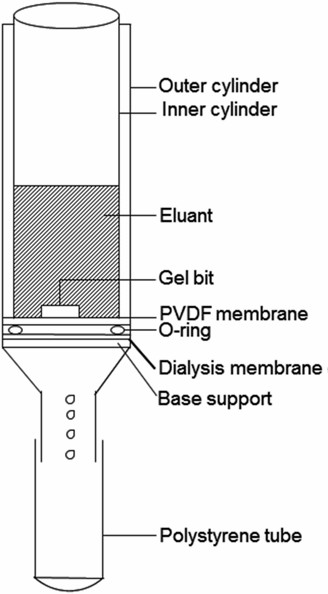 Figure 1. The centrifuge-blotting assembly: The assembly consists of an outer cylinder which supports the whole structure.
Reference
Loading ......
