Specifications
Immunogen
A cell membrane antigen preparation that was isolated from the human pre-B leukemia cell line NALM-1.
Conjugate
Unconjugated (Low endotoxin)
Target
Alternative Names
CD24; CD24 molecule; CD24A; signal transducer CD24; CD24 antigen (small cell lung carcinoma cluster 4 antigen)
Citations
 Publication ()
Have you cited CABT-L2451E in a publication?
Let us know and earn a reward for your research.
CD24 signalling through macrophage Siglec-10 is a target for cancer immunotherapy
Amira A Barkal, Rachel E Brewer, Maxim Markovic, Mark Kowarsky, Sammy A Barkal, Balyn W Zaro, Venkatesh Krishnan, Jason Hatakeyama, Oliver Dorigo, Layla J Barkal, Irving L Weissman
Applications: IA
Reactive species: Mouse
"Abstract: Ovarian cancer and triple-negative breast cancer are among the most lethal diseases affecting women, with few targeted therapies and high rates of metastasis. Cancer cells are capable of evading clearance by macrophages through the overexpression of anti-phagocytic surface proteins called 'don't eat me' signals-including CD471, programmed cell death ligand 1 (PD-L1)2 and the beta-2 microglobulin subunit of the major histocompatibility class I complex (B2M)3. Monoclonal antibodies that antagonize the interaction of 'don't eat me' signals with their macrophage-expressed receptors have demonstrated therapeutic potential in several cancers4,5. However, variability in the magnitude and durability of the response to these agents has suggested the presence of additional, as yet unknown 'don't eat me' signals. Here we show that CD24 can be the dominant innate immune checkpoint in ovarian cancer and breast cancer, and is a promising target for cancer immunotherapy. We demonstrate a role for tumour-expressed CD24 in promoting immune evasion through its interaction with the inhibitory receptor sialic-acid-binding Ig-like lectin 10 (Siglec-10), which is expressed by tumour-associated macrophages. We find that many tumours overexpress CD24 and that tumour-associated macrophages express high levels of Siglec-10. Genetic ablation of either CD24 or Siglec-10, as well as blockade of the CD24-Siglec-10 interaction using monoclonal antibodies, robustly augment the phagocytosis of all CD24-expressing human tumours that we tested. Genetic ablation and therapeutic blockade of CD24 resulted in a macrophage-dependent reduction of tumour growth in vivo and an increase in survival time. These data reveal CD24 as a highly expressed, anti-phagocytic signal in several cancers and demonstrate the therapeutic potential for CD24 blockade in cancer immunotherapy."
Article snippet: Mice were randomized into treatment groups, receiving either anti-CD24 monoclonal antibody (clone SN3, Creative Diagnostics) or mouse IgG1 isotype control (*). 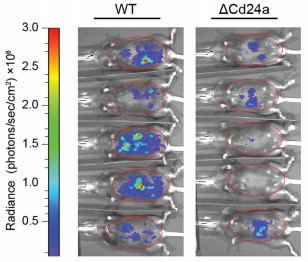 Figure 1. Representative bioluminescence image of tumour burden in C57Bl/6 mice with ID8 wild-type versus ID8(ΔCd24a) tumours
Anti-CD24 Antibody Plus Liposomal Doxorubicin for the Management of Residual Cancers After Incomplete Radiofrequency Ablation
Liu, J., Sun, B., Li, J., Liu, X., Zhang, G., Lei, Z., Zheng, C., & Kan, X.
Applications: IA
Reactive species: Mouse
"Abstract: Background: Achieving a complete radiofrequency ablation (RFA) for a solid malignant tumor of large size or at high-risk locations is challenging. A slow release of doxorubicin by liposomal doxorubicin (L-Dox) in solid tumors can selectively suppress the immune suppressive cells. In this study, the feasibility of using anti-CD24 antibody plus L-Dox was explored to inhibit residual cancers after incomplete RFA (iRFA) of hepatocellular carcinoma (HCC), with an attempt to reduce the tumor recurrences post-RFA.
Methods: The expressions of CD24 protein and sialic-acid-binding lg-like lectin 10 (Siglec-10) in residual cancers after iRFA of human HCC were evaluated. The mice orthotopic HCC models were treated by (1) pseudo iRFA: the ablation electrode was only put in the live tumor but without ablation treatment; (2) iRFA: the tumors only received iRFA treatment; (3) iRFA+anti-CD24 antibody; (4) iRFA+L-Dox; (5) iRFA+anti-CD24 antibody+L-Dox. The treatment effects and the immune microenvironment of treated tumors in each group were assessed and compared.
Results: The CD24 protein and Siglec-10 were highly expressed in the residual cancers (p<0.001). The iRFA+anti-CD24 antibody+L-Dox group had the smallest tumor size and the longest survival time (p<0.001). The anti-CD24 antibody in combination with L-Dox significantly decreased the expressions of CD24 and Siglec-10, significantly promoted the polarization of M2-like tumor-associated macrophages (TAMs) towards M1-like TAMs, significantly reduced the regulatory T cells and myeloid-derived suppressor cells, and significantly increased the infiltrations of natural killer cells and functional CD8+T cells into residual cancers.
Conclusion: The combined therapy of anti-CD24 antibody with L-Dox could significantly improve the suppressive tumor immune microenvironment and result in a strong tumor-killing immunity in residual cancers, which significantly inhibited the residual cancers after iRFA of HCC. These findings may lead to a new strategy of enhancing the curative efficacy of RFA for large-sized HCC or HCC at high-risk locations."
Article snippet: iRFA+anti-CD24 antibody group: tumors were subjected to iRFA, followed by intraperitoneal injection of anti-CD24 antibody (50 μg at day 0, and 200 μg at days 2, 4, 6 after treatment, clone SN3, Creative Diagnostics, New York) in 100 μL phosphate buffered saline (PBS)  Figure 1. The effect of anti-CD24 antibody plus L-Dox on residual cancers after iRFA of HCC.

 COA
COA


 Loading ......

