
Inquiry Basket
 Loading ......
Basal cell carcinoma, also known as basal cell epithelial tumor, is a malignant tumor originating from basal cells. This disease is more common in elderly people and is more likely to occur in areas such as the head, face, neck, and back of the hand that have been exposed to sunlight for a long time. The course of the disease is usually slow, with a low metastasis rate, mostly belonging to low-grade malignant tumors, and the prognosis is generally good. The typical symptoms of basal cell carcinoma are non inflammatory pale yellow brown or light gray white, waxy nodules, hard in texture, and the epidermis generally does not rupture. As the condition progresses, some skin lesions may develop erosions, scabs, or bleeding in the central area, forming ulcers with raised edges and uneven surfaces. Some skin lesions will spread superficially to the surrounding skin, heal on their own and form scars, while others may form corrosive ulcers. Accompanying symptoms may include skin peeling and erosion, as well as pus and foul odor during infection.
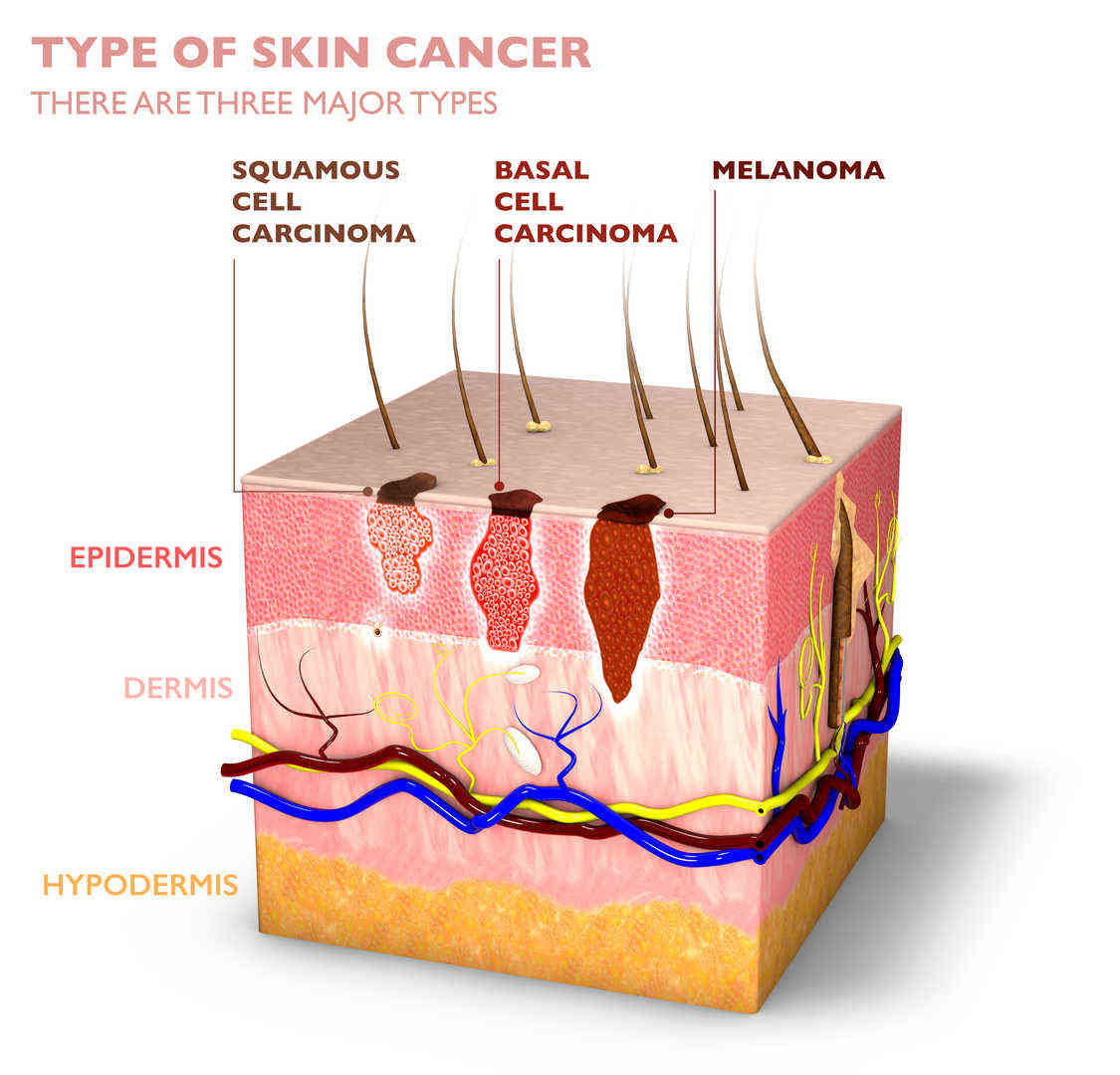 Figure 1. Type of skin cancer.
The treatment methods for basal cell carcinoma include drug therapy, surgical treatment, radiotherapy, chemotherapy, and traditional Chinese medicine treatment. Surgical treatment is a common method, and different surgical approaches are adopted according to the size of the tumor diameter. Radiotherapy and chemotherapy are suitable for patients with specific conditions. Traditional Chinese medicine treatment can compensate for the shortcomings of other treatments, but it needs to be carried out under the guidance of a physician. The prognosis of basal cell carcinoma is related to tumor staging, local damage, and timely treatment. If the treatment is standardized and timely, the cure rate is higher. If not treated in a timely manner, it will develop into a late stage and be difficult to cure. Therefore, early detection and treatment are crucial for improving the cure rate. Meanwhile, postoperative care and rehabilitation are also crucial, including preventing infections, maintaining skin cleanliness, and supplementing vitamins.
| Disease Type | Details |
| Nodular type | Commonly found on the face, nodular basal cell carcinoma is the most common type, initially appearing as small gray white and hard nodules that slowly enlarge and ulcerate, surrounded by pearl shaped inward curled raised edges. Nodular basal cell carcinoma may exhibit invasive enlargement or deep growth, damaging the eyes and nose, and invading the dura mater. |
| Shallow type | Commonly occurring in the trunk, superficial basal cell carcinoma is one or several mildly invasive red patches with clear boundaries and slow expansion. Often wrapped around a fine pearl like edge, with small superficial ulcers and scabs visible on the surface. Smooth atrophic scars remain after healing. |
| Type of hard spot disease | Often solitary on the head and face, the type of hard spot disease is a flat or mildly atrophic yellow white waxy hardening plaque, without raised edges, ulcers, or scabs. |
| Cystic type | Cystic basal cell carcinoma is a transparent, dome shaped, blue gray cystic nodule. |
| Pinkus fibroepithelial tumor type | Prone to occur on the back, it is a smooth surface, hard and elevated nodule. |
Basal cell carcinoma is a malignant tumor originating from basal cells, which is closely related to sunlight exposure. Long term exposure to sunlight on the skin of the head, face, neck, or back of the hand may lead to skin cell carcinogenesis.
The specific cause is unknown, but research has shown that its occurrence may be related to gene mutations or abnormal cell proliferation ability.
The most common triggering factor for basal cell carcinoma is exposure to ultraviolet radiation, which also includes ionizing radiation, arsenic exposure (through water, medication, or diet), immune suppression, organ transplantation, and so on. In addition, basal cell carcinoma may be related to scars, such as surgical scars and burn scars. Basal cell carcinoma is also associated with many hereditary cancer syndromes, such as Rombo syndrome and nevus like basal cell carcinoma syndrome.
The treatment goal of basal cell carcinoma is to completely remove the skin tumor while preserving its appearance and function. The treatment principle is to choose the best treatment plan based on the patient's condition.
Drug Therapy
Drug therapy for basal cell carcinoma should be limited to small-scale basal cell carcinoma in superficial or low-risk areas, such as retinoids, 5% fluorouracil cream, and imiquimod cream.
Surgical Treatment
Surgical treatment is a common treatment method for basal cell carcinoma. If the skin lesion is located in a special area or if the invasive ulcer is severe and other treatments are ineffective, treatment can be carried out.
Preoperative surgery should be performed based on the patient's clinical examination results to estimate the extent and level of cancer invasion. Surgical resection has a high cure rate, fast healing, and small scars. After surgery, it is necessary to do a good job of nursing and rehabilitation to prevent infection.
Basal cell carcinoma is the most common type of skin cancer, mainly caused by chronic ultraviolet radiation. Although it usually has low risk and is rarely transmitted, if left untreated, it may cause serious local damage. Early detection through regular skin examinations and timely treatment with surgical resection or Mohs surgery can lead to a good prognosis. By developing sun protection habits and avoiding excessive UV exposure, individuals can significantly reduce their risk of developing basal cell carcinoma. Understanding the etiology, symptoms, and treatment options of BCC is crucial for promoting skin health and preventing long-term complications of this common disease.
| Cat. No. | Product Name | Host | Isotype | Application | |
| DPAB-DC2857 | Anti-SHH (aa 181-280) polyclonal antibody | Mouse | / | WB, ELISA | Inquiry |
| DPAB-DC2877 | Anti-BMP2 (aa 283-396) polyclonal antibody | Mouse | / | WB, ELISA | Inquiry |
| DPAB-DC3615 | Anti-PTCH2 (aa 79-188) polyclonal antibody | Mouse | / | WB, ELISA | Inquiry |
| DPAB-DC3246 | Anti-FZD5 polyclonal antibody | Mouse | / | WB, ELISA | Inquiry |
| DPAB-DC3284 | Anti-FZD3 polyclonal antibody | Goat | / | ELISA | Inquiry |
| DPAB-DC3285 | Anti-FZD3 (aa 55-157) polyclonal antibody | Mouse | / | WB, ELISA | Inquiry |
| Cat. No. | Product Name | Size | Species Reactivity | Application | Detection Method | |
| CKERS-BMP2-002H | Human Bone Morphogenetic Protein 2, BMP2 ELISA Kit | 10 plates | Human | Quantitative | Sandwich ELISA | Inquiry |
| Cat. No. | Product Name | Size | Target | Species | |
| CDBP2738 | Human SMO blocking peptide | 100 g | SMO (C Terminus) | Human | Inquiry |
| CDBP2739 | Human SMO blocking peptide | 100 g | SMO (internal) | Human | Inquiry |
Loading ......
