
Inquiry Basket
 Loading ......
Cell death, like cell growth, differentiation, and proliferation, is a normal part of cell life activities. There are many factors that cause cell death. The internal cause usually refers to the natural death caused by aging, while the external cause refers to the damage caused to the cell by various factors in the external environment exceeding the strength and threshold of the cell. According to different modes of cell death, it can be divided into two types: necrosis and apoptosis. A comprehensive understanding of the different ways cells can die is necessary to develop effective treatments for diseases like cancer.
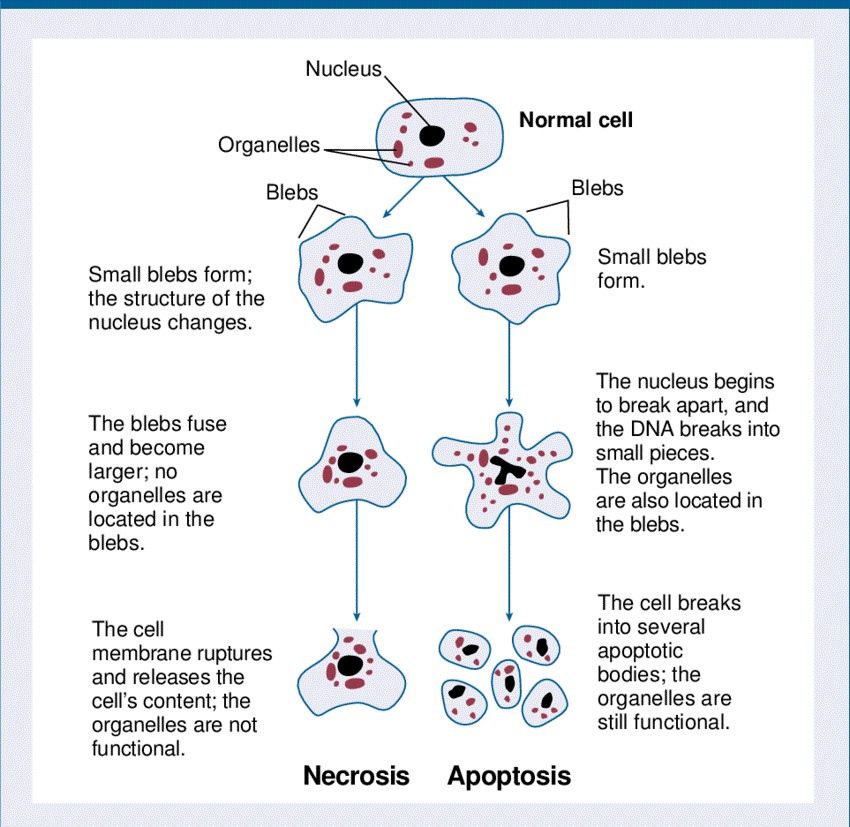 Fig. 1 Structural changes of cells undergoing necrosis or apoptosis. (Goodlett C R, et al., 2001)
Necrosis is the process of irreversible cell damage and eventual cell death caused by pathological processes, including hypoxia, physical factors, chemical factors, biological factors, and immune response. According to its microscopic and macroscopic manifestations, necrosis can be divided into coagulation necrosis (ischemia is the main cause), liquefaction necrosis (mainly in the central nervous system), caseous necrosis (mainly in tuberculosis infection), gangrenous necrosis (mainly in limb ischemia), fat necrosis (mainly in acute pancreatitis), and fibrinoid necrosis (mainly in blood vessels).
It is uncontrolled cell death manifested by swelling of organelles and damage to the plasma membrane, eventually leading to cell lysis and spillage of cellular contents into surrounding tissue, which in turn damages the tissue. Different from the programmed death-apoptosis generated by internal signals, necrosis is mainly caused by overwhelming harmful stimuli from the outside world. This stimulation includes the release of heat shock proteins produced by inflammatory responses, the release of urea, ATP, DNA, and nuclear proteins, leading to the activation of inflammasomes and the release of pro-inflammatory cytokines. Typical types of necrosis are not related to the metabolism and activation of caspases, but other types of necrosis such as necroptosis, pyroptosis, and ferroptosis are associated with the activity of caspases, kinases, and polyubiquitination.
Apoptosis is a highly regulated form of cell death that is essential for many homeostatic and pathological processes. The morphology of apoptosis is characterized by cell membrane blebbing, cell shrinkage, and the formation of apoptotic bodies. Apoptosis is primarily initiated by signals generated within the cell itself. It is an essential part of the cell cycle and is mediated by caspases, enzymes present in all cells. In addition, certain stimuli, such as hypoxia, immune responses, high temperature, and exposure to specific chemicals, can induce apoptosis.
Apoptosis can usually proceed through three different pathways, namely the extrinsic pathway, the intrinsic pathway, and the endoplasmic reticulum (ER) stress-induced pathway. The extrinsic pathway is triggered by ligand binding to transmembrane death receptors, such as tumor necrosis factor receptor 1 (TNFR1) and Fas receptor (FasR). The intrinsic pathway, also known as the mitochondrial pathway, involves the release of cytochrome c from the mitochondria to the cytoplasm in response to cellular stress, where cytochrome c interacts with apoptotic protease activating factor-1 (Apaf-1) to form apoptosomes. In the ER stress pathway, infection, hypoxia, starvation, chemical factors (such as tunicamycin\BrefeldinA), and unsteady changes in the secretion function of the ER result in the accumulation of unfolded or misfolded proteins in the ER, which promotes endoplasmic reticulum stress-induced cell death. An unfolded protein response (UPR) pathway is also initiated when protein misfolding occurs in the ER. Other pathways that induce apoptosis include mitotic disorders (MC) and anoikis.
Proteins associated with necrosis
Proteins associated with apoptosis
Creative Diagnostics is dedicated to the research and development of high-quality proteins, antibodies, and ELISA kits. We offer a range of proteins related to necrosis and apoptosis. These proteins can be valuable tools for studying and understanding the mechanisms of cell death processes.
Understanding the mechanisms and characteristics of necrosis and apoptosis is vital for various fields of research and applications.
References
Loading ......
