
Inquiry Basket
 Loading ......
Spinosad, also known as spinosyn, is a macrolide-based pollution-free and highly efficient biological pesticide extracted from the fermentation broth of Saccharopolyspora spinosa. The spinosad-producing parent strain of the soil actinomycete Saccharopolyspora spinosa was originally isolated from an abandoned brewery in the Caribbean.
Spinosyn is a light gray-white crystal with an odor similar to that of slightly stale earth. The melting point of spinosad type A is 84°C ~ 99.5°C, and type D is 161.5°C ~ 170°C. The density is 0·512g/cm3 (20℃). Spinosad has very low solubility in water and is easily soluble in organic solvents, such as methanol, ethanol, capronitrile, acetone, dimethyl sulfoxide, dimethylformamide, etc. Its pH value in aqueous solution is 7.74, and it is relatively stable against metals and metal ions within 28 days. The shelf life of the formulated product is 3 years. It is degraded in the environment through a combination of pathways, mainly photodegradation and microbial degradation.
Spinosad, also known as spinosyn or spinosyn and erythritol, is a secondary metabolite produced by the soil actinomycete Saccharopolyspora spinosum after aerobic fermentation in culture media. From a structural point of view, these compounds belong to macrolides, which are a unique tetranuclear ring system composed of 21 carbons, and are connected to two different six-membered sugars through glycosidic bonds, one is β-D- Fuller amino sugar, one is α-L-2,3,4-trioxymethylrhamnose, the difference between spinosad D and spinosad A lies in the group on C6, the group connected to spinosad D is a methyl group, while spinosyn A is connected to a hydrogen. Since the first mg-level spinosad fermentation product was characterized in 1988, more than 30 secondary metabolites have been found in spinosad fermentation broth. The two most active components are a mixture of spinosad A and D. Known as spinosad. Among them, spinosad A component accounts for about 85~90%, and spinosad D component accounts for about 10~15%. The new spinosad product is derived from the same actinomycete species as the first-generation spinosad, which is a mixture of spinosad A and spinosad D, but the newly available second-generation spinosad the ingredients of biocides are not disclosed in the products.
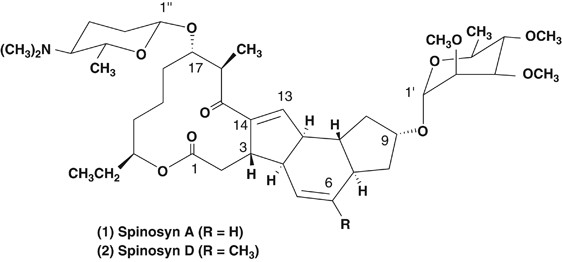 Figure 1. Structures of spinosyn A and spinosyn D. (Kirst HA. et al.; 2010)
The mechanism of action of spinosad is very novel and unique. It is different from general macrolide compounds. Its unique chemical structure determines its unique insecticidal mechanism. Spinosad has rapid contact and feeding toxicity to insects. It has poisoning symptoms unique to nerve agents. Its mechanism of action is to stimulate the nervous system of insects and increase their spontaneous activity, leading to non-functional muscle contraction and failure, accompanied by Tremors and paralysis show sustained activation of nicotinic acetylcholine receptors (nChR) resulting in a prolonged release of acetylcholine (Ach). Spinosyn also acts on the gamma-aminobutyric acid (GAGB) receptor, changing the function of GABA-gated chloride channels and further promoting its insecticidal activity.
Spinosad's high selectivity for beneficial insects makes it an attractive pesticide in integrated pest management. Studies have shown that spinosad can be rapidly absorbed and extensively metabolized in rats, dogs, cats and other animals. It is reported that within 48 hours, 60% to 80% of spinosyn or its metabolites are excreted through urine or stool. Spinosyn has the highest content in the adipose tissue of animals, followed by liver, kidney, milk and muscle tissue. The residual amount of spinosyn in animals is mainly metabolized through N2 demethylation, O2 demethylation and hydroxylation. Additionally, spinosad was previously thought to be highly toxic to bees, but recent field trials have demonstrated that spinosad has minimal effects on bees under actual use conditions. Mammalian chronic toxicity experiments have proven that spinosad is not carcinogenic, mutagenic, teratogenic or neurotoxic.
Spinosyn itself is widely used due to its low toxicity, but its inherent toxicity and residue make its detection necessary. Currently, there are various methods for detecting the presence and concentration of spinosad in samples, including biological methods, physicochemical methods, and immunological methods. Here are some common spinosyn testing methods:
High Performance Liquid Chromatography (HPLC): HPLC is a physicochemical method that separates and detects components in a sample. This method is fast, accurate and reproducible, and is suitable for the determination of spinosad content.
Liquid Chromatography-Mass Spectrometry (LC-MS): LC-MS combines liquid chromatography and mass spectrometry technologies to provide higher resolution and specificity. It is often used for qualitative and quantitative analysis of spinosad.
Biosensing: Use biosensing, such as biosensors, to detect the presence of microorganisms, enzymes, or other organisms by monitoring their response to spinosad.
Immunoassay: Immunological methods include ELISA (enzyme-linked immunosorbent assay), immunochromatography, immunoelectrophoresis, etc. ELISA is one of the most commonly used methods.
Reference
| Target | Cat. No. | Product Name | Expression System | Tag/Conjugate | Application | |
| Spinosad | DAG-WZ1054B | Spinosad [BSA] | N/A | BSA | ELISA, LFIA | Inquiry |
| DAG-WZ1054O | Spinosad [OVA] | N/A | OVA | ELISA, LFIA | Inquiry | |
| GABA | DAG3309 | GABA (Gamma-Aminobutyric acid) [BSA] | N/A | BSA | IHC, ICC | Inquiry |
| Target | Cat. No. | Product Name | Size | Species Reactivity | Application | Detection Sample | |
| Spinosad | DEIA6870 | Spinosyn ELISA Kit | 96T | N/A | Qualitative, Quantitative | N/A | Inquiry |
| GABA | DEIA05749 | GABA ELISA Kit | 96T | Quantitative | plasma, serum, urine. | Inquiry | |
| DEIASL174 | Gamma-aminobutyric acid (GABA) ELISA Kit | 96T | Quantitative | Stool | Inquiry | ||
| GABARAP | DEIA-LL140 | Human GABARAP ELISA Kit | 96T | Human | Quantitative | Serum, plasma, tissue homogenates and other biological fluids | Inquiry |
| GABARAPL1 | DEIA-LL141 | Human GABARAPL1 ELISA Kit | 96T | Human | Quantitative | Serum, plasma, tissue homogenates and other biological fluids | Inquiry |
Loading ......
