

Inquiry Basket
 Loading ......
Methotrexate stands as a fundamental anticancer medication which oncologists use in their practice today. The treatment method which doctors developed many years ago remains essential for multiple cancer types because doctors use it to start patient care or combine it with other medications. Methotrexate shows clinical value in cancer therapy because it treats various cancer types and medical professionals still use this medication in their practice.
The article provides an evidence-based review of methotrexate-treated cancers which focuses on treatment principles instead of basic drug information.
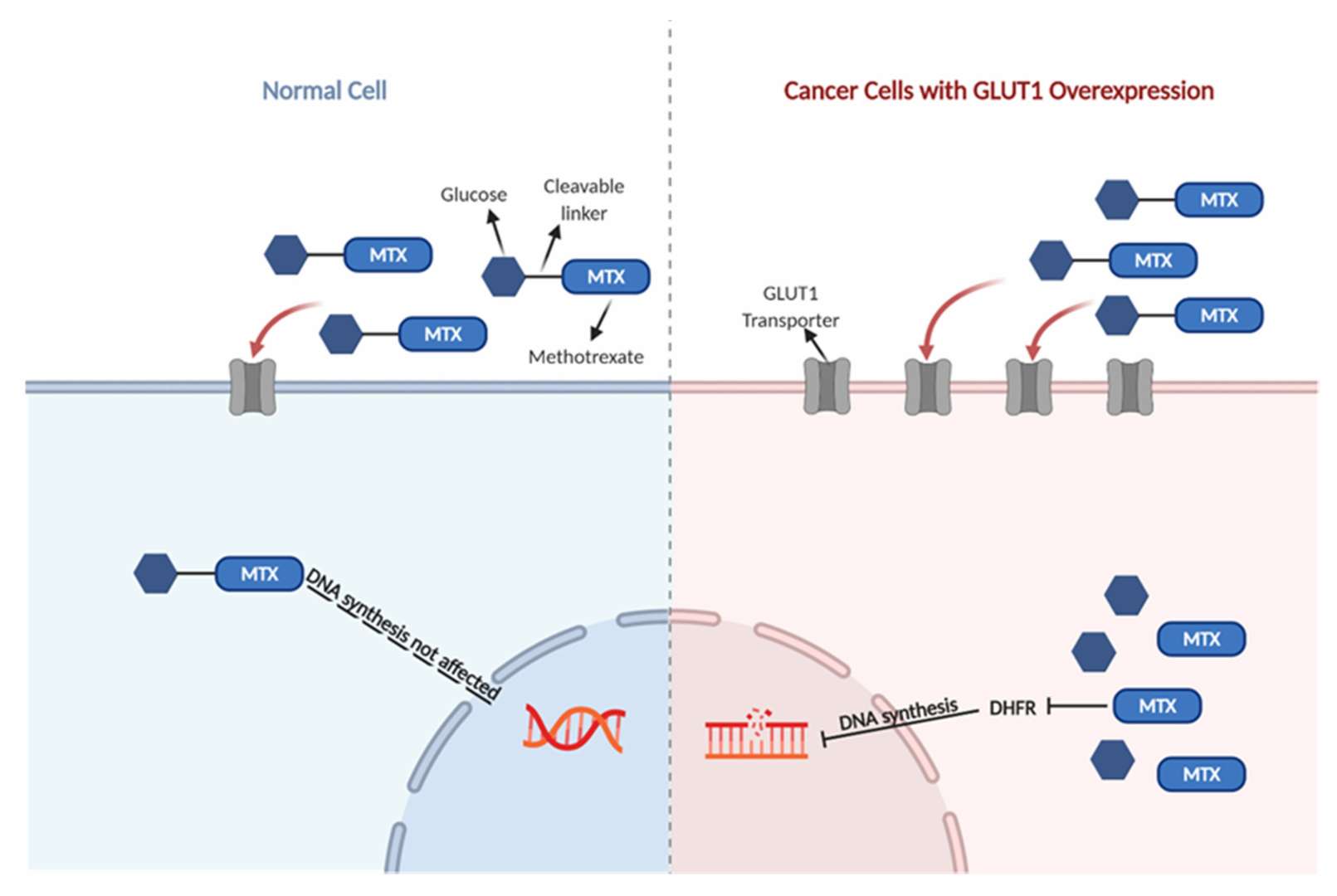 Figure 1. Cellular transport of glucose–methotrexate conjugate (GLU–MTX) in healthy and cancer cells with GLUT1 overexpression. (Source: Woźniak M, et al.; 2021)
Methotrexate is an antimetabolite and antifolate agent. The compound blocks DNA synthesis and repair and cell replication through its ability to stop dihydrofolate reductase enzyme function which cells need to make nucleotides. The fast cell division of cancer cells creates their most vulnerable point because their abnormal growth patterns become easily disrupted.
The blood–brain barrier allows high-dose methotrexate to pass through which makes it the primary treatment for both leukemic CNS prevention and treatment.
The initial treatment for PCNSL requires high-dose methotrexate-based regimens because these regimens help achieve therapeutic drug levels that can enter brain tissue.
Methotrexate plays a major role in the treatment of osteosarcoma, especially in children and adolescents.
High-dose methotrexate, combined with:
The new treatment methods have resulted in better patient survival outcomes which now enable patients to live longer. The medical team performs strict monitoring of methotrexate treatment while using leucovorin rescue to minimize side effects while preserving its ability to fight cancer cells.
Methotrexate has historically been used in early-stage and metastatic breast cancer, particularly as part of combination chemotherapy regimens such as:
While newer agents have reduced its frontline use, methotrexate remains relevant in:
Methotrexate is used in squamous cell carcinomas of the head and neck, particularly in:
Low-dose methotrexate is commonly prescribed for cutaneous T-cell lymphoma, especially early-stage disease.
Benefits include:
Methotrexate has shown activity in selected sarcoma subtypes, often as part of multi-agent chemotherapy, though its use is less common than in osteosarcoma.
Methotrexate is uniquely valuable in oncology due to its ability to penetrate the CNS at high doses.
It is used in:
Despite the rise of targeted therapies and immuno-oncology, methotrexate continues to be used because it offers:
Its pharmacology is well understood, allowing clinicians to optimize dosing, toxicity management, and supportive care strategies.
Cancer-related methotrexate therapy requires close monitoring due to potential toxicities, including:
Standard clinical practice includes:
These measures have significantly improved the safety profile of methotrexate in oncology.
Future research directions for methotrexate mainly include:
The research into new medical approaches shows that this well-known drug offers extra therapeutic benefits to patients.
Methotrexate serves as a cancer treatment for various types of tumors. The drug maintains its essential position in cancer therapy because it demonstrates powerful tumor destruction properties while medical personnel have developed expertise through their extensive experience with the drug.
Methotrexate serves as an essential treatment choice which connects conventional chemotherapy to contemporary precise cancer therapy for both medical staff and their patients.
Methotrexate has proven effective in treating solid tumors which include osteosarcoma and breast cancer and head and neck cancers. The clinical effectiveness of this treatment depends on three factors which include cancer type and disease stage and treatment approach as either standalone therapy or combined with other medications.
High-dose methotrexate is used to:
Leucovorin rescue is administered afterward to protect healthy cells.
Yes. The blood–brain barrier becomes accessible to methotrexate when patients receive high doses of the medication which makes this treatment effective for central nervous system cancers including CNS leukemia and primary CNS lymphoma.
Reference
| Target | Cat. No. | Product Name | Host | Application | |
| MTX | DPATB-H81809 | Anti-Methotrexate polyclonal antibody | Goat | ELISA, RIA | Inquiry |
| DMAB-WZ0004 | Anti-Methotrexate monoclonal antibody | Mouse | IA | Inquiry | |
| DPABY-912 | Anti-Methotrexate polyclonal antibody | Sheep | ELISA, Pr* | Inquiry | |
| DPABY-070 | Anti-Methotrexate (C-terminal) polyclonal antibody | Sheep | ELISA | Inquiry | |
| DMABB-JX341 | Mouse Anti-Methotrexate monoclonal antibody, clone MTX | Mouse | ELISA, LFIA | Inquiry |
| Target | Cat. No. | Product Name | Conjugate | Application | |
| MTX | DAGB319 | Methotrexate [HRP] | HRP | IA | Inquiry |
| DAGA-351B | Methotrexate [BSA] | BSA | LFIA | Inquiry | |
| DAGA-351K | Methotrexate [KLH] | KLH | Immunogen | Inquiry | |
| DWT109 | Methotrexate Standard solution | N/A | Inquiry | ||
| DAG-WZ3635O | Methotrexate [OVA] | OVA | IA | Inquiry |
| Target | Cat. No. | Product Name | Size | Species Reactivity | Application | Detection Sample | |
| MTX | DEIA-US209 | Methotrexate ELISA kit | 96T | Human, mouse, rat | Quantitative | Serum, plasma and urine | Inquiry |
| DEIA-XYZ209 | Methotrexate ELISA kit | 96T | Human | Quantitative | Serum, Plasma | Inquiry |
Loading ......
