
Inquiry Basket
 Loading ......
Immunoglobulins (Igs), also known as antibodies, are an essential component of the immune system. They bind to specific antigens, such as viruses, bacteria, and cancer cells, and help to neutralize or eliminate them. Igs are composed of two identical heavy chains and two identical light chains that form a Y-shaped structure. The fragment antigen-binding (Fab) region of the Ig molecule is responsible for antigen recognition and binding.
However, in some applications, it may be desirable to use only the Fab region of an antibody, rather than the full-length Ig molecule. This is where F(ab) and F(ab')2 fragments come into play.
F(ab) and F(ab')2 fragments are smaller antibody fragments that retain full-length antibodies' antigen-binding specificity. The F(ab) fragment is generated by the enzymatic digestion of the Ig molecule with the proteolytic enzyme papain. Papain cleaves the antibody molecule below the hinge region, resulting in two separate Fab fragments and a smaller Fc fragment. The F(ab')2 fragment is generated by the enzymatic digestion of the Ig molecule with the proteolytic enzyme pepsin. Pepsin cleaves the antibody molecule below the hinge region, but leaves a small portion of the hinge region intact, resulting in two separate Fab fragments covalently linked by disulfide bonds.
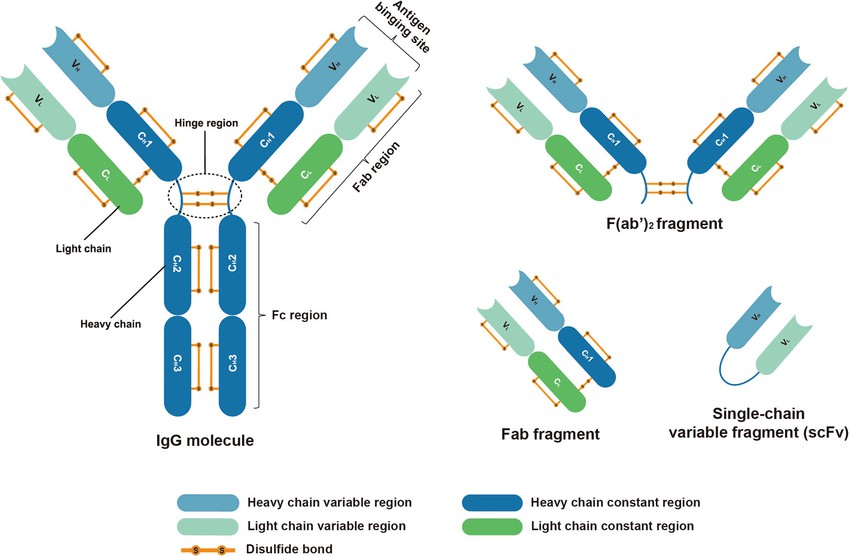 Fig. 1 Structure of IgG molecule and its fragments: F(ab') 2 fragment, Fab fragment, and single-chain variable fragment (SCFv). (Lin X,et al., 2021)
Both F(ab) and F(ab')2 fragments consist of one or two Fab regions, respectively, which retain the antigen-binding specificity of the full-length antibody. However, F(ab) and F(ab')2 fragments lack the Fc region, which is responsible for effector functions such as complement activation and antibody-dependent cell-mediated cytotoxicity.
The use of F(ab) and F(ab')2 fragments in various applications provides several advantages over full-length Ig molecules. One of the main advantages is increased specificity, as F(ab) and F(ab')2 fragments have a reduced likelihood of binding non-specifically to other molecules in the sample. This is particularly important in applications such as immunohistochemistry, where specific antigen detection is the primary goal.
Furthermore, F(ab')2 fragments have two Fab regions that can bind to two separate antigenic epitopes, increasing the binding strength or avidity. This is especially useful in applications such as Western blotting and ELISA, where the detection of low-abundance antigens is required.
Additionally, F(ab) and F(ab')2 fragments can be used in applications where effector functions are not required, such as immunohistochemistry, where the detection of specific antigens is the primary goal. This allows increased sensitivity and reduced background staining.
As fragment secondary antibodies, these fragment antibodies do not interfere with anti-Fc-mediated antibody detection. Moreover, due to their small volume, they can penetrate tissues more effectively.
F(ab) and F(ab')2 fragments have a wide range of applications in various fields, including research, diagnostics, and therapeutics. Some of the most common applications include:
Immunohistochemistry (IHC) is a technique used to detect specific antigens in tissue sections. F(ab) and F(ab')2 fragments are commonly used in IHC applications, as they provide increased specificity by reducing non-specific binding to other molecules in the sample.
Western blotting is a technique used to detect specific proteins in a sample. F(ab) and F(ab')2 fragments can be used as secondary antibodies in Western blotting applications, as they provide increased specificity and reduced background staining.
Flow cytometry is a technique that is used to detect and analyze cells based on their physical and chemical properties. F(ab) and F(ab')2 fragments can be used as primary or secondary antibodies in flow cytometry applications. In these applications, F(ab) and F(ab')2 fragments provide increased specificity and reduced background staining, allowing for the accurate identification and analysis of cells based on their physical and chemical properties.
F(ab) and F(ab')2 fragments can be used as therapeutic agents in various applications, such as cancer therapy and autoimmune disorders. In these applications, F(ab) and F(ab')2 fragments can be used to target specific antigens, while minimizing the risk of unwanted side effects by eliminating effector functions.
When choosing the appropriate F(ab) or F(ab')2 fragment for a particular application, several factors should be considered. These include:
Reference
Loading ......
