
Inquiry Basket
 Loading ......
Neurobiology research has made significant strides in understanding the intricate workings of the nervous system. One crucial area of study is Schwann cells, which play a fundamental role in the development, maintenance, and regeneration of the peripheral nervous system. Identifying and studying Schwann cells requires reliable markers that can distinguish them from other cell types.
Schwann cells are essential for the maintenance and regeneration of motor and sensory neurons in the peripheral nervous system (PNS). Their primary functions include insulating (myelinating) nerve fibers and providing nutrient support to these fibers. Myelination enhances the speed of electrical signal transmission along the axons, ensuring efficient communication within the nervous system. Additionally, Schwann cells are crucial for the regeneration of PNS neurons, making them indispensable for the repair and recovery of damaged nerves. In addition, Schwann cells also encompass non-myelinating forms that provide nutrition and cushioning effects to non-myelinated axons.
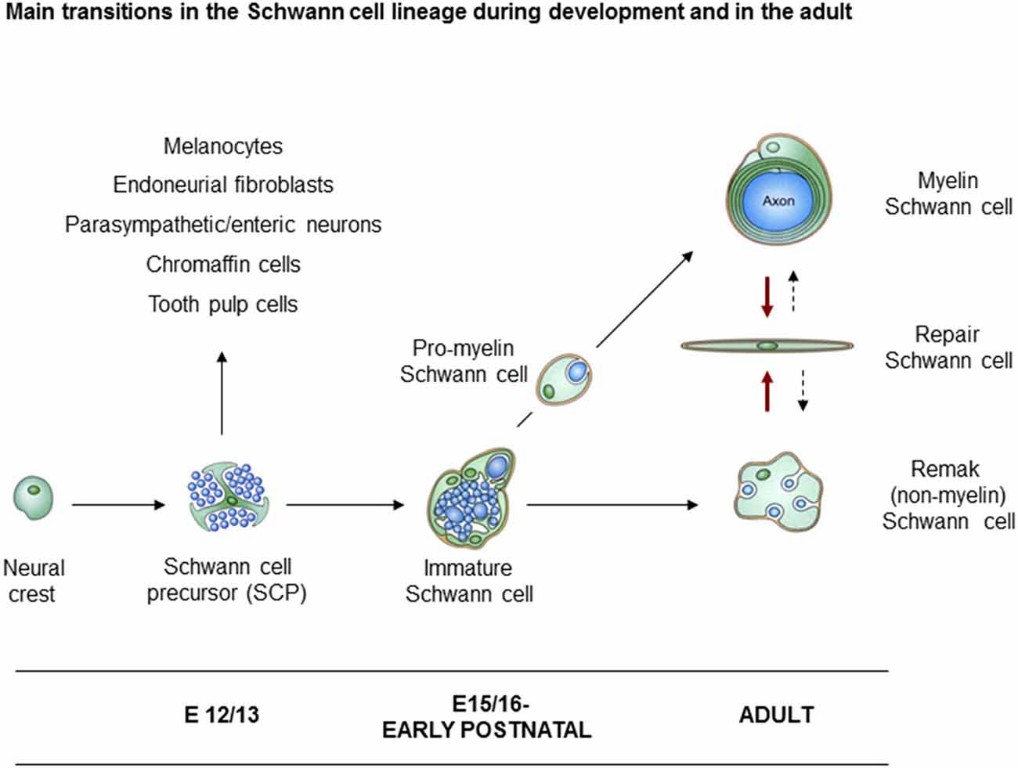 Fig. 1 Main transitions in the Schwann cell lineage. (Jessen K R, et al., 2019)
Schwann cells derive from neural crest cells and undergo distinct stages of development, including precursor, immature, pro-myelin, myelinating, and non-myelinating stages.
Schwann Cell Markers serve as essential tools for researchers to identify, characterize, and study Schwann cells in various experimental contexts. These markers enable the precise labeling and visualization of Schwann cells, facilitating the examination of their distribution, morphology, and functional properties. By understanding the expression patterns of Schwann Cell Markers, researchers can gain insights into Schwann cell development, myelination processes, and their involvement in peripheral nerve regeneration. Several Schwann cell-specific markers such as S100, MBP, MPZ, P75NTR, and SOX2 have been reported. The specific markers of Schwann cells at different stages are different but partially overlap.
| Schwann Cell Stage | Suggested Markers |
| Schwann Cell Precursor | SOX10, GAP43, MPZ, SOX2, DHH, Oct6/POU3F1 |
| Immature Schwann Cells | SOX10, GAP43, MPZ, SOX2, S100, P75NTR, NCAM, Oct6/POU3F1 |
| Pro-myelin Schwann Cells | SOX10, S100, EGR2, Oct6/POU3F1 |
| Myelinating Schwann Cells | SOX10, MPZ, S100, EGR2, MBP |
| Non-myelinating Schwann Cells | SOX10, GAP43, S100, P75NTR, NCAM |
Sox protein acts as a nuclear-cytoplasmic shuttle protein and is crucial in the development of the neural crest and PNS. During development, Sox10 first appears in the formation of neural crests and continues to be expressed, as these cells contribute to the formation of PNS and ultimately differentiate into Schwann cells.
Growth-associated protein (GAP-43), known as a "growth" or "plasticity" protein, is a validated marker of neuronal development and regeneration and, to a lesser extent, reactive glial cells. This protein is expressed at high levels in neuronal growth cones during development and axonal regeneration and is thought to be a key component of the nervous system's efficient regenerative response. GAP-43 is widely used to specifically label damaged neurons and score neuronal regeneration.
Octamer-binding protein 6 (Oct6), also known as POU domain, class 3, transcription factor 1 (POU3F1), is primarily located in the cytoplasm of Schwann cells. However, during the early phase of acute axonal degeneration, there is a notable shift in Oct6 expression, with the protein being observed in the nuclei of Schwann cells. This nuclear expression reaches its peak during the regenerative stage of Schwann cell activity.
S100 protein is localized in the cytoplasm and/or nucleus of a variety of cells and regulates various cellular processes such as cell cycle progression and differentiation. Chromosomal rearrangements and altered expression of the gene encoding this protein are associated with many types of diseases, such as neurological and neoplastic diseases.
Myelin protein zero (P0, MPZ) is a crucial component of the myelin sheath found in the PNS. It is a single membrane glycoprotein that plays a major structural role in the formation and maintenance of myelin. P0 is predominantly expressed by Schwann cells and accounts for more than 50% of all proteins present in the PNS, making it the most abundant protein in this system. Mutations in the gene encoding this protein are associated with several polyneuropathies, such as Dejerine-Sottas syndrome (DSS).
NCAM is a cell adhesion protein that serves as a differentiation marker for postmigratory immature neurons during nervous system development. NCAM is involved in cell-cell interactions and cell-matrix interactions during development and differentiation. It is expressed by non-myelinating Schwann cells in normal nerves and is overexpressed in Schwann cells from patients with chronic axonal neuropathies and Schwannomas.
Schwann cells are indispensable in the development and maintenance of the PNS. The identification and isolation of Schwann cells from complex cell populations require reliable markers that can accurately distinguish them. Creative Diagnostics offers a comprehensive range of high-quality antibodies and detection kits targeting Schwann cell markers. With our cutting-edge products, researchers can study Schwann cells in greater depth, increasing the understanding of neurobiology and paving the way for novel therapeutic interventions for neurological diseases.
References
Loading ......
