
Inquiry Basket
 Loading ......
Since researchers in the Netherlands discovered human metapneumovirus (hMPV) in 2001, hMPV and its subtype structures have been detected in many countries. hMPV is a respiratory pathogenic virus, a paramyxovirus, and can express a variety of proteins. Among them, G, F, and M2 gene proteins are the focus of vaccine development, and people already have a certain understanding of them. Currently, it is known that hMPV has two genotypes, A and B, and four subtypes, A1, A2, B1, and B2. All subtypes can cause respiratory tract infections. There are many reports that severe or fatal diseases can occur after hMPV infection. Therefore, research on its immunity and related vaccines has attracted increasing attention.
hMPV shows a morphology similar to paramyxovirus particles under an electron microscope, and the particles are multi-shaped, spherical, and fibrous. The average particle diameter is 15nm, the nucleoprotein diameter is 17nm, and the nucleoprotein length is 200 to 1000nm. It has a non-segmented negative helical single-stranded RNA structure with a shell membrane and belongs to the paramyxovirus family. hMPV is a single-negative strand non-staged RNA virus. The genome RNA is about 13,000 nucleotides long and contains 9 protein genes in the order 3-N-P-M-F-M2-SH-G-L-5. Among all hMPV proteins, N protein often induces the body's cellular immune response and mainly plays a role in virus clearance, while the antibodies it induces often lack neutralizing antibody activity; G and F glycoproteins are the main functional molecules for the virus to adhere to and infect target cells. It can induce the body to produce neutralizing antibodies and is the most effective molecule discovered so far to protect the body from infection.
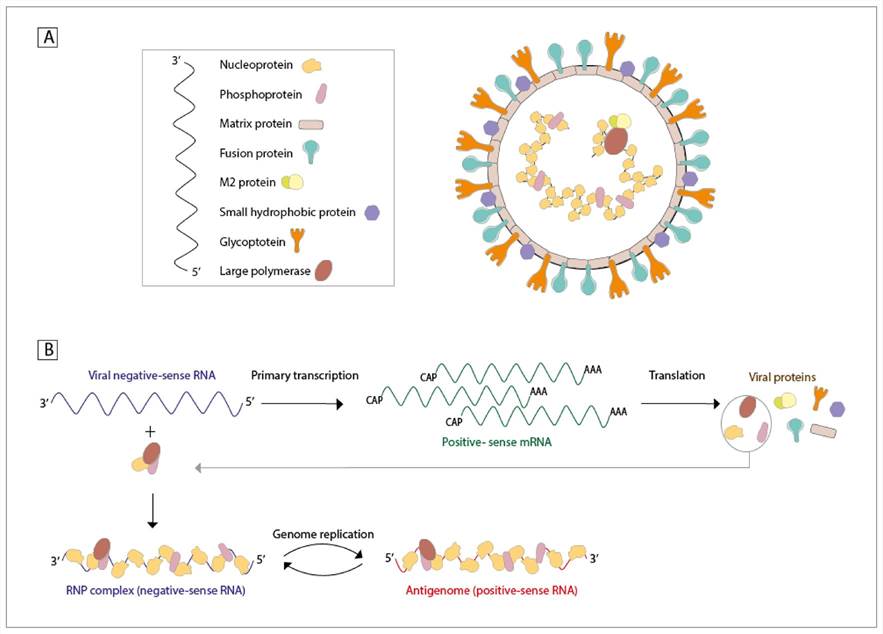 Figure 1. Structure, genetic material, and replication cycle of human metapneumovirus (hMPV).
As a membrane protein component, G protein has frequent contact with the body's immune system and plays an important role in the pathogenesis. G protein can induce the body to produce neutralizing antibodies, which is the body's most important way to prevent infection. By observing the response of bronchoalveolar lavage (BAL) cells to inflammation, it was found that the G protein expression of RSV is closely related to the expression of Th1-type cytokines, chemokines CC and CXC. Since the G protein of RSV is structurally similar to the G protein of hMPV, the G protein of hMPV may be closely related to the expression of Th1 type cellular immunity and related inflammatory factors. By studying the BALB/c mouse model, it was found that hMPV infection is not only related to the weakened innate immune response and inert immune response mediated by CD4 T cells in the lungs, but also related to the reduced expression level of interferon in the late stage of infection, and local interferon plays a role in limiting the virus. It plays a vital role in replication and body defense. After hMPV infection, the body's immune response can be triggered through the expression of Th1 or Th2 type cytokines. There is a reciprocal negative feedback regulation between Th1 and Th2 types of immune responses: interferon produced by Th1 can promote Th1-type responses and correspondingly inhibit Th2-type responses; while interleukin 10 produced by Th2 has the effect of on the contrary. Analysis results using cell counting methods showed that in the early stage of hMPV infection, the levels of Th1-type cytokines interleukin 2, gamma interferon, and tumor necrosis factor α produced by CD4 T cells were higher; while in the later stage of hMPV infection, the levels of Th2-type cells produced by CD8 T cells Levels of the factor interleukin 10 are higher. The study also found that when the levels of gamma interferon produced by CD8 T cells are low and the levels of interleukin 10 produced by CD4 T cells and CD8 T cells are high, the corresponding levels of virus replication in the lungs will also be at a higher level, indicating that cytokines The secretion pattern and expression quantity are closely related to virus replication and the occurrence of infection. Viruses can also adopt various methods, including replication of immune privileged sites, downregulation of immune molecules, antigenic mutation, and molecular mimicry to weaken or weaken the body's immune response. Further infection of the nasopharynx of BALB/c mice with hMPV was found to cause clinical symptoms such as pulmonary inflammatory response, respiratory obstruction, and respiratory hyperresponsiveness in mice, and during the initial infection, CD4+ and CD8+ T cells were able to coordinate clearance hMPV, but more CD4+T cells also aggravated clinical symptoms and lung pathological changes. Although the body's ability to neutralize anti-viral antibodies is weakened after the loss of CD4+ T cells, the pathological changes in the lungs and clinical symptoms are alleviated, indicating that intact CD8+ T cells provide immune protection to the body.
The latest research shows that G protein plays an important role in virus replication both in vivo and in vitro. Recombinant hMPV with G protein removed (rhMPVΔDG) was used to infect the respiratory tracts of Syrian hamsters and African green monkeys. It was found that infection with hMPV with intact structure was similar to that of hMPV with intact structure. In comparison, the MPV replication ability in Syrian hamsters and African green monkeys was significantly weakened. Since the G protein can inhibit the pro-inflammatory response and the secretion of antiviral molecules, the replication ability and pathogenic effect of rhMPVΔDG are weakened, which is also similar to the role of the G protein of RSV (compared with wild-type RSV infection, the lack of G protein RSV infection of BALB /c mouse model, it can mediate the release of more CC and CXC inflammatory factors by monocytes and lung epithelial cells in vivo). In addition, the G protein in rhMPV can also inhibit the innate immune response of the infected host and plays an important role in regulating signal transduction pathways. It can affect genes such as nuclear factor kappa B, interferon regulatory factors, cytokines, and chemokines. to regulate the expression of pro-inflammatory response molecules and the secretion of interferon; by inhibiting the secretion of nuclear factor κB and interferon regulatory factors, it weakens host beta interferon, interleukin 8 and chemokine RANTES (regulates the activation of normal T Chemokines (chemokines) expressed and secreted by cells are transcribed, thereby increasing the ability of the virus to replicate. It can also inhibit the inflammatory response of alpha interferon and beta interferon by blocking signal transduction and the phosphorylation of transcription kinase factors, which ultimately leads to respiratory tract infection and pathogenesis. In summary, G protein plays an extremely important role in the rhMPV infection process.
It has now been confirmed that hMPV is an important pathogen causing acute respiratory infections in infants and children with low immunity, with an infection rate of 4% to 15%, second only to RSV infection, and its incidence rate has even been reported to be as high as 25.3%. There is currently no effective way to avoid hMPV infection, so research on hMPV vaccines is also ongoing. Research on viral vaccines first began in the 1860s. After recipients of the formaldehyde-inactivated RSV vaccine were infected with RSV again, their infection worsened significantly. Since this phenomenon could not be explained at the time, research on viral vaccines was abandoned. Further research, and later animal experiments proved that this phenomenon was caused by an imbalance of Th2 response to viral antigens. Since the hMPV membrane surface glycoprotein has important homology with RSV, it also hinders the research and development of hMPV vaccines; however, there have been many reports about viral vaccines in recent years. The current vaccine trials are mainly on the G of hMPV. Based on the research on protein, F protein and M2-2 protein. Mainly include the following three types:
References
Loading ......
