
Inquiry Basket
 Loading ......
Amidation of proteins is a critical post-translational modification (PTM) that plays a vital role in regulating protein activity, stability, and function. It is worth noting that it is an important PTM for neuropeptides and hormones. It is a complex and highly regulated process that contributes to the diversity and functionality of the proteome.
Protein amidation modifications can occur at different sites within the protein sequence, leading to various types of amidated residues. Here are some of the key types of protein amidation modifications:
C-terminal amidation is one of the most common types of amidation modification. It involves the conversion of the terminal carboxyl group (-COOH) at the C-terminus of a protein or peptide into an amide group (-CONH2). This modification is crucial for the bioactivity of many neuropeptides, hormones, and bioactive peptides.
N-terminal amidation involves the conversion of the free amino group (-NH2) at the N-terminus of a protein or peptide into an amide group (-CONH2). This modification expands the scope of protein amidation beyond the C-terminus. N-terminal amidation can influence protein properties and function, although it is less common than C-terminal amidation.
Alpha-amidation is a process that involves the attachment of a glycine residue to the C-terminus of a protein or peptide, followed by the subsequent cleavage of the glycine residue to form an amidated group. Alpha-amidation is commonly observed in peptide hormones and neuropeptides, and it plays a role in modulating their biological activity and stability.
Gamma-carboxyglutamic acid (Gla) formation is a specific type of amidation that occurs in certain proteins involved in blood clotting, such as prothrombin and factors VII, IX, and X. Gla residues are carboxylated, resulting in the formation of an amide group. Gla formation is crucial for the proper functioning of these clotting factors and is mediated by the enzyme gamma-glutamyl carboxylase.
Asparagine or glutamine residues within a protein can undergo deamidation, resulting in the conversion of these residues into aspartic acid or glutamic acid, respectively. Deamidation introduces a negative charge and can affect protein structure, stability, and function. Although deamidation is not considered a typical amidation modification, it is worth mentioning as it involves the conversion of an amide group (-CONH2) to a carboxyl group (-COOH).
Amidation can occur naturally in living organisms (in vivo) or can be artificially introduced through chemical synthesis or enzymatic methods (in vitro), and the mechanism varies accordingly.
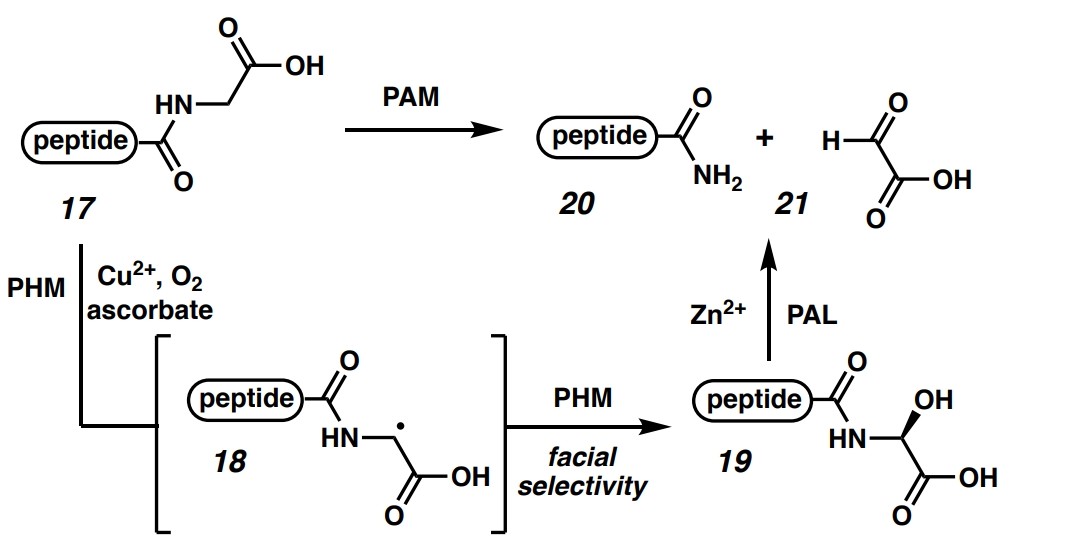 Figure 1. Two-step biosynthetic amidation of peptidylglycine.
(Source: Arbour, C. A. et al., 2020)
Amidation provides several benefits to peptides. One important advantage is that it reduces susceptibility to proteolytic degradation, leading to an increased half-life in the bloodstream. By replacing the ionizable carboxyl group with a nonionizable amide group, amidation alters the physicochemical properties of the peptide. For instance, it can result in increased hydrophobicity under physiological conditions. This change in hydrophobicity is particularly important for bioactive peptides involved in receptor recognition and signal transduction.
Furthermore, amidation has an impact on the binding affinity of peptides to their G-protein coupled receptors. The presence of amidation influences the interaction between peptides and these receptors, potentially affecting their biological activity.
References
For research use only, not for use in diagnostic procedures.
| Target | Cat. No. | Product Name | Host | Isotype | Application | |
| PAM | DPABH-06139 | Rabbit Anti-Human PAM Polyclonal Antibody | Rabbit | IgG | WB | Inquiry |
| Target | Cat. No. | Product Name | Expression System | Tag/Conjugate | Application | |
| PAM | CDBP2190 | Human PAM blocking peptide | N/A | Unconjugated | Apuri, BL, ELISA | Inquiry |
| DAG-KO087 | PAM Knockout Cell Lysate | WB | Inquiry |
Loading ......
