
Inquiry Basket
 Loading ......
Aeromonas is a type of Gram negative bacteria widely distributed in aquatic environments. Bacterial cells are rod-shaped to nearly spherical in shape, with a diameter of 0.3-1.0 μm, and usually exist in monomeric, paired, or short chain form. This genus includes various bacterial strains, such as Aeromonas hydrophila and Aeromonas aeromonas, which are not only opportunistic pathogens in aquaculture, but can also cause human sepsis, diarrhea, and other diseases through wound infection or food transmission. Research has shown that Aeromonas has a resistance rate of over 80% to antibiotics such as ampicillin, and its quorum sensing system, which regulates the expression of virulence factors, has become a key focus in the development of new inhibitors.
 Figure 1. Infections in Humans and Animals.( Pessoa, Rafael Bastos Gonçalves, et al.2019)
The strains under the genus Aeromonas are Gram negative and oxidase positive. The morphology of the bacterial cells can vary between straight rod-shaped (1.0-3.5 μ m in length) and nearly spherical (0.3-1.0 μ m in diameter) depending on the environment. According to a study conducted in 2023, gray smooth colonies with a diameter of 1-2mm were formed on Colombian blood plates after 18 hours of colony cultivation, and different bacterial strains may exhibit differences in hemolytic rings.
Deciphering the complex pathogenesis of Aeromonas relies on specialized reagents that enable precise detection, characterization, and targeting of bacterial factors. Key tools in this field include Anti-Aeromonas Monoclonal antibody, Recombinant Protein Aeromonas caviae, and Recombinant Protein Aeromonas hydrophila. The Anti-Aeromonas Monoclonal antibody offers high specificity for identifying Aeromonas species in clinical samples, environmental isolates, or host tissues—facilitating rapid diagnosis and tracking of infection routes. Recombinant proteins derived from major pathogenic species, such as Recombinant Protein Aeromonas caviae and Recombinant Protein Aeromonas hydrophila, serve as critical substrates for studying virulence factor function. These proteins allow researchers to investigate how specific bacterial components interact with host cells, trigger immune responses, or contribute to tissue damage—providing insights into species-specific pathogenic mechanisms. Together, these tools accelerate the discovery of novel drug targets, diagnostic markers, and vaccine candidates for combating Aeromonas infections.
The study of virulence factors revealed that strains such as Aeromonas hydrophila carry virulence genes such as hemolysin and enterotoxin. Among them, the American drinking water source strain has a significantly higher ability to produce enterotoxin than the Thai aquaculture source strain. Regulating biofilm formation and virulence expression through AI-1 quorum sensing system.
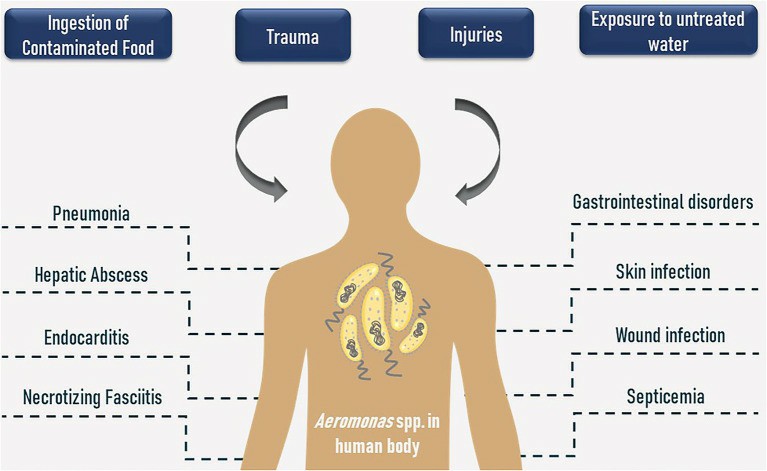 Figure 1. Contamination routes and human health disorders caused by Aeromonas spp.( Pessoa, Rafael Bastos Gonçalves, et al.2022)
The human skin consists of two layers, serving as a physical barrier to protect the body from external threats. Infection involving this wide range of organs is one of the major disabling diseases in the world. Due to the presence of damage and other risk factors, their characteristic is the invasion of toxic microorganisms into the epidermis and adjacent tissues, which initially produces common symptoms of local inflammation and may evolve into various pathological processes, depending on the nature of the invading microorganisms. Naturally, the epidermis is colonized by several types of microorganisms. When it comes to bacteria, the most common microorganisms on the skin of adult individuals belong to the genera Staphylococcus, Streptococcus, and Corynebacterium. The main bacterial skin infections include pustulosis, erysipelas, cellulitis, folliculitis, abscesses, and necrotizing fasciitis. It is worth noting that when these diseases are infected through previous exposure to aquatic environments, multiple microbial causes of infection must be considered, especially those related to the presence of abnormal microorganisms such as Aeromonas.
As of 2022, clinical isolates have a resistance rate of 82.7% to ampicillin and over 80% to levofloxacin. In 2023, research found that plasmid mediated horizontal transfer of resistance genes is the main cause of the increase in resistance rates, with some strains carrying blaTEM-1 type β - lactase genes.
Natural water bodies are widely present in groundwater, rivers, and still water environments. The US Environmental Protection Agency lists Aeromonas hydrophila as a water pollution indicator bacterium and requires that the free chlorine concentration in the water supply system be maintained at 0.3-0.5mg/L to inhibit its proliferation. Some strains of symbiotic relationship can enhance lodging resistance and inhibit excessive reproduction of blue-green algae by symbiotic relationship with crops such as rice.
1. Traditional methods involve preliminary screening through biochemical tests such as oxidase and peroxidase, while specific strains such as Pseudomonas aeruginosa need to be identified through dynamic tests.
2. According to the 2024 mass spectrometry identification study using modern technology, the accuracy rate of identifying Pseudomonas aeruginosa in guinea pigs is 99.9%, but there is a 100% misjudgment rate for Pseudomonas aeruginosa in Dhaka, which needs to be confirmed by joint multi site phylogenetic analysis. The DL-96 bacterial detection system can improve the efficiency of clinical sample identification
For a long time, the genus Aeromonas has been mistakenly isolated from bacterial pathogens that cause human infections. Some signs, such as several diarrhea outbreaks around the world and the widespread distribution of Aeromonas in the environment, indicate that these microorganisms have been present in medical routines for a long time. In addition, many people have died as a result of its transmission process. Given the diversity of clinical manifestations that Aeromonas may cause in immunocompromised and immunocompromised patients, doctors should not underestimate this bacterial genus. As an emerging pathogen, Aeromonas is as common as other bacterial pathogens and is more likely to develop multidrug resistance, posing a serious threat to human health in the future. Therefore, the scientific research progress on new methods for identifying Aeromonas and appropriate antibacterial strategies will have potential help for clinical methods.
References
| Target | Cat. No. | Product Name | Host | Isotype | Application | |
| Aeromonas | DMAB9689 | Anti-Aeromonas Monoclonal antibody, Clone I138W138 | Mouse | IgG1 | ELISA, LFIA | Inquiry |
| DMAB6798 | Mouse anti-Bacteria Aeromonas Salmonicida Monoclonal antibody, clone 2E9/D2 | Mouse | IgG2a | ELISA, WB, IF | Inquiry | |
| DMAB6799 | Mouse anti-Bacteria Aeromonas Salmonicida Monoclonal antibody, clone 4C12/H6 | Mouse | IgG1 | ELISA, WB, IF | Inquiry |
Loading ......
