
Inquiry Basket
 Loading ......
Type I helper T lymphocytes (Thl) and type II helper T cells (Th2) are two distinct subsets of CD4+ helper T cells that play pivotal roles in immune responses. The differentiation of these cells is a highly regulated process influenced by various factors, including cytokines, transcription factors, and signaling pathways. Understanding the mechanisms behind Th1 and Th2 cell differentiation is crucial for unraveling their functions in immunity and disease.
The regulation of T helper (TH) cell differentiation and effector responses has been a significant area of research since the distinction between cell-mediated and humoral immunity was first recognized. When naïve Th lymphocytes are activated by antigen-presenting cells (APCs) presenting immunogenic peptides in the context of major histocompatibility (MHC) molecules, they can differentiate into two distinct memory TH cell populations: TH1 and TH2. TH1 cells produce interleukin-2 (IL-2) and interferon-gamma (IFN-gamma), leading to macrophage activation and effective control of intracellular infections. In contrast, TH2 cells secrete signature cytokines such as IL-4, IL-5, and IL-13. They play a crucial role in assisting B cells with antibody production and are essential for eliminating helminths and other extracellular parasites. Apart from TH1 and TH2 cells, there are other CD4+ T regulatory cell populations that secrete high levels of IL-10 and TGF-beta. These regulatory cells have the capacity to suppress both TH1 and TH2 responses.
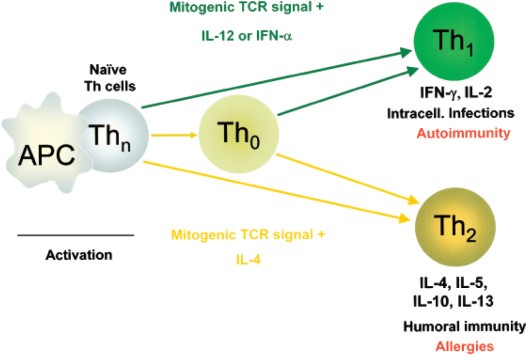 Fig. 1 TH1 and TH2 differentiation is dominated by cytokines. (Biedermann T, et al., 2004)
The main difference between TH1 and TH2 immune responses is that TH1 immune responses are pro-inflammatory, killing intracellular microorganisms and perpetuating the autoimmune response. The TH2 immune response, on the other hand, promotes IgE and eosinophilic responses in ectopic disease and produces an anti-inflammatory response that kills a large number of extracellular parasites. The TH1 and TH2 immune responses are the two types of immune responses produced by T helper cells, both of which are mediated by cytokines.
Th1 and Th2 cell differentiation is regulated by an intricate network of factors. Cytokines, including IL-4, IL-12, IFN-γ, and IL-13, play pivotal roles in directing the differentiation of these cell subsets. IL-4 and IL-13 predominantly drive Th2 cell differentiation, while IFN-γ and IL-12 promote Th1 cell development. Additionally, transcription factors such as NFAT, C-MAF, T-bet, and GATA-3 are crucial for orchestrating the gene expression programs that define Th1 and Th2 cell phenotypes.
GATA-3 is a general lymphoid transcription factor involved in Th cell development and function. It is selectively expressed in Th2 and is upregulated during Th2 differentiation. GATA-3 plays a critical role in regulating the expression of Th2 cytokines such as IL-4, IL-13, and IL-5. Its expression is regulated not only by IL-4R/STAT6 signaling but also by other GATA family members such as GATA-1 and GATA-4. In addition, factors such as NF-κB and FOG-1 are also involved in regulating the function of GATA-3.
T-bet is required for the development of Th0 cells into effector Th cells. As a Th1-specific transcription factor, T-bet can induce the production of IFN-γ and plays a decisive role in the differentiation of Th1 cells. T-bet can be induced and upregulated by IFN-γ during T-cell activation. Through the STAT1-dependent pathway, TGF-β can inhibit Th1 differentiation by inhibiting T-bet.
C-MAF is a transcription factor selectively expressed in Th2 cells and plays a crucial role in promoting Th2 cell differentiation. It activates the expression of IL-4, a key cytokine in Th2 responses. Furthermore, C-MAF is closely associated with the expression of IL-4R and IL-5R, suggesting its involvement in regulating IL-4 gene expression and possibly affecting Th2 cell function.
STATs, or signal transducers and activators of transcription, are a family of proteins that mediate cytokine responses. The STAT family has four members with highly conserved DNA and calcineurin binding sites. Each member is activated by a specific subset of cytokines. For example, STAT-1 is activated by Th1 cytokines such as IFNγ, while STAT-4 is activated by Th2 cytokines such as IL-21.
Several signaling pathways contribute to the differentiation of Th1 and Th2 cells. The T cell receptor (TCR) signaling pathway is a fundamental pathway that integrates signals from antigen recognition, co-stimulatory molecules, and cytokine receptors to guide T cell fate determination. The Notch signaling pathway plays a crucial role in Th cell differentiation, with Notch receptors and ligands mediating cell-cell interactions and influencing lineage commitment.
The JAK/STAT signaling pathway is also involved in Th cell differentiation, with cytokine receptors activating Janus kinases (JAKs) and subsequent phosphorylation of STAT proteins. MAPK signaling pathways, including ERK, JNK, and p38 MAPK, play a role in T cell activation and differentiation. The calcium signaling pathway, mediated by calcium fluxes, contributes to T cell activation and cytokine production. Moreover, NF-κB signaling pathway is involved in regulating T cell activation and immune responses.
As a leading provider of innovative research tools and reagents, Creative Diagnostics offers a comprehensive range of products to support investigations into Th1 and Th2 cell differentiation. Our portfolio includes high-quality ELISA kits, proteins, antibodies, and molecular biology products that are vital for studying the cytokines, transcription factors, and signaling pathways involved in Th cell development.
Loading ......
