
Inquiry Basket
 Loading ......
One of the most commonly used fusion tags for recombinant protein expression and purification is the His tag. His tag, also known as histidine tag, consists of 6-10 histidine residues, the molecular weight is less than 0.84KD, and is usually inserted at the C-terminal or N-terminal of the target protein. His-Tag is currently the most commonly used tag for prokaryotic expression. After protein purification, this tag does not need to be removed, and it will not affect the function of the protein. At the same time, the protein purification steps are simple, the purification conditions are mild, and the protein will not be greatly affected. His-Tag is the preferred tag for protein purification.
There is an imidazole group on the residue of histidine (His), which can form coordination bonds with transition metal ions such as Ni2+ and Co2+ and selectively bind to metal ions. These metal ions can be chelated with ligands Immobilized on the chromatographic medium, so the protein with histidine tag can selectively bind to the medium when passing through the chromatographic medium equipped with metal ions, while other impurity proteins cannot bind or only weakly bind. The His-tagged protein bound to the medium can be competitively eluted by increasing the concentration of imidazole in the buffer, thereby obtaining a higher-purity His-tagged protein.
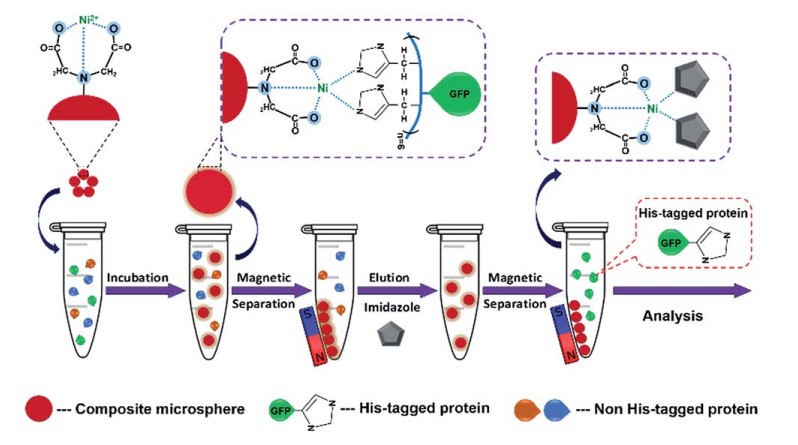 Fig 1. The schematic representation of His-tagged protein purification by using Ni2+–IDA–GLYMO@SiO2@Mag-SiO2 microspheres.
(Source: RSC Adv., 2017, 7, 8718)
His tag does not affect the structure and function of the target protein and can be used in purification under denaturing conditions, coupled with its low cost, is currently one of the most popular and efficient options for protein isolation and purification.
His tag has special interactions with a variety of metal ions, such as Ca2+, Mg2+, Ni2+, Cu2+, Fe3+, etc. The principle is to use the characteristics of the protein surface to make it adsorbed on the gel column. So as to achieve the purpose of separating and purifying protein.
After the His tag protein is purified, it is not necessary to remove the tag, and the purification conditions are mild and will not affect the function of the protein.
What should I do if the His-tagged protein does not hang on the column?
1. Whether the His tag is lost
During the process of expressing foreign proteins in E. coli, the phenomenon of sequence loss often occurs. If the tag is lost, the protein will naturally not be able to hang on the column. The Western-Blot method can be used to detect whether the target protein has a His tag through the His antibody. If the His-tag can be detected, it may be related to the structure of the protein. The tag is "embedded" and cannot be exposed, so naturally it cannot be hung on the column. You can try to build the tag on the other end of the protein, for example, it was originally at the N-terminus and changed to the C-terminus.
2. Whether the His tag is exposed on the surface of the fusion protein can be determined by adding an appropriate amount of denaturants such as urea or guanidine hydrochloride to the protein. If it can be hung on the column, it means that the tag is not exposed enough, and denatured purification can be tried. If the experiment cannot be denatured, you can only try to change the upstream conditions, either increase the length of his to increase the probability of tag exposure, or modify the position of the His tag.
3. In addition, please confirm the chromatography buffer. Don't make a mistake with the balance solution and eluent. At the same time, confirm whether the formula of the eluent is correct.
4. Increase incubation time.
Reference
Loading ......
