
Inquiry Basket
 Loading ......
Based on homology and domain organization, the different DENN domain proteins in the human genome have been classified into eight different subfamilies, which appear to possess Rab-directed GEF activity. In recent years, several studies have focused on the characterization of DENND subfamily members, linking their functional role to a variety of processes through their direct interaction with Rabs. The DENND protein family remains largely uncharacterized, as does the DENND5A/B subfamily, two families that share approximately 70% identity, have the same conserved structural features and similar tissue expression patterns, are both localized at the Golgi, and have been associated with membrane trafficking events between the Golgi and vesicular bodies.
 Fig 1. Domain models of DENND5A/B proteins.
DENND5A, also known as Rab6IP1, was initially identified as a Rab6(GTP)-specific binding protein using a yeast two-hybrid screen. Further analysis of the crystallized complex of Rab6A with the tandem RUN1-PLAT domain of DENND5A confirmed the interaction. DENND5A is a cytosolic protein recruited to the Golgi membrane by the activation of Rab6. Additionally, DENND5A interacts with Rab11 in a GTP-dependent manner, suggesting that DENND5A serves as a link between Rab6 and Rab11 during transport events between the Golgi and recycling endosomes.
Loss-of-function mutations in DENND5A were found to be closely associated with epileptic encephalopathy in the study of DENND5A and disease. DENND5A is mostly expressed in neural tissues, and it is highly expressed during developmental stages. The knock-down of DENND5A leads to alterations in neural development, perhaps due to changes in apical cell polarity during developmental stages of the nervous system. A study using embryonic rat brain lysates for pull-down experiments showed that DENND5A interacts with three proteins, MUPP1, Pals1 and Lin7, all of which are essential for maintaining apical basal polarity and integrity of embryonic epithelial cells. Additionally, DENND5A was proposed as a cancer driver candidate, as several mitotic defects have been observed in MDCK DENND5A knock-down cells, presumably by affecting the generation of apical membranes and lumen in MDCK cells during cell division. During the first cell division, polarity complex proteins such as Crumbs3a and CDC42 are concentrated in Rab11a-positive recycling endosomes, partitioned between two daughter cells before cytokinesis, and delivered to the site of cytokinesis. A first apical membrane is generated to eventually form the lumen. Therefore, due to the interaction of DENND5A with Rab11, it is possible that it regulates a Rab11a-directed network, resulting in defective lumen establishment when loss-of-function mutations occur.
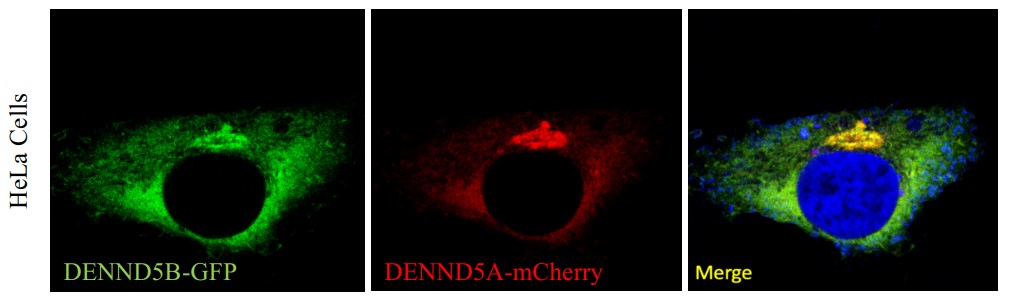 Fig 2. Co-localization of endogenous DENND5A and DENND5B in HeLa cells.
(Source: McGill University. 2022)
DENND5B is thought to be a homolog of DENND5A, also known as Rab6IP-like, which shares a very similar structure with DENND5A and is co-localized in the Golgi apparatus with DENND5A.
Recent studies have linked the aberrant expression of DENND5B with some of the most frequently diagnosed malignancies. A recent study aimed to determine the role of DENND5B in the regulation of epileptic attacks proposed that DENND5B expression is impaired in patients with temporal lobe epilepsy (TLE) and that its expression is similarly decreased in chronic epileptic mice. DENND5B might play a critical role in the normal function of the brain. A recent meta-analysis of multiple genome-wide association studies aimed to identify new risk loci variations for colorectal cancer (CRC) in the East Asians population, found an intronic risk variation in the intron 8 of DENND5B to be one of the first low-frequency variations associated with CRC. A further analysis that aimed to construct a competing endogenous RNA (ceRNA) regulation network for CRC found that patients with high expression of DENND5B mRNA had significantly poor overall survival compared to those with low expression, suggesting that DENND5B functions as a promising prognostic biomarker for CRC. Additionally, two independent studies with the aim of constructing ceRNAs networks for Wilms' tumor, one of the most common types of childhood kidney cancer, showed that high expression levels of the long non-coding RNA (lncRNA) DENND5B-AS1 was correlated with tumor stage and poor survival rate in patients with Wilms' tumor.
References
| Target | Cat. No. | Product Name | Host | Isotype | Application | |
| DENND5A | DPABH-14935 | Anti-DENND5A (aa 815-867) polyclonal antibody | Rabbit | IgG | IHC-P | Inquiry |
| DPABH-06488 | Anti-DENND5A (full length) polyclonal antibody | Mouse | IgG | WB, ICC/IF | Inquiry | |
| DCABH-15160 | Anti-DENND5A monoclonal antibody | Rabbit | IgG | WB, ELISA | Inquiry |
| Target | Cat. No. | Product Name | Host | Isotype | Application | |
| DENND5B | DCABH-15161 | Anti-DENND5B monoclonal antibody | Rabbit | IgG | WB, ELISA | Inquiry |
| CABT-L4504R | Rabbit Anti-Human DENND5B polyclonal antibody | Rabbit | IgG | IHC, ICC/IF | Inquiry | |
| CABT-BL4504 | Anti-DENND5B (aa 1073-1102) polyclonal antibody | Rabbit | IgG | WB | Inquiry |
Loading ......
