
Inquiry Basket
 Loading ......
The global malaria epidemic surpasses the transmission of dengue fever by mosquitoes. Aedes aegypti and Aedes albopictus mosquitoes serve as the primary carriers transmitting the dengue virus (DENV) which causes the disease. Present scientific investigations examine neurological issues associated with dengue fever symptoms which present as mild flu-like conditions or escalate to severe hemorrhagic fever.
The Dengue virus presents four separate serotypes identified as DENV-1 through DENV-4. All four dengue virus serotypes contain unique antigens yet every serotype can transmit to humans via mosquito bites. The dengue virus remains dormant within an infected mosquito before it transmits itself to another host via the mosquito’s saliva during the bite. Mosquito transmission depends on environmental temperature conditions which global warming and urban growth influence and increase transmission chances.
Residents of areas with high mosquito populations along with travelers and people who live near mosquito breeding grounds are more likely to contract dengue. Most people are vulnerable to the virus because widespread immunity among humans does not exist. People who recover from one serotype develop permanent immunity to that type but face a greater danger of serious disease upon infection with different serotypes. Both elderly individuals and immunocompromised persons together with children experience increased health complications.
The United States has fewer dengue fever cases than tropical regions yet the number of cases has risen because of increased international travel and mosquito habitat growth. The Centers for Disease Control and Prevention states that international travel serves as the primary source for most dengue infections in the United States. However, localized outbreaks have also raised concerns. The state of Florida recorded its first locally transmitted dengue fever instance in 2013 and Texas faced local dengue outbreaks in 2019. The development of these outbreaks shows dengue fever transmission is becoming an increasing danger for many U.S. cities and suburban areas.
Reported cases of dengue in the United States have shown an upward trend since the year 2000. The majority of dengue cases result from international travel but some outbreaks take place within local U.S. communities. The southern U.S. regions of Florida and Texas along with other areas that maintain strong connections to Latin America and the Caribbean experience more frequent dengue outbreaks.
While most dengue cases in the United States present with mild symptoms, they can progress to severe forms which occasionally result in fatalities. People with mild cases usually show signs of fever along with headache and muscle pain together with joint pain and rash. Dengue hemorrhagic fever (DHF) or dengue shock syndrome (DSS) develops from serious cases and both conditions demand immediate medical attention. DHF presents with intense bleeding both externally as skin bruises and internally while DSS manifests through low blood pressure and organ failure with a high risk of mortality.
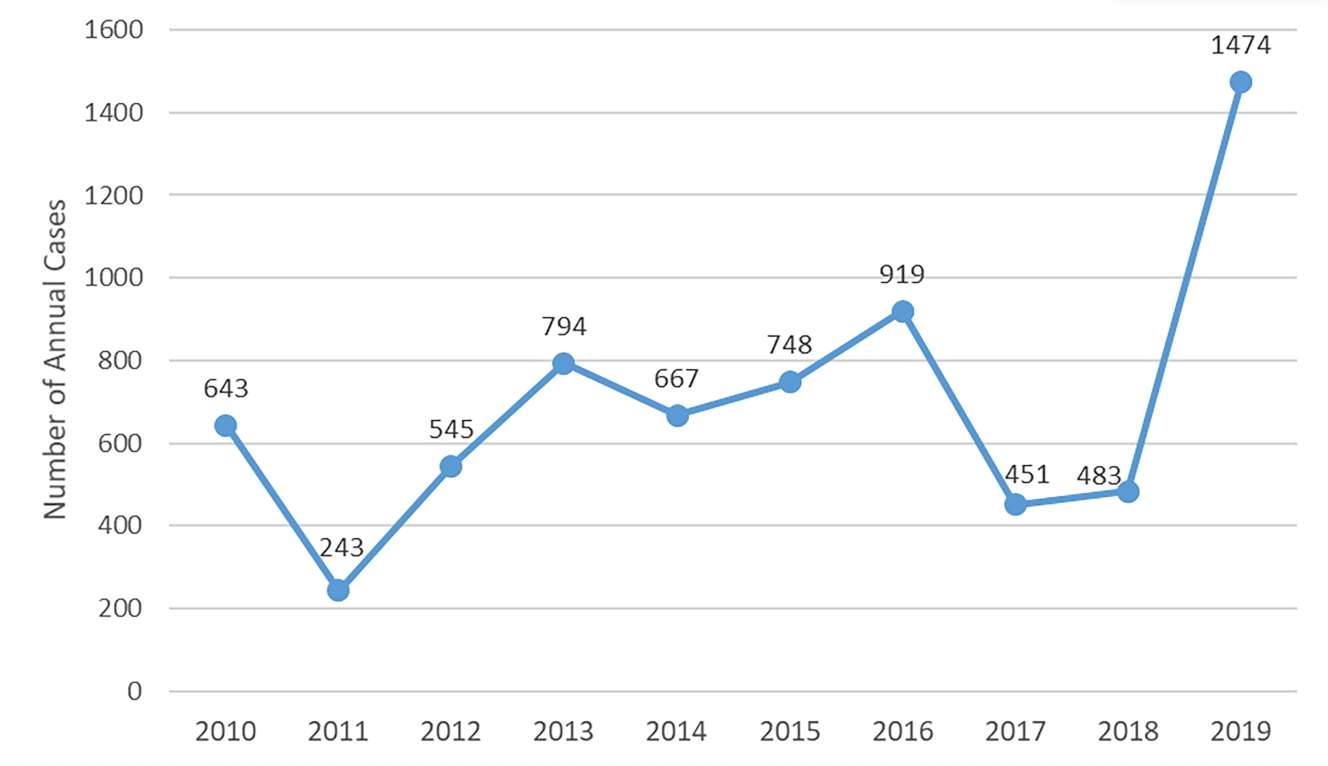 Figure 1. Annual number of travel-associated cases of dengue reported, from all US jurisdictions from 2010 to 2019 (n = 6967). (Source: Joshua M. Wong, et al. 2022)
Recent scientific findings reveal that dengue infection triggers neurological disorders such as encephalitis and meningitis alongside Guillain-Barré syndrome (GBS). Although these complications happen rarely worldwide their incidence has increased greatly in regions where dengue is prevalent. Medical professionals frequently observe complications related to DENV-2 and DENV-3 infections and such incidents in the United States have generated considerable interest.
The transmission risk of dengue fever in the United States is increasing because global climate change and mosquito habitat expansion continue to advance. The United States must improve its dengue prevention systems and monitoring efforts specifically in southern areas and parts of the Midwest due to higher mosquito populations. New challenges for future control efforts emerge from the virus mutation together with increasing neurological complications and vaccine development. Through improved public health strategies combined with vaccine progress and global partnerships the U.S. can tackle the public health challenge of dengue fever.
References
| Target | Cat. No. | Product Name | Size | Species | Application | Detection Sample | |
| DENV | DEIABL333 | Dengue virus IgM µ-capture ELISA Kit | 96T | Qualitative | serum, plasma | Inquiry | |
| DEIA508 | Dengue IgG ELISA Kit | 96T | Human | Qualitative | serum, plasma (EDTA, lithium heparin or citrate plasma | Inquiry | |
| DEIA510 | Dengue IgM ELISA Kit | 96T | Human | Qualitative | serum or plasma (EDTA or lithium heparin plasma). | Inquiry | |
| DEIA1439 | Dengue Virus IgG ELISA Kit | 96T | Human | Qualitative | serum, plasma (EDTA, lithium heparin or citrate plasma | Inquiry | |
| DENV NS1 | DEIABL14 | Dengue NS1 Antigen ELISA Kit | 96T | Human | Qualitative | human serum | Inquiry |
| DEIA-JY2107 | Human Dengue Virus Non-Structural Protein 1 (DENV NS1) ELISA Kit | 96T | Human | Quantitative | Serum, Plasma, Tissue Homogenates and other Biological Fluids. | Inquiry |
Loading ......
