
Inquiry Basket
 Loading ......
Astrocytes, a type of glial cell, play a crucial role in maintaining the structural and functional integrity of the central nervous system (CNS). Understanding astrocytes biology and their involvement in various neurological processes is essential for advancing our knowledge of brain function and pathology.
Astrocytes are star-shaped cells found throughout the CNS, including the brain and spinal cord. They outnumber neurons by a significant margin and are involved in numerous essential functions. Astrocytes provide structural support to neurons, help maintain the blood-brain barrier, regulate ion and neurotransmitter concentrations, and participate in the clearance of metabolic waste. Furthermore, they play a critical role in synapse formation, plasticity, and overall brain development.
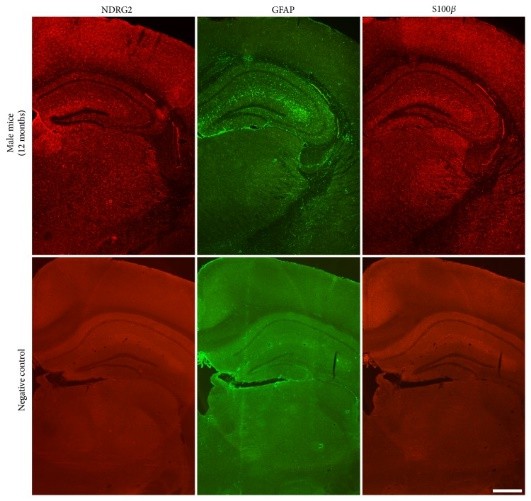 Fig. 1 The distribution of astrocytes labeled by NDRG2, GFAP and S100β in the cerebrum. (Zhang Z, et al., 2019)
In order to study and understand astrocytes, researchers rely on specific markers that allow their identification and characterization. These markers are proteins that are selectively expressed in astrocytes and can be used to distinguish them from other glial cells or neuronal populations. Researchers typically utilize specific antibodies to visualize astrocyte-specific proteins through common techniques such as immunohistochemistry and immunofluorescence. By utilizing these markers, scientists can isolate, purify, and study astrocytes in various experimental settings.
One of the most widely used astrocyte markers is glial fibrillary acidic protein (GFAP). GFAP is an intermediate filament protein found predominantly in astrocytes within the CNS. Its role in providing structural support and maintaining cytoskeletal integrity makes it an essential component for identifying mature astrocytes. Additionally, the upregulation of GFAP in response to pathological conditions allows for the evaluation of astrocyte reactivity and gliosis. By utilizing GFAP as a marker, researchers can gain valuable insights into the dynamic nature of astrocytes and their involvement in various neurological disorders.
S100B is a calcium-binding protein predominantly expressed in astrocytes. It is involved in various intracellular processes, including calcium homeostasis and cell proliferation. In addition to its role as an astrocyte marker, S100β has also been investigated as a potential biomarker for neurodegenerative diseases and brain injuries.
N-Myc downstream-regulated gene 2 (NDRG2) is a gene associated with cell proliferation, differentiation, and cell stress responses. In the brain, NDRG2 is widely expressed in various regions such as the cerebral cortex, mid-cerebral, olfactory bulb, thalamus, and hippocampus. Importantly, NDRG2 is specifically expressed in astrocytes. This unique expression pattern makes NDRG2 a specific marker for astrocytes, especially those that are mature, nonreactive, and nonproliferating.
Excitatory amino acid transporter 2 (EAAT2), also known as glutamate transporter 1 (GLT-1), is a membrane transporter predominantly expressed in astrocytes. It is responsible for the reuptake of the neurotransmitter glutamate from the synaptic cleft, regulating its concentration and preventing excitotoxicity. EAAT2 is a valuable marker for studying glutamate metabolism and astrocyte-neuron interactions.
Aldehyde dehydrogenase 1 family member L1 (ALDH1L1) is an enzyme and classical astrocyte marker that serves multiple important functions in the CNS. It plays a vital role in cellular detoxification processes and is involved in the metabolism of retinoic acid. ALDH1L1 exhibits high expression levels in astrocytes throughout the CNS, making it a reliable marker for identifying and distinguishing these cells from other cell types.
SOX9 is a transcription factor that functions as a reliable marker for astrocytes. SOX9 is expressed in the nuclei of astrocytes throughout the CNS. Its primary function is to regulate the expression of genes specific to astrocytes, thereby promoting their differentiation and ensuring their mature phenotype. As such, SOX9 is considered a key player in the development and function of astrocytes, and its expression is closely linked to the identity of these cells.
Vimentin is an intermediate filament protein expressed in various cell types, including astrocytes. It provides structural support and contributes to the migratory capacity of astrocytes during development and in response to injury. The expression of vimentin is upregulated during the activation process of astrocytes, which enables them to serve as indicators of astrocyte reactivity.
The availability of reliable astrocyte markers has significantly advanced our understanding of astrocyte function and the involvement of astrocytes in various neurological disorders. Researchers have used these markers to study conditions such as Alzheimer's disease, multiple sclerosis, epilepsy, and neurodevelopmental disorders. By examining changes in astrocyte marker expression, scientists can gain insights into disease progression, identify potential therapeutic targets, and develop novel treatment strategies.
As a leading provider of life science research solutions, Creative Diagnostics recognizes the importance of reliable and high-quality reagents for astrocyte research. We offer a comprehensive range of antibodies, ELISA kits, and other tools specifically designed for studying astrocytes and their markers. Our products undergo rigorous quality control and have been validated for various applications, including immunohistochemistry, immunofluorescence, and functional assays.
References
Loading ......
