
Inquiry Basket
 Loading ......
Antibody labeling involves the covalent attachment of a marker (enzyme, fluorescein, biotin, etc.) to an antibody, which reacts specifically with the substance to be detected to form a multiplex, and the test result is observed or determined by direct microscopic examination with an instrument. Some substances that are both easy to measure and highly sensitive, such as horseradish peroxidase (HRP), biotin, etc., are labeled to specific antibody molecules, and the nature and content of the antigen or antibody in the reaction system can be displayed or quantified by the enhanced amplification effect of these markers.
HRP is a glycoprotein with a molecular weight of 44,000, composed of colorless enzyme protein and dark brown iron porphyrin. It is one of the most commonly used enzymes in immunoenzyme technology. The enzyme can be conjugated with antibodies and proteins for a variety of applications such as ELISA, IHC, and Western Blotting. HRP catalyzes the transfer of electrons from the substrate to hydrogen peroxide, producing an oxidized substrate and water. In protein detection, HRP substrates generate chromogenic, chemiluminescent, or fluorescent signals upon oxidation, facilitating signal measurement and quantification of proteins of interest. Its small size allows for better penetration into sample tissues and cells without interfering with conjugated protein function. In addition, HRP has four lysines that increase cross-linking efficiency to the protein of interest, making it a popular choice for protein detection.
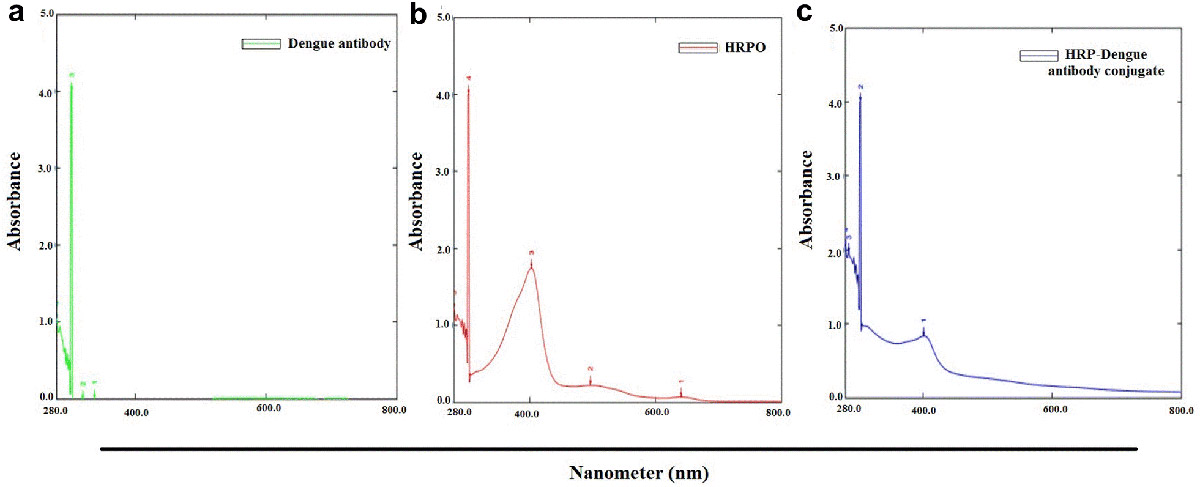 Fig. 1 Image of UV–vis absorption spectra an antibody, b Horseradish peroxidase HRPO and c HRP–antibody conjugate in the suspension solution. (Regidi S,et al., 2018)
The most classic method for labeling HRP with antibodies is the NaIO4 oxidation method. First, HRP sugar groups are oxidized into aldehyde groups. The aldehyde groups react with the -NH2 of the antibody to form a Schiff's base reaction, and the antibody molecules form a stable structure with the HRP molecules. When labeling, the molar ratio of antibody molecules to HRP molecules is generally 1:4. At this time, the mass of the two is about 1:1. To prevent the coupling of the aldehyde group of the sugar in HRP to its own protein amino group, the amino group was blocked with dinitrofluorobenzene prior to oxidation with sodium periodate. At the end of the oxidation reaction, Schiff's base is stabilized with NaBH4.
| Weighing machine | Blotting paper | Microfuge tube | Micropipette |
| Pipette | Pipette pump | Dialysis tubing membrane | Glass rod |
| Wash bottle | Dialysis clamps | Magnetic stirrer | Stir bar |
| Test tube | Gel filtration coloum | Cuvetttes | UV spectrophotometer |
The labeling step takes 2 mg of the antibody as an example.
(Note: All subsequent operations are carried out under dark conditions.)
HRP antibody labeling is a powerful technique that enhances the sensitivity and specificity of various immunoassays. The technique involves covalently attaching the HRP enzyme to an antibody molecule, allowing for the detection and quantification of specific proteins in biological samples. To optimize labeling efficiency, researchers should consider various factors such as the antibody concentration, pH of the labeling buffer, ratio of HRP to antibody, and reaction time. Creative Diagnostics offers a wide range of high-quality HRP-conjugated antibodies and labeling kits that simplify HRP antibody labeling. If you have any requirements for HRP antibody labeling, please contact us for more information.
Reference
Loading ......
