

Inquiry Basket
 Loading ......
Laboratory settings need precise serum creatinine measurements for kidney function assessment because their diagnostic outcomes depend on accuracy and reliability. Laboratories must learn technical details about each method to balance accuracy, cost, and operational efficiency when selecting from various available methods. This article reviews common creatinine detection techniques to examine their foundational principles and performance aspects while assessing their conformity to clinical standards to guide laboratories in making decisions that best suit their unique requirements.
The process of creatinine testing has made substantial progress from its beginnings with the Jaffe reaction which was established in the late 1800s. The Jaffe reaction method continues to be widely used because it creates a red-orange chromogen from creatinine and alkaline picric acid and benefits from being low-cost and straightforward. The accuracy of this method declines because of interference from substances that are not creatinine which include glucose and uric acid in addition to certain medications. The presence of hyperbilirubinemia or hemolyzed samples produces false elevations in test results that result in the renal impairment being overestimated. Jaffe's method remains in use within resource-limited settings because affordability takes precedence over specificity demands.
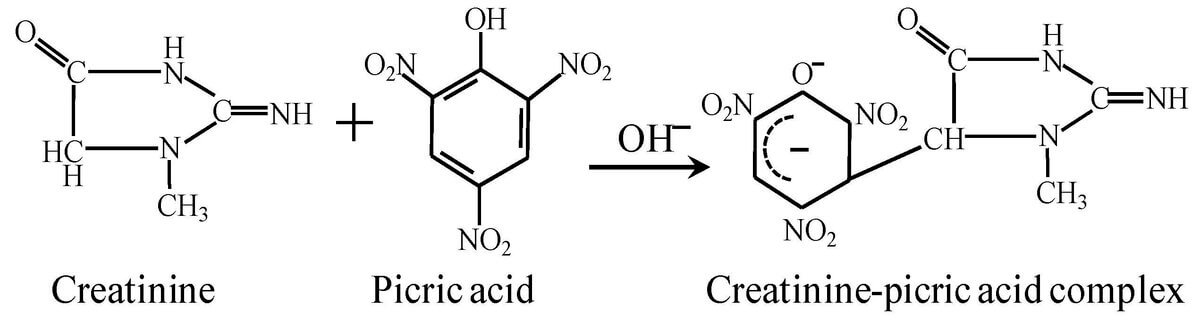 Figure 1. Jaffé reaction between creatinine sample and picric acid/NaOH indicator. (Sources: Chang TH, et al. 2018)
Enzymatic methods currently represent the preferred choice for standard routine testing procedures. These assays first use creatinine amidohydrolase to break down creatinine into creatine which then goes through enzymatic reactions to produce detectable compounds such as hydrogen peroxide through sarcosine oxidase activity. The Trinder's reaction represents the final step through which peroxidase enzyme catalyzes chromogenic substrate oxidation resulting in a color change correlated with creatinine concentration. Enzymatic methods demonstrate superior specificity by preventing interference from pseudo-creatinines such as acetone and ascorbic acid. The ability of these methods to work seamlessly with automated analyzers enhances laboratory throughput which makes them suitable for high-volume laboratory settings. Despite higher reagent expenses compared to Jaffe's method the decreased need for repeat tests along with increased diagnostic confidence make this investment worthwhile for numerous institutions.
Laboratories needing absolute precision benefit from advanced measurement techniques like isotope dilution mass spectrometry and high-performance liquid chromatography because they deliver exceptional accuracy. Global standardization bodies acknowledge IDMS as the reference method because it uses stable isotope-labeled creatinine as its internal standard. By applying this method researchers can remove matrix effects and standardize results across multiple laboratories to reach measurement uncertainties below 2%. HPLC employs chromatographic columns to separate creatinine from interfering substances which guarantees high specificity. The two methods remain essential tools for the calibration of routine assays as well as the validation process of new diagnostic platforms. Their complicated nature along with costly instruments and specialized training necessary for operation restricts their application to reference laboratories and research facilities
POCT methods together with dry chemistry techniques deliver swift outcomes while requiring only modest sample preparation steps. Dry chemistry strips incorporate reagents into their porous layers which interact with creatinine when a sample is applied. These portable systems combine user-friendly operation with suitability for urgent care and field applications. The reduced sensitivity of these systems along with their vulnerability to environmental conditions such as humidity limits their effectiveness for precise quantitative assessments. Capillary electrophoresis and immunochemical assays provide specialized options for specific applications. Capillary electrophoresis achieves high-resolution separation for nanoliter sample volumes yet faces difficulties maintaining reproducibility. Immunoassays utilize antibody-antigen interactions to achieve high sensitivity yet encounter difficulties with cross-reactivity and cost-effectiveness.
Research findings continue to demonstrate that enzymatic approaches outperform Jaffe's reaction in terms of both specificity and diagnostic precision. Enzymatic assay methods show less than 3% variability compared to IDMS while Jaffe's method reaches up to 15% deviation in response to interfering substances. The National Kidney Foundation and the International Federation of Clinical Chemistry clinical guidelines recommend using enzymatic methods or IDMS-standardized assays to determine glomerular filtration rate (eGFR). The recommendations arise because Jaffe-based results show poor harmonization that results in incorrect CKD stage classification. Laboratories that make the switch to enzymatic methods see improved agreement with cystatin C due to its high sensitivity for detecting early renal dysfunction which underscores the importance of precise creatinine measurement.
Choosing the optimal creatinine assay hinges on multiple factors:
Throughput and Automation: High-volume labs benefit from enzymatic methods integrated into automated systems, reducing manual errors and turnaround time.
Budget Constraints: While IDMS and HPLC offer precision, their operational costs may be prohibitive. Enzymatic methods strike a pragmatic balance for most clinical labs.
Standardization Needs: Labs participating in global CKD initiatives should prioritize IDMS-traceable methods to ensure data comparability.
Interference Management: Laboratories handling diverse patient populations (e.g., oncology or hepatology) require methods resistant to common interferents, favoring enzymatic assays.
In conclusion, enzymatic methods currently represent the optimal choice for routine creatinine testing, combining robust accuracy, automation compatibility, and resistance to interference. Reference labs continue to see IDMS as their top standard but must manage its increased operational needs. Laboratories can produce dependable results for kidney assessment when they match their method choice to institutional needs and clinical standards. The ongoing standardization process will lead to better renal diagnostics through the adoption of precise assays that resist interference.
Researchers favor the enzymatic method for creatinine detection because of its high specificity and minimal interference. Enzymatic assays function through a multi-step biochemical pathway which contrasts with the Jaffe reaction that depends on a non-specific colorimetric interaction of alkaline picric acid and creatinine together with other chromogens including glucose, proteins or ketones. Creatinine undergoes hydrolysis by creatinine amidohydrolase to form creatine before being further degraded into sarcosine and urea. The enzyme sarcosine oxidase processes sarcosine to produce glycine and hydrogen peroxide (H₂O₂), which subsequently interacts with a chromogen through the Trinder reaction resulting in a detectable color change. The precise nature of this method prevents false positive readings from pseudo-creatinines and hyperbilirubinemia that often distort results from Jaffe-based assessments. Enzymatic approaches demonstrate high concordance with standard IDMS techniques and deliver >95% precision for clinical samples while Jaffe methods show a deviation range of 10–15% in intricate scenarios.
The IDMS method earns gold standard status for creatinine measurement by using isotopic labeling together with advanced mass spectrometry to remove matrix effects and analytical bias. The analytical procedure requires the introduction of a predetermined amount of stable isotope-labeled creatinine (such as 13C-creatinine) into the sample to serve as an internal standard. Scientists ionize the mixture before sending it through a mass spectrometer which measures the ratio between natural creatinine and its labeled counterpart. The very similar chemical characteristics of labeled and unlabeled molecules mean that any changes occurring during extraction or ionization impact both samples equally which allows for accurate calibration. IDMS delivers measurement uncertainties below 2% which makes it critical for calibrating routine assays and defining standardized reference intervals. The requirement for costly equipment and expert knowledge restricts this method to reference labs and extensive research projects.
Dry chemistry strips enable quick and portable testing at point-of-care locations with results in 2–5 minutes yet face limitations from poor analytical sensitivity and environmental influences. The strips contain layers with reagents that interact with creatinine present in whole blood or serum to produce a color change which a reflectance meter measures. These devices fail to provide precise detection of minor creatinine level changes (such as early kidney disease) because their coefficients of variation (CVs) surpass 10% relative to laboratory procedures. The kinetics of biochemical reactions can be affected by humidity levels and temperature changes and also hematocrit concentrations resulting in measurement errors. Elevated bilirubin and lipidemia levels might prevent proper color development but hemolysis tends to produce lower than accurate results. Thus, dry chemistry methods are best suited for urgent screenings or resource-limited settings, not for definitive diagnosis or monitoring chronic kidney disease.
Accurate eGFR calculation depends on standardized, interference-resistant creatinine measurements, which directly impact clinical decisions like drug dosing or dialysis eligibility. Enzymatic methods and IDMS are endorsed by guidelines (e.g., KDIGO, NKF) because they address critical flaws in older techniques:
Standardization: IDMS-traceable assays ensure harmonized results across laboratories, reducing inter-lab variability from 20% (Jaffe) to<5%.
Reduced Bias: Enzymatic methods provide accurate creatinine measurements in patients with diabetes or liver disease because Jaffe assays produce false readings from ketones and bilirubin interference.
Early Detection: Enhanced accuracy allows identification of mild renal dysfunction (eGFR 60–90 mL/min/1.73m²) typically undetected by Jaffe-based eGFR calculations.
A patient with an actual creatinine level of 1.2 mg/dL will show 1.0 mg/dL through enzymatic assays resulting in an eGFR of 68 while Jaffe assays show 0.8 mg/dL resulting in an eGFR of 85 which delays CKD staging.
Capillary electrophoresis (CE) and immunosensors represent niche advancements with unique advantages and hurdles:
CE separates creatinine from interferents using an electric field in a silica capillary, achieving high resolution with minimal sample volume (1–10 nL). However, protein adsorption on capillary walls and batch-to-batch reproducibility issues hinder its adoption.
Immunosensors employ anti-creatinine antibodies immobilized on electrodes or optical surfaces. Binding events are transduced into electrical or optical signals, offering ultra-low detection limits (0.01 mg/dL). Yet, cross-reactivity with structurally similar molecules (e.g., creatine) and high production costs remain challenges.
While these technologies are promising for specialized applications (e.g., neonatal testing or multiplexed panels), they currently lack the robustness and cost-effectiveness required to replace enzymatic or IDMS methods in routine practice.
Elevate your laboratory's capabilities with Creative Diagnostics' anti-creatinine antibodies and ELISA kits, engineered to deliver unmatched specificity and reproducibility in renal function studies. Our antibodies target creatinine with high affinity, minimizing cross-reactivity with structural analogs like creatine or urea, ensuring data integrity even in complex biological matrices. Whether refining diagnostic assays or advancing biomarker discovery, Creative Diagnostics provides the tools to transform renal health insights. Explore our catalog today and partner with innovation—where accuracy meets purpose.
Reference
| Target | Cat. No. | Product Name | Host | Application | |
| Creatinine | DMAB27374 | Anti-Creatinine Monoclonal antibody, clone NBC20353 | Sheep | ELISA, WB, Dot, IHC, IA | Inquiry |
| Target | Cat. No. | Product Name | Type | Host | Conjugate | Application | |
| Creatinine | DAG-WT2531 | Creatinine control | Synthetic | N/A | Unconjugated | Calibration, Control | Inquiry |
| Creatinine | DAGA-369 | Creatinine Standard (98%) | N/A | N/A | ELISA | Inquiry | |
| Creatinine | DAG608S | Creatinine [BSA] | Synthetic | N/A | BSA | ELISA, LFIA | Inquiry |
| Creatinine | DAG1075 | Creatinine(N) [HRP] | Synthetic | N/A | HRP | N/A | Inquiry |
| Target | Cat. No. | Product Name | Size | Species Reactivity | Application | |
| Creatinine | DEIABL-M4 | Cr(Creatinine) Assay Kit(Colorimetric) | 96T | Universal | Quantitative | Inquiry |
| Creatinine | DEIA-XYL4 | Creatinine ELISA Kit | 96T | Human, Research Animal | Quantitative | Inquiry |
Loading ......
