
Inquiry Basket
 Loading ......
Rickettsia typhi, also known as Rickettsia morovoni, belongs to the order Rickettsia, family Rickettsiaceae, genus Rickettsia, group typhus. Rickettsia typhi has varying degrees of toxicity to humans and livestock and can cause endemic typhus in humans.
The size and shape of Rickettsia morovoni are the same as those of Rickettsia prowazekii. They are mostly club-shaped or small rod-shaped, and may also be arranged in filaments or chains, but they are not as common as Rickettsia prowazekii. The size is 0.3~0.7μm×0.8~2μm. Observation under an electron microscope shows three layers of cell walls and three layers of cytoplasmic membrane, which are the unit membrane structures of typical bacterial cells. DNA, ribosomes, electron-transparent areas, vacuoles and small membranous organs can be seen in the cytoplasm. Rickettsia morovoni can be stained red by Macchiavello or Giemnitz, and purple-red by Giemsa, which can show two extreme strong stains. Interestingly, Rickettsia morovoni has varying degrees of toxicity to humans and livestock, and can cause endemic typhus disease in humans.
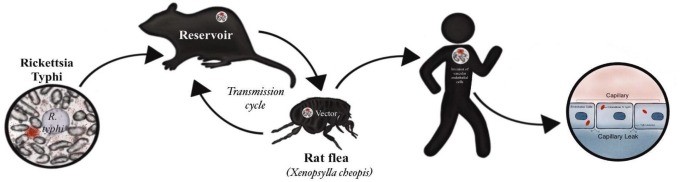 Figure 1. Illustrates the mechanism of transmission of R. typhi from the reservoir to the vector and subsequently infecting a human. (Talhelm CF, et al.; 2020)
The clinical features of endemic typhus are similar to those of epidemic typhus, except that the symptoms are milder and the course of the disease is shorter. The mode of transmission of Rickettsia morovoni is different from that of Rickettsia prowazekii. Rickettsia mosnii parasitizes latently infected mice for a long time. After rat fleas suck the blood of mice, the rickettsiae enter their digestive tract and multiply in the intestinal epithelial cells. After the cells rupture, the rickettsiae are released, mixed into flea feces, and spread among groups of mice and house mice. Rat fleas only leave the rat after the rat dies and turn to bite human blood, thereby infecting humans. At this time, the human body is parasitized by human lice, which can be transmitted among the population secondaryly through human lice. In addition, dried flea feces containing rickettsiae can also enter the human body through the mouth, nose and conjunctiva of the eyes and cause disease. There is cross-immunity with Rickettsia prowazekii after infection with Rickettsia morovoni.
IFA is the "gold standard" method for detecting Rickettsia moschoniii. The WHO standard method is briefly described as follows: use 3% skimmed milk powder PBS to make serial comparative dilutions of patient serum, and IgM>1:40 and IgG>1:80 are used as the positive endpoints. Add the diluted serum into the antigen well, incubate for 60 minutes at 37°C in a wet box, wash twice with PBS, 10 minutes each time, and finally wash with sterile water for 10 minutes. Add fluorescently labeled anti-human IgM or IgG, incubate for 60 minutes at 37°C in a wet box, and wash twice with PBS, 10 min each time, and finally washed with sterile water for 10 min, added fluorescently labeled anti-human IgM or IgG, incubated in a wet box at 37°C for 60 min, washed twice with PBS, 10 min each time, dried and mounted with glycerol for microscopy. Note that when detecting IgM, the serum must be treated with rheumatoid factor removal in advance to remove the influence of IgG.
On the concave well plate, the serum is serially diluted with physiological saline. Add 0.5 ml of diluted serum to each well, then add an equal amount of diluted antigen, and observe the results overnight at room temperature or 37°C for 2 hours. Physiological saline was used instead of serum as a negative control. Observation of the results, using the negative control as the standard, the highest dilution of the serum to produce a "+" agglutination (1/4 bacterial agglutination) is the end point. A single serum antibody titer of OX19 or OX2 is ≥1:160 as positive. A 4-fold increase in duplicate serum has clear diagnostic significance.
Reference
| Target | Cat. No. | Product Name | Expression System | Tag/Conjugate | Application | |
| R. rickettsii Omp | DAG-WT756 | R. rickettsii Omp | Baculovirus | His | N/A | Inquiry |
| DAG-WT757 | R. rickettsii Omp | E. coli | His | N/A | Inquiry | |
| R. typhi | DAGF-008 | R. typhi | E. coli | His | Inquiry | |
| Rickettsia typhi | DAGF-002 | Rickettsia typhi | E. coli | His | WB, ELISA | Inquiry |
Loading ......
