
Inquiry Basket
 Loading ......
Filter By Product Search for
ATP8B4
ATP8B4 Full Name
ATPase, class I, type 8B, member 4
ATP8B4 Introduction
ATP8B4 (ATPase, class I, type 8B, member 4) is a member of the P4-ATPase family, a group of ATP-dependent phospholipid flippases that maintain membrane lipid asymmetry by transporting specific phospholipids from the exoplasmic/luminal leaflet to the cytoplasmic leaflet of biological membranes. Unlike several well-characterized P4-ATPases such as ATP8B1 and ATP11C, the exact endogenous substrate preference and physiological transport activity of ATP8B4 remain incompletely defined. Current evidence suggests that ATP8B4 functions as a phospholipid transporter with a molecular architecture similar to other P4-ATPases, potentially contributing to membrane organization, lipid homeostasis, and cellular signaling processes. Because disruption of phospholipid distribution can affect immune responses, neuronal function, and intracellular trafficking, understanding ATP8B4 biology may provide important insights into diseases where lipid imbalance and cellular dysfunction are central mechanisms.
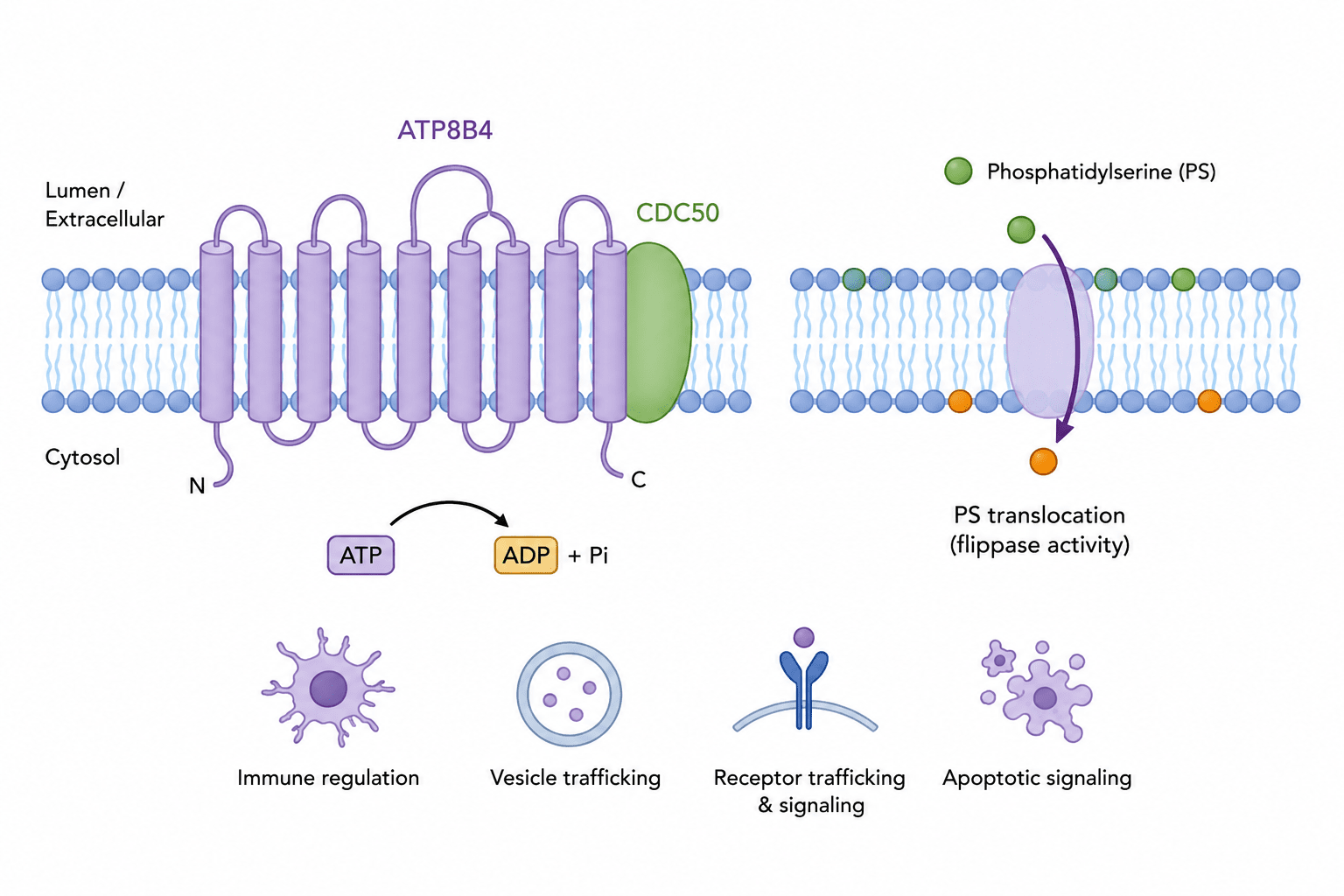
Recent genetic studies have highlighted ATP8B4 as an emerging disease-associated target, particularly in neurodegenerative and autoimmune disorders. Large-scale exome sequencing has identified rare damaging variants in ATP8B4 as risk factors for Alzheimer's disease (AD), with evidence suggesting that ATP8B4 is predominantly expressed in brain microglia and may influence neuroimmune pathways through regulation of lipid metabolism and membrane dynamics. The identification of recurrent missense variants, including G395S, has provided strong genetic support linking ATP8B4 dysfunction to AD susceptibility, although the disease mechanism may not simply result from complete loss of function. Genome-wide association studies have also reported ATP8B4-related genetic signals associated with Alzheimer's disease, further supporting its potential role in modulating disease risk through lipid-related pathways in the central nervous system.
Beyond neurodegeneration, ATP8B4 has also been implicated in autoimmune disease susceptibility, particularly systemic sclerosis (SSc), a complex disorder characterized by immune dysregulation and progressive fibrosis. Whole-exome sequencing studies identified rare ATP8B4 coding variants enriched in SSc patients, suggesting that altered phospholipid transport may contribute to abnormal immune activation or extracellular matrix-related processes. Although the precise biological mechanisms linking ATP8B4 variants to disease progression remain under investigation, current findings position ATP8B4 as a promising research target connecting membrane lipid regulation, immune homeostasis, and neurological health. Further functional studies are needed to define ATP8B4 substrates, regulatory partners, and therapeutic potential, which may help researchers develop new strategies for targeting lipid-associated pathways in Alzheimer's disease and autoimmune disorders.
Alternate Names for ATP8B4
ATP8B4; ATPase, class I, type 8B, member 4; probable phospholipid-transporting ATPase IM; ATPIM; KIAA1939; ATPase class I type 8B member 4; Potential phospholipid transporting ATPase IM; Probable phospholipid transporting ATPase IM; potential phospholipid-transporting ATPase IM
Loading ......
