
Inquiry Basket
 Loading ......
Schwann cells are a vital component of the peripheral nervous system (PNS), playing a crucial role in supporting and protecting nerve fibers. Understanding the markers associated with Schwann cells is essential for studying their development, function, and potential therapeutic applications.
Schwann cells are the most important glial cells unique to the PNS. They have similar functions to oligodendrocytes, forming myelin sheaths and helping neurons transmit signals. Unlike oligodendrocytes, Schwann cells form a spiral-like structure around the axon, while oligodendrocytes extend from the central cell to the surroundings. Schwann cells play an important role in peripheral nerve development and regeneration after injury. Schwann cells are also part of the immune cells in the PNS. When nerve cells are damaged, they can engulf the axons of the nerve and provide a protective pathway for the formation of new axons.
Schwann cells originate from neural crest cells and undergo specific stages of development. It is important to identify markers that are expressed during different Schwann cell stages to accurately characterize their properties. These stages include:
During the early stages of Schwann cell development, specific markers are expressed, indicating their transition from neural crest cells to Schwann cell precursors. Some suggested markers for Schwann cell precursors include SOX10, GAP43, BLBP, MPZ, DHH, and P75NTR. These markers play crucial roles in Schwann cell specification and early differentiation processes.
As Schwann cells mature, they undergo a myelination process where they form the myelin sheath around axons. Key markers expressed by myelinating Schwann cells include SOX10, S100, EGR2, MBP, and MPZ. These markers are involved in the regulation of myelin synthesis and maintenance, ensuring proper nerve conduction.
In addition to myelinating Schwann cells, the peripheral nervous system also contains non-myelinating Schwann cells. These cells surround several small-diameter axons, ensheathing each axon in a pocket of its cytoplasm, forming a Remak bundle. They provide essential support and nutrition to the axons, ensuring their survival and proper functioning. Some common markers for non-myelinating Schwann cells include SOX10, GAP43, S100, NCAM, and P75NTR. These markers are involved in processes such as cell adhesion, cytoplasmic signaling, and neural crest-derived cell identification.
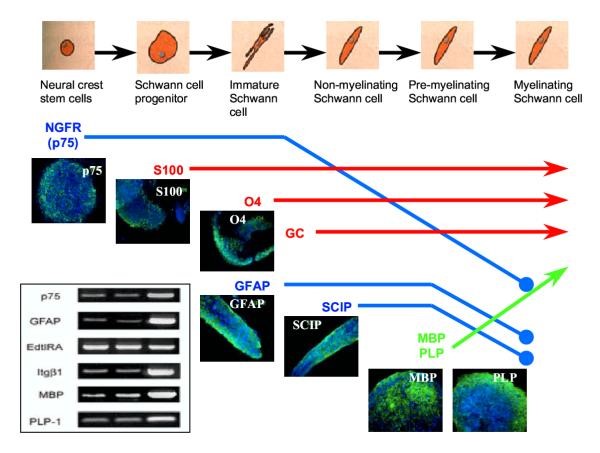 Fig. 1 A schematic presentation of Schwann cell markers expressed during various developmental stages. (Pau K Y, et al., 2004)
Schwann cell markers serve as valuable tools for researchers and clinicians in distinguishing Schwann cells from other cell types within peripheral nerves. By using specific markers, scientists can accurately identify and isolate Schwann cells, enabling further investigation into their properties, functions, and interactions with other cells. These markers also aid in the diagnosis and monitoring of peripheral nerve-related disorders, such as peripheral neuropathy and nerve tumors.
| SOX10 | SOX10 is a transcription factor that is essential for Schwann cell development and myelination. It regulates the expression of genes involved in Schwann cell differentiation and myelin formation. SOX10 is expressed in both Schwann cell precursors and mature Schwann cells. |
| S100 | S100 proteins are a family of calcium-binding proteins that are commonly expressed by Schwann cells. They are involved in various cellular processes, including cytoskeletal organization, cell signaling, and intracellular calcium regulation. S100 markers, such as S100B and S100β, have been widely used to identify Schwann cells in immunohistochemistry and immunocytochemistry studies. |
| EGR2 | Early growth response 2 (EGR2), also known as Krox20, is a transcription factor that plays a critical role in Schwann cell myelination. It regulates the expression of myelin-associated genes, such as myelin basic protein (MBP) and peripheral myelin protein 22 (PMP22). EGR2 is predominantly expressed by myelinating Schwann cells. |
| MPZ | Myelin protein zero (MPZ), also called P0 protein, is a major structural component of peripheral myelin. It is specifically expressed by myelinating Schwann cells and is essential for the formation and stability of the myelin sheath. Mutations in the MPZ gene are associated with peripheral neuropathies. |
| GAP43 | Growth-associated protein 43 (GAP43) is a membrane protein that is involved in neuronal growth and axon regeneration. It is expressed by both Schwann cells and neurons during development and nerve regeneration. GAP43 is used as a marker to study Schwann cell plasticity and nerve repair processes. |
| NCAM | Neural cell adhesion molecule (NCAM) is a cell surface glycoprotein involved in cell-cell adhesion, neurite outgrowth, and synaptic plasticity. It is expressed by both Schwann cells and neurons and is important for Schwann cell-axon interactions during peripheral nerve development and regeneration. |
| P75NTR | The p75 neurotrophin receptor (P75NTR) is a transmembrane receptor that binds to various neurotrophins and is expressed by Schwann cells. It has been implicated in Schwann cell survival, differentiation, and myelination. |
Schwann cell markers play a crucial role in the study of Schwann cell biology and peripheral nerve-related disorders. The identification and characterization of these markers enable researchers and clinicians to gain a deeper understanding of Schwann cell functions, interactions, and their involvement in neurological conditions. As a leading company in the field of biological research, Creative Diagnostics provides a wide range of high-quality antibodies and reagents targeting Schwann cell markers. These tools empower scientists to advance their research and enhance diagnostic capabilities, ultimately contributing to the development of novel therapeutic approaches for peripheral nerve disorders.
References
Loading ......
