
Inquiry Basket
 Loading ......
Salivary gland tumors are diseases that occur in the salivary gland tissue, with common sites including the parotid gland (about 80%), submandibular gland, and small salivary gland. The pathological types are complex and diverse, with the vast majority being epithelial tumors and few originating from mesenchymal tissue. Benign tumors are more common in the parotid gland, with a benign to malignant ratio of about 3:1, while the proportion of malignant tumors in sublingual gland tumors is as high as 90%. The age range of onset is relatively large, with benign lesions being predominant in adults and malignant lesions being predominant in children.
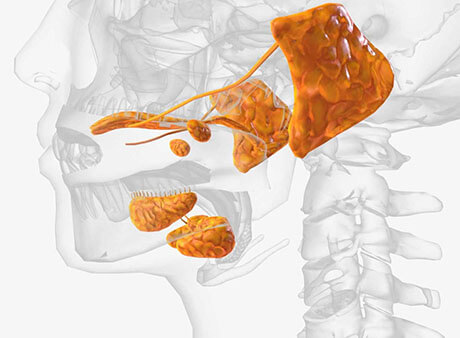 Figure 1. Salivary Gland Cancer.
The clinical manifestations of this disease vary depending on the nature of the tumor. Benign tumors usually present as painless active masses, while malignant tumors are often accompanied by pain and invasive growth. Alveolar cell carcinoma belongs to malignant epithelial tumors of the salivary gland, which are more common in middle-aged women, with 80% occurring in the parotid gland. It grows slowly but infiltrates, and a few may rapidly enlarge and adhere to surrounding tissues. Diagnosis mainly relies on imaging examinations (B-ultrasound, CT, MRI) and histopathological analysis of tissues. Surgical resection is the main treatment, and malignant tumors require a combination of radiotherapy or chemotherapy.
1. According to their nature, they can be divided into benign tumors and malignant tumors;
2. According to the location of occurrence, it can be divided into parotid gland tumors, submandibular gland tumors, sublingual gland tumors, small salivary gland tumors, molar posterior gland tumors, tongue gland tumors, lip gland tumors, etc.
3. According to pathological types, it can be divided into pleomorphic adenoma, ovarian cancer, mucoepidermoid carcinoma, adenoid cystic carcinoma, eosinophilic adenoma, etc.
1. Incidence rate: There is a significant difference in the incidence rate of different countries, and the literature report is 0.15-1.6/100000.
2. Age of occurrence: It can occur at any age. Adults are more benign than malignant, and children are more malignant than benign.
3. Gender ratio: There are more women than men with pleomorphic adenoma and mucoepidermoid carcinoma, and there are significantly more men than women with ovarian cancer.
4. Proportion of salivary gland tumors to systemic tumors: Large salivary gland tumors account for 5% of all benign and malignant tumors except for the skin, and 20.6% of oral and maxillofacial tumors.
5. Location of occurrence: Among all salivary gland tumors, parotid gland tumors have the highest incidence rate, accounting for about 80%; The submandibular gland accounts for 10%; Sublingual gland tumors account for 1%, while small salivary gland tumors account for 9%. The most common type in small salivary glands is the palatal gland.
6. Proportion of benign and malignant tumors: The proportion varies in different locations. The benign/malignant ratio in parotid gland tumors is about 3:1; The ratio in the submandibular gland is 3:2; Malignant tumors in sublingual gland tumors account for up to 90%, and malignant tumors in small salivary glands also account for up to 60%.
| Diagnosis Method | Details |
| B-mode ultrasonography | 1. More practical for lesions of large salivary glands; 2. Can determine the presence of space occupying lesions and the size of tumors, and preliminarily evaluate the nature of the lesions; 3. Due to its safety, speed, repeatability, and low cost, B-ultrasound examination can be listed as the first choice. |
| CT | 1. Can determine the location of the tumor and its relationship with surrounding tissues. 2. It is particularly suitable for tumors in the deep lobe of the parotid gland, especially those that are difficult to distinguish from pharyngeal tumors, and those with a wide range. |
| Salivary gland imaging | 1. It has high diagnostic value for salivary gland inflammation and Sjogren's syndrome. 2. In addition to its certain value in certain diseases of the salivary gland, salivary gland imaging has been rarely used in the diagnosis of salivary gland tumors since the 1980s due to the widespread application of examination methods such as B-ultrasound. |
The tumor has no adhesion to the facial nerve, and the facial nerve should be preserved as much as possible while minimizing mechanical damage. When there is mild adhesion between the tumor and the facial nerve, but it can still be separated, it should be preserved as much as possible and postoperative radiation therapy should be added. If there is facial paralysis before surgery, or if the facial nerve is found to pass through the tumor during surgery, or if it is a highly malignant tumor, the facial nerve should be sacrificed and then repaired.
In clinical practice, if enlarged lymph nodes are found and lymph node metastasis is suspected, therapeutic lymph node dissection can be chosen. For those who have not reached the enlarged lymph nodes in the neck or do not suspect metastasis, selective neck lymph node dissection should not be performed. For highly malignant tumors, selective neck lymph node dissection should generally be considered.
Salivary gland malignant tumors are not sensitive to radiation, and simple radiation therapy is difficult to achieve a curative effect. However, for certain tumors, radiation therapy can significantly reduce the postoperative recurrence rate, such as adenoid cystic carcinoma and other highly malignant tumors, those with incomplete surgical resection and residual tumors, and those with tumors closely attached to and separated from the facial nerve while preserving the facial nerve.
Malignant tumors of the salivary gland may undergo distant metastasis, especially adenoid cystic carcinoma and salivary ductal carcinoma, with a distant metastasis rate of about 40%. Therefore, postoperative chemotherapy is necessary for prevention, but currently no highly effective chemotherapy drugs have been found.
| Cat. No. | Product Name | Host | Isotype | Application | |
| CABT-BL2383 | Anti-MFSD1 (internal region) polyclonal antibody | Rabbit | IgG | ELISA, WB, IHC-P | Inquiry |
| Cat. No. | Product Name | Size | Target | Species | |
| CDBP1870 | Human MFSD1 blocking peptide | 50 μg | MFSD1 | Human | Inquiry |
Loading ......
