
Inquiry Basket
 Loading ......
Retinoblastoma is a rare cancer affecting the eyes of children that develops in the retina which functions as the light-sensitive inner lining at the eye's rear. Retinoblastoma stands as the most common primary intraocular cancer during childhood development and typically develops before children reach five years old in one or both eyes. Combining early identification of retinoblastoma with contemporary therapies achieves survival rates exceeding 95% in developed regions. People living in areas with limited resources encounter substantial delays in diagnosis that often lead to blindness or loss of life. This thorough resource examines the beginnings of retinoblastoma as well as its symptoms and diagnostic methods while presenting treatment options and recent research developments.
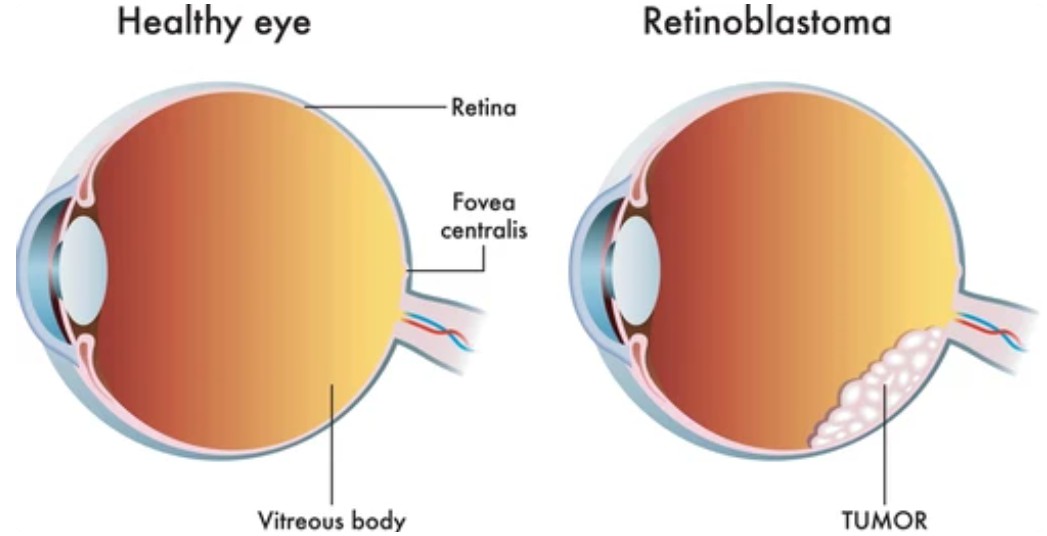 Figure 1. Retinoblastoma.
Each year doctors diagnose retinoblastoma in about 8,000 children while the incidence rate stands at approximately 1 in 15,000-20,000 live births. Key epidemiological facts include:
The RB1 gene mutation on chromosome 13 represents the essential cause of retinoblastoma as this gene is a crucial tumor suppressor. Tumor suppressor genes function like brakes to control cell growth by regulating cell division and stopping uncontrolled cell proliferation.
The RB1 Gene and Two-Hit Hypothesis

A child with hereditary retinoblastoma receives one defective RB1 gene from their parent which represents the initial mutation. The presence of this genetic mutation in all cells throughout their body predisposes them to cancer development. A single retinoblast cell develops the second "hit" when the remaining healthy RB1 gene copy experiences a new spontaneous mutation. The second genetic change eliminates functional RB1 protein entirely which triggers tumor development. The inherited nature of the initial genetic mutation makes these children more susceptible to multiple tumors which can affect both eyes. A child with non-hereditary retinoblastoma begins life with two unaffected RB1 genes. Two spontaneous mutations happen within the same retinoblast cell during early childhood. The random development of mutations in retinoblastoma cells accounts for the condition's impact on just one eye and its absence in familial inheritance patterns.
The presence of retinoblastoma changes the way light reflects off the tumor resulting in the pupil taking on a white, yellowish-white, or pinkish appearance rather than red. In flash photography, pictures often show an eye with the usual "red eye" effect next to an affected eye that displays a white or glowing look.
Less Common Symptoms
Some less frequent signs and symptoms that may present include:
| Stage | 5-Year Survival |
| Intraocular | 95-98% |
| Orbital extension | 70-80% |
| CNS metastasis | <10% |
Recognizing symptoms of retinoblastoma early helps save lives. The most common clinical manifestations include:
| Stage | 5-Year Survival |
| Leukocoria (56% of cases) |
|
| Strabismus (20% of cases) |
|
| Other Presenting Symptoms |
|
Retinoblastoma diagnosis starts with a complete eye examination followed by advanced imaging techniques and genetic analysis. Effective treatment and better patient results depend heavily on the early and precise identification of medical conditions.


Staging establishes how far cancer has advanced through the body. Retinoblastoma staging helps select the best treatment approach and assesses both the probability of saving the eye and the patient's overall prognosis. The International Intraocular Retinoblastoma Classification (IIRC) system classifies eye-confined tumors while the International Retinoblastoma Staging System (IRSS) stages all retinoblastoma forms including extraocular manifestations.
International Intraocular Retinoblastoma Classification (IIRC)
The classification system assists treatment decisions by evaluating intraocular tumor types to estimate eye preservation probability. The classification system divides tumors into five categories labeled A through E according to their dimensions and placement along with the existence of vitreous or subretinal seeding (tumor cells that float within the eye fluids or beneath the retina).
The development of retinoblastoma treatment from a fatal disease into a largely curable condition demonstrates remarkable progress. Disparities between countries continue to exist requiring ongoing dedicated work in the following areas:
The combination of precision medicine progress and worldwide cooperation makes the goal of saving every retinoblastoma patient while preserving their sight more achievable than ever. The medical community's steadfast dedication to defeating childhood eye cancer offers hope to families who receive this diagnosis.
| Cat. No. | Product Name | Host | Isotype | Application | |
| CABT-NS1520 | Mouse Anti-Parainfluenza Virus 1 Monoclonal Antibody, clone MN337 | Mouse | IgG2a | ELISA, IF | Inquiry |
| CABT-NS1521 | Mouse Anti-Parainfluenza Virus 1 Monoclonal Antibody, clone MN338 | Mouse | IgG2a | ELISA, IF | Inquiry |
| DMABB-JX251 | Rabbit Anti-Human INI1(SNF5/SMARCB1) monoclonal antibody, clone SN579 | Rabbit | IgG | IHC, WB | Inquiry |
| DMAB-CDB25211 | Hi-Affi 6 4 Recombinant Mouse Anti-Human PSMD10 Monoclonal antibody, clone F5 | Mouse | IgG | WB, ELISA, FuncS | Inquiry |
| DMAB-CDB25212 | Hi-Affi 6 4 Recombinant Human Anti-Human PSMD10 Monoclonal antibody, clone F5 | Human | IgG | WB, ELISA, FuncS | Inquiry |
| DMAB-CDB25213 | Hi-Affi 6 4 Recombinant Rabbit Anti-Human PSMD10 Monoclonal antibody, clone F5 | Rabbit | IgG | WB, ELISA, FuncS | Inquiry |
| Cat. No. | Product Name | Size | Species Reactivity | Application | Detection Method | |
| DEIA-XYA1874 | KNTC2 ELISA Kit | 96T | Human, Mouse | Qualitative | / | Inquiry |
| DEIA-XYA1559 | Retinoblastoma ELISA Kit | 96T | Human, Mouse, Rat | Qualitative | / | Inquiry |
| DEIA-XYA1559 | Retinoblastoma ELISA Kit | 96T | Human, Mouse, Rat | Qualitative | Inquiry |
| Cat. No. | Product Name | Size | Target | Species | |
| DAG-P1929 | RB1 peptide | / | / | / | Inquiry |
| DAG-P1929 | RB1 peptide | / | / | / | Inquiry |
| DAG-P1925 | Human RBBP4 peptide | / | / | / | Inquiry |
| DAG-P1126 | Human PRDM2 blocking peptide | / | / | / | Inquiry |
Loading ......
