
Inquiry Basket
 Loading ......
Skin cancer (most commonly on sun-exposed skin) occurs when an error (mutation) in the DNA of skin cells causes the cells to grow out of control and form large numbers of cancer cells. Skin cancer starts in the top layer of the skin (the epidermis). The epidermis contains three main types of cells, corresponding to the three main skin cancers:
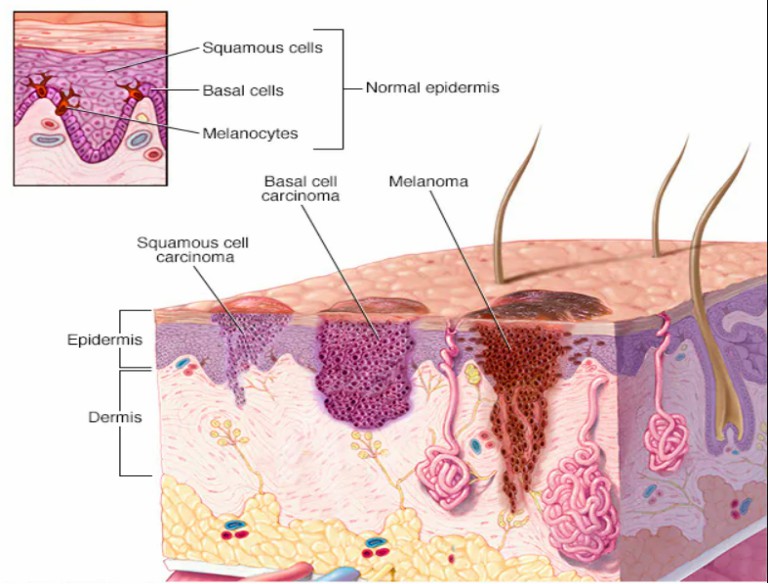 Fig. 1 Anatomy of skin structure
Patients with different skin cancers will have different symptoms. The three main types of skin cancer symptoms are as follows, A pearly or waxy bump, A flat, flesh-colored or brown scar-like lesion, Bleeding or scabbing, sore that heals and returns (Basal cell carcinoma); A firm, red nodule, A flat lesion with a scaly, crusted surface (Squamous cell carcinoma); A large brownish spot with darker speckles, A mole that changes in color, size or feel or that bleeds, A painful lesion that itches or burns, Dark lesions on your palms, soles, fingertips or toes, or on mucous membranes lining your mouth, nose, vagina or anus (Melanoma).
Most of the damage to DNA in skin cells is caused by ultraviolet (UV) radiation from sunlight and the lights used in tanning beds. Skin cancer that develops on skin not exposed to the sun involves other factors, such as exposure to toxic substances or having a disease that weakens the immune system. Factors that may increase the risk of skin cancer include fair skin, history of sunburn, excessive sun exposure, high-altitude climate, moles, having actinic keratosis, family history of skin cancer, and exposure to certain substances (such as arsenic), etc.
The molecular and genetic basis for the development of skin cancers involves multiple pathways, the misregulation of which, leads to abnormal cell proliferation and tumorigenesis, promotion, and progression. Major signaling pathways currently known to be deregulated in melanoma with an implication to its development and progression are Ras, B-Raf, MEK, PTEN, phosphatidylinositol-3 kinase (PI3Ks) and Akt, etc., which are constitutively activated in a significant number of melanoma tumors, in most cases due to genomic change. Other pathways involved include the hedgehog pathway in basal cell carcinoma, the p53 (TP53) pathway in squamous cell carcinoma, and the BRAF pathway in melanoma. In addition, proteins like nuclear factor-κB (NF-κB), signal transducer and activator of transcription 3 (STAT3) and hypoxia-inducible factor 1α (HIF-1α) also play a role in skin carcinogenesis.
 Fig.2 Sonic hedgehog signaling pathway
The diagnosis of skin cancer usually involves a skin examination to confirm whether skin changes are symptoms of skin cancer, a skin biopsy for suspicious skin tissue for diagnosis, and also determining the type of skin cancer. Other tests (CT, MRI, PET, bone scan) could be required to check nearby tissues and organs for signs of cancer to determine if the tumor has metastasized.
In addition, novel tumor markers, such as GPC3 (melanoma diagnosis), PTCH mutation (basal cell nevus syndrome), tumor suppressor gene TP53, phosphorylated signal transducers and activators of transcription (pSTAT1, pSTAT3), miR145-5p and miR203- 3p (tumor invasion), melanoma progression and metastasis (MIA, MITF, PAX3) are commonly used for auxiliary diagnosis and prognosis of skin cancer. Other related targets include cell cycle regulator CDKN1A, Wnt pathway regulator DKK1, receptor tyrosine kinase EPHA2, growth factor GDF15, ferredoxin reductase (FDXR), p53-inducible protein TP5313, transcription factor ATF3, DNA repair Enzymes DDB2 and β-adrenergic receptor ADBR2 are currently being actively studied.
Small skin cancers that are confined to the surface of the skin may not require treatment, and an initial skin biopsy can remove the entire cancerous tissue. If additional treatments are required, options may include cryotherapy, excisional surgery, Mohs surgery, curettage and electrodesiccation, chemoradiotherapy, and photodynamic therapy. Multiple targeted therapies can also be used in the treatment of skin cancer, Such as ipilimumab and vemurafenib for the treatment of metastatic melanoma with BRAF proto-oncogene (BRAF) mutations, pembrolizumab and nivolumab for unresectable and metastatic melanoma, Vismodegib (Erivedge) and Sonidegib (Odomzo) (Hedgehog pathway inhibitors) used to treat some advanced or recurrent basal cell skin cancers; cetuximab (an EGFR inhibitor) used to treat squamous cell skin cancers.
Loading ......
