
Inquiry Basket
 Loading ......
Pyrrolobenzodiazepine (PBD) toxins represent a fascinating group of natural products that transformed from simple antibiotic agents into powerful cancer treatment tools. The distinctive structure of these molecules enables them to attach to the DNA minor groove thereby positioning them as potential candidates for targeted cancer treatments. This article investigates the development of PBD toxins which transitioned from antibiotic use to become advanced cancer treatment agents. During our exploration we will investigate how PBDs function and examine how synthetic chemistry progressions are determining their future.
Scientists discovered pyrrolobenzodiazepine toxins in the 1980s when they isolated them from multiple Streptomyces strains which produce numerous bioactive substances. Researchers first explored these compounds because they disrupted bacterial DNA replication which suggested potential antibiotic applications. Researchers identified PBD molecules as a groundbreaking discovery in natural product history because their distinctive structure promised potential applications beyond just fighting bacterial infections.
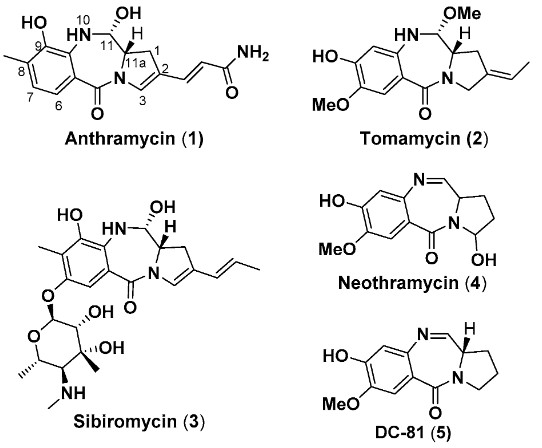 Figure 1. Structures of naturally occurring PBD monomers 1–5. (Sources: Ferguson L, et al. 2020)
The PBD structure combines a pyrrole ring with a benzodiazepine core which enables the molecule to precisely interact with the DNA double helix. The biological activity of PBDs depends on their interaction with the DNA minor groove. PBDs capture scientific interest through their capacity to generate DNA adducts and produce crosslinks between DNA strands which disrupt DNA replication and cell division processes. Their unique characteristic has established them as potential anticancer agents beyond their antibiotic function.
PBD toxins belong to the category of DNA minor groove binders because they attach themselves exclusively to the minor groove region of the DNA double helix. The minor groove presents specific sites that perfectly fit the distinctive structure of the PBD molecule enabling highly selective binding. Binding of the PBDs results in major DNA structural alterations that halt the normal operation of DNA replication machinery. This interference leads to cell cycle arrest which eventually causes cell death.
The therapeutic potential of PBD toxins stems from their ability to specifically attack cancer cells. The rapid and unregulated replication of DNA in cancer cells increases their vulnerability to DNA damage. The DNA-binding properties of PBDs enable scientists to create targeted cancer cell therapies that minimize harm to normal healthy cells. Researchers increasingly study PBDs for cancer treatment because their selective toxicity offers potential therapy against several cancer types including leukemia, lymphoma and solid tumors.
PBD molecules maintain a standard structural backbone yet display substantial variability in chemical properties along with biological activities. The existence of different PBD toxins stems from their dimeric structure. PBD dimers consist of two PBD monomers connected together through either peptide or chemical bonds. Structural and functional characteristics form the basis for dimer classification which becomes essential for their effectiveness in cancer therapy.
The following text provides a simple comparison between major PBD dimer classes.
| PBD Dimer Class | Structural Features | Biological Activity | Cancer Therapeutic Potential |
| Type I Dimer | Two PBD monomers linked by a short peptide | Strong DNA crosslinking and high cytotoxicity | Suitable for aggressive cancers requiring DNA crosslinking |
| Type II Dimer | Two PBD monomers with a longer linker | Moderate DNA binding, more selective | Effective in targeting specific tumor types |
| Type III Dimer | Two PBD monomers linked via a synthetic spacer | Low toxicity, high specificity | Promising for targeted therapies with reduced side effects |
Every PBD dimer class possesses its own set of benefits and disadvantages. Type I dimers exhibit high cytotoxic properties that cause substantial DNA damage which makes them suitable for treating cancers that do not respond to standard treatments. Type II and Type III dimers enhance selectivity in targeting cancer cells which decreases off-target effects to improve therapeutic outcomes. The continued research and optimization of PBD dimer classes leads to expanding opportunities for PBD-based cancer therapies which show promise for more effective treatments with reduced side effects.
The pharmaceutical industry recently embraced antibiotic repurposing as PBD toxins demonstrate the potential to convert antibiotics into cancer treatments. The process of repurposing takes medications originally created for a specific use and discovers additional medical uses for them. The main benefits of this strategy include reduced development time and decreased costs because necessary safety and pharmacokinetic studies have already been conducted.
Originally PBDs attracted research attention for their antibiotic properties until their anticancer potential led cancer researchers to study them more. Research teams have initiated clinical trials to evaluate PBD-based chemical treatments against multiple cancer types including mesothelioma alongside ovarian and prostate cancer. While researchers must overcome obstacles like toxicity and delivery systems, the new use of PBDs as cancer treatments could transform cancer care especially for difficult cancers to treat.
The ability of synthetic chemistry to enhance therapeutic properties makes PBD research particularly promising. Researchers constantly modify the chemical structure of PBD toxins to enhance their therapeutic effectiveness by improving both potency and selectivity while optimizing their pharmacokinetic characteristics. Researchers utilize synthetic chemistry methods to develop PBD analogs that specifically target cancer cells and reduce overall toxicity in the body.
The drug's crosslinking capability with DNA and induction of cell death are affected by structural changes to the linker regions between PBD monomers. Structural modifications enable researchers to boost cancer drug effectiveness while minimizing damage to healthy cells. Research teams are actively working to enhance PBD-based drug formulations through improved solubility and bioavailability leading to clinical effectiveness.
The development of advanced drug delivery systems is enabling better targeting and releasing of PBD toxins within cancer cells. The targeted delivery of PBD drugs to tumor sites through nanoparticles or liposomal carriers allows for higher drug concentrations at the action site while mitigating side effects.
Current research primarily explores PBDs for cancer therapy but future applications will span beyond oncology. Applications of PBDs extend to fields like antimicrobial treatment and gene therapy. The interaction and damage of bacterial DNA by PBDs indicates their potential repurposing as novel antibiotics which could be essential due to increasing antibiotic resistance. PBDs demonstrate precise DNA-binding properties which positions them as potential instruments for gene editing and gene regulation technologies.
Successful development of PBD-based therapies requires resolution of their toxic effects combined with advancements in delivery and formulation methods. Advancements in synthetic chemistry and drug delivery systems provide significant potential for PBDs to emerge as important treatments for cancer and infectious diseases.
The current use of pyrrolobenzodiazepine toxins as cancer treatment agents represents a significant evolution from their initial role as antibiotics. The ability of these compounds to bind to the DNA minor groove and induce DNA crosslinks makes them highly promising for cancer treatment development. Advancements in synthetic chemistry together with antibiotic repurposing initiatives enable researchers to improve the selectivity and potency of their compounds. Current scientific studies demonstrate that PBD-based drugs possess therapeutic potential for both cancer treatment and other medical applications.
Reference
| Target | Cat. No. | Product Name | Host | Isotype | Application | |
| PBD | CABT-L3116 | Rabbit Anti-PBD SG3199 polyclonal antibody | Rabbit | IgG | ELISA | Inquiry |
| CABT-L3117 | Mouse Anti-PBD SG3199 monoclonal antibody, clone 8I7I0B7 | Mouse | IgG | ELISA | Inquiry |
| Target | Cat. No. | Product Name | Expression System | Tag/Conjugate | Application | |
| PBD | DAG-WZ1008 | PBD SG3199[BSA] | BSA | ELISA, LFIA | Inquiry | |
| DAG-WT677K | MC-Val-Ala-PBD [KLH] | N/A | KLH | N/A | Inquiry | |
| DAG-WT677B | MC-Val-Ala-PBD [BSA] | N/A | BSA | N/A | Inquiry |
Loading ......
